(5451) Paul’s letters should not be viewed as divinely-inspired
The humans who made the decision to include the letters of Paul in the Bible did so without sufficient cause. As explained below, there is no reason to elevate his writings above those of many who came later:
The letters of Paul should not be considered to be divinely inspired.
Why should our understanding of God, salvation, or morality rest on believing any random person who claims a divine experience?
It’s never made sense to me that so much of Christian theology is based on the letters of Paul.
What is it that gives Paul such credibility?
Paul never met Jesus while he was alive during his ministry.
His authority comes almost entirely from his own claim that he received revelations or visions from a resurrected Jesus, or God, the Holy Spirit, or Angels.
I can’t think of why I should trust Paul over anyone else who has claimed divine revelation.
Spoiler alert – I don’t believe any of them.
Seriously, why trust Paul over any others? And there are many others – even in relatively modern times.
Joseph Smith claimed angels appeared to him and revealed divine scripture – he founded the Mormons.
Marshall Applewhite and Bonnie Lu Nettles claimed higher revelation about salvation. They founded Heaven’s gate, and their movement ended in a mass suicide of 39 people in 1997.
David Koresh claimed prophetic authority and divine insight. That belief system ended with the Waco siege and the deaths of more than 70 people.
Jim Jones founded the Peoples Temple. He led over 900 followers in a mass murder-suicide in Jonestown in 1978
In the 1800’s Ellen G. White claimed over 2,000 visions from God , and helped found the Seventh-day Adventist Church, with millions of followers worldwide still today.
In the 1700’s, “Mother Ann” Lee led the Shakers and claimed to have revelations that she was the female incarnation of Christ on Earth.
In the 20th century, Sun Yung Moon claimed that at age 15, Jesus appeared to him and asked him to complete his “unfinished mission” on Earth. He founded the Unification Church (also known as “Moonies”)
Ahn Sahng-hong claimed to be the Second Coming of Christ in modern South Korea —and his church is still active today.
There are so many others I could name.
Every one of these figures was most likely fully convinced of their experience,
They weren’t insignificant: They founded churches; They gained devoted followers; They were believed.
But they were still rejected by most people because we now recognize the human mechanisms behind them.
The fact that Paul’s revelation happened long ago shouldn’t make it any more credible, especially since there were many others claiming divine encounters at that time as well.
Paul was just a random guy with no more insight into God than anyone else – – that is to say – he had no reliable insight about God.
The inclusion of Paul’s letters was an arbitrary decision, giving undeserved credit to his claims of having a divine imprimatur. Given that much of what he wrote conflicts with what Jesus is alleged to have said gives this point extra emphasis.
(5452) Theists are too quick to believe in miracles
Most theists are groomed to first consider anomalous activity as a sign from God or a miracle in its own right. This is an error in probability analysis, which posits that the most likely case, and the one that should first be considered, is that what happened reflects a purely natural phenomenon. The following was taken from:
Theists are way too quick to believe in miracles.
A miracle should be the LAST thing you think occurred in any uncertain situation. Imagine if you woke up one day and your spouse was just missing. What would it take for you to believe they just miraculously poofed out of existence? You’d have to ask SO many questions to even consider that. Let’s say you have cameras all around your house and none saw anyone leave. Then you’d ask ‘what if the cameras glitched?’. And if for sure the cameras didn’t glitch and weren’t hacked, then you’d ask if they’re hidden under the floors of the house. If they aren’t then you’d ask if there’s a secret tunnel connected to the house behind a poster like in Shawshank. Because that is still WAY more likely than they miraculously just teleported somewhere.
So when I hear ‘a couple people died for their belief that Jesus rose from the dead’, that should NOT be met with ‘oh well people don’t die for a lie, so it’s true’. Hell no. There are so many more questions that all could explain this simpler. Maybe those people didn’t ACTUALLY die in the way you’re thinking where they had a chance to recant. Maybe they were just walking the street preaching about Christianity and got stabbed to death out of nowhere. And then the story got altered to just mean ‘he died for his belief in Jesus’. Maybe what’s written down is just wrong and never happened. Maybe they hallucinated! Because yes, a couple people hallucinating and then others having vivid dreams that feel real and then saying ‘Jesus appeared to me’ is SO much more likely than a dude rose from the dead. We should never be that fast to believe a miracle happened but most theists absolutely are. And they do it until this day. No, it’s very unlikely anyone has ever witnessed a miracle.
It can be safely conjectured that much of the ancient religious texts that speak of miracles reflects either made-up stories or the misinterpretation of natural events. Buttressing this argument is the rather safe conjecture that if there existed real-life miracles we would be in possession of irrefutable evidence of the same. Instead, the lack of such, given the incredible amount of opportunities to observe them, provides powerful evidence that miracles are not happening anywhere or at anytime- past, present, and (most probably) future.
(5453) Paul, the complex apostle
Standard Christian theology claims that God selected Paul to be his first ambassador for the faith after Jesus left the earth. And further, God ‘hired’ him to author a major portion of the New Testament. You would think that this would result in Paul disseminating a consistent message in his writings. But this is not the case. The following essay, created by Google Gemini 3.0 Pro, lists ten ways in which Paul contradicted himself:
The Complex Apostle: Internal Tensions and Contradictions in the Pauline Epistles
The letters of Paul form the theological backbone of the New Testament. However, because these were “occasional” letters—written to specific congregations at specific times to address specific crises—they do not always present a consistent, systematic theology. Critics and biblical scholars have long noted several areas where Paul’s instructions or theological claims appear to contradict one another.
1. The Value and Status of the Jewish Law (Torah)
Paul’s most famous “contradiction” involves his fluctuating attitude toward the Law. Depending on which letter one reads, the Law is either a divine gift or a spiritual prison.
-
- The Law as Holy: In Romans 7:12, Paul writes, “So the law is holy, and the commandment is holy and righteous and good.” He argues in Romans 3:31 that faith does not nullify the law but “upholds” it.
- The Law as a Curse/Obsolete: Conversely, in Galatians 3:13, he states that “Christ redeemed us from the curse of the law.” In 2 Corinthians 3:7, he refers to the Law (engraved in stone) as a “ministry of death.” In Romans 10:4, he flatly states that “Christ is the end of the law.”
- The Tension: Paul seems to oscillate between respecting the Law as God’s revelation and dismissing it as a temporary “tutor” that has been superseded and rendered powerless by the Spirit.
2. Faith vs. Judgment by Works
While Paul is the primary architect of the doctrine of “Justification by Faith,” he frequently lapses into language of “Judgment by Works.”
-
- Faith Alone: In Romans 3:28, Paul asserts, “For we hold that one is justified by faith apart from works of the law.” This is the foundational text for the Reformation.
- Judgment by Works: Yet, in Romans 2:6-10, he writes that God “will render to each one according to his works: to those who by patience in well-doing seek for glory… he will give eternal life.” In 2 Corinthians 5:10, he warns that everyone must receive “what is due for what he has done in the body, whether good or evil.”
- The Tension: Paul struggles to reconcile a system of pure grace with a system of moral accountability, often switching between the two depending on whether he is arguing against legalism or against moral laxity.
3. Gender Roles and Equality
Paul’s views on women are among the most debated parts of his letters, appearing to champion radical equality in one breath and strict patriarchy in the next.
-
- Radical Equality: In Galatians 3:28, Paul writes the famous egalitarian slogan: “There is neither Jew nor Greek, there is neither slave nor free, there is no male and female, for you are all one in Christ Jesus.”
- Subordination and Silence: However, in 1 Corinthians 11:3, he asserts that “the head of every woman is man,” and in 1 Corinthians 14:34-35, he commands: “the women should keep silent in the churches… For it is shameful for a woman to speak in church.”
- The Tension: Scholars often suggest that the “silence” passages may be later interpolations (additions by other writers) or that Paul was applying specific cultural “damage control” to certain churches that contradicted his broader theological vision of equality.
4. Pleasing Men vs. Pleasing God
Paul’s rhetorical strategy sometimes led him to make contradictory claims about his own motivations and behavior.
-
- Not a People-Pleaser: In Galatians 1:10, he writes, “For am I now seeking the approval of man, or of God? Or am I trying to please man? If I were still trying to please man, I would not be a servant of Christ.”
- The Great People-Pleaser: Yet, in 1 Corinthians 10:33, he says, “just as I try to please everyone in every way, not seeking my own advantage, but that of many, that they may be saved.” In 1 Corinthians 9:22, he famously admits, “I have become all things to all people.”
- The Tension: This reflects Paul’s pragmatic “missionary adaptability,” but it creates a moral paradox where he condemns the very behavior he claims to practice for the sake of the Gospel.
5. Burdens vs. Loads (The Immediate Contradiction)
One of the most curious examples of a direct contradiction occurs within the span of just four verses in the same chapter.
-
- Galatians 6:2: “Bear one another’s burdens, and so fulfill the law of Christ.”
- Galatians 6:5: “For each will have to bear his own load.”
- The Tension: While Greek distinguishes between a heavy “burden” (baros) and a soldier’s “pack” (phortion), the proximity of the two commands creates a jarring rhetorical whiplash regarding the nature of Christian community and individual responsibility.
6. Submitting to Authorities
-
- Divine Institution: In Romans 13:1-2, Paul writes that “there is no authority except from God, and those that exist have been instituted by God. Therefore whoever resists the authorities resists what God has appointed.”
- The Rulers of this Age: However, in 1 Corinthians 2:8, he refers to the “rulers of this age” as those who are “doomed to pass away” and who were responsible for crucifying the “Lord of glory.”
- The Tension: In Romans, the Roman state is a servant of God to be obeyed; in other letters, the world’s power structures are part of a failing, evil eon that is in direct opposition to God’s Kingdom.
7. Predestination vs. Universal Opportunity
In his letter to the Romans, Paul presents two back-to-back arguments that are notoriously difficult to harmonize logically.
-
- God Chooses (Predestination): In Romans 9, Paul argues for God’s absolute sovereignty in election. He uses the example of Jacob and Esau to show that God chooses “not because of works but because of him who calls.” He even asks rhetorically, “Does not the potter have the right to make out of the same lump of clay some pottery for special purposes and some for common use?”
- Man Chooses (Universal Call): Immediately following in Romans 10, Paul shifts the focus to human responsibility. He writes, “For everyone who calls on the name of the Lord will be saved” (10:13) and blames the Jewish people for their “disobedience.”
- The Tension: Paul moves from a deterministic view where God “has mercy on whom he wants to have mercy” to a free-will view where salvation is available to all who choose to believe.
8. Eating Food Sacrificed to Idols
Paul’s advice on dietary restrictions shifts depending on the specific community he is addressing and the degree of “liberty” he feels comfortable granting.
-
- Idols are Nothing: In 1 Corinthians 8, Paul argues that because idols are not real, eating meat sacrificed to them is technically harmless. He tells believers they are free to eat unless it hurts the conscience of a “weaker” brother.
- Idols are Demonic: However, in 1 Corinthians 10:20-21, he takes a much harder line: “the sacrifices of pagans are offered to demons, not to God… You cannot drink the cup of the Lord and the cup of demons too.”
- The Tension: Paul oscillates between a philosophical dismissal of idols (it’s just meat) and a spiritual warning of demonic contamination (it’s spiritual treason).
9. The Timing of the Second Coming (Parousia)
Paul’s letters reflect a changing perspective on the imminence of the end of the world.
-
- Imminent Arrival: In 1 Thessalonians 4:15-17, Paul writes as if the end is happening in his lifetime: “we who are still alive, who are left until the coming of the Lord…”
- Necessary Delays: In 2 Thessalonians 2:1-3, he warns the same congregation not to think the day of the Lord has already come or is immediate. He claims certain things must happen first, such as the appearance of the “man of lawlessness.”
- The Tension: While many scholars believe 2 Thessalonians may have been written by a later follower (pseudonymous), the presence of both letters in the canon creates a contradiction between a “sudden and immediate” end and a “delayed and signs-based” end.
10. The Absolute Prohibition of Circumcision
-
- A Loss of Christ: In Galatians 5:2, Paul is uncompromising: “I, Paul, tell you that if you let yourselves be circumcised, Christ will be of no value to you at all.”
- A Matter of Indifference: In 1 Corinthians 7:19, he says, “Circumcision is nothing and uncircumcision is nothing. Keeping God’s commands is what counts.”
- Practical Application: According to Acts 16:3, Paul personally circumcised Timothy “because of the Jews who lived in that area.”
- The Tension: Paul views circumcision as a spiritual catastrophe in Galatia but a minor cultural detail in Corinth, and a useful missionary tool in the book of Acts.
Conclusion
These contradictions suggest that Paul was not writing a static textbook of theology, but was an active, sometimes frustrated pastor thinking on his feet. He used different arguments for different audiences, which resulted in a corpus of letters that is as intellectually turbulent as it is historically influential.
Contradictions are expected when fallible humans take pen to paper. But when the concept of divine inspiration is assumed, these sorts of issues should not exist. That they do is prime evidence that Paul was operating strictly on his own mental resources, bereft of divine influence.
(5454) Christianity operates like a polytheistic religion
Christian theologians have tried to convince everyone that their religion is monotheistic. This is like telling someone that they are not seeing what they are seeing. The following was taken from:
Christianity operates like a polytheistic religion.
The doctrine of the Trinity describes God as three distinct persons the Father, the Son, and the Holy Spirits each with unique actions and interactions. Jesus is worshiped as God, prayed to directly, and performs divine acts, while the Holy Spirit teaches, guides, and communicates with believers, all of which can make them seem like separate divine entities. Additionally, prayer practices often address the Father, the Son, or the Spirit individually, and in some traditions, saints and Mary are invoked for intercession, which resembles the use of multiple divine figures.
The roles of the three persons the Father sending the Son, the Son obeying the Father, the Spirit proceeding from the Father further give the appearance of a divine council rather than a single deity. While Christianity and Christian scholars teach that all three share one essence and insist that it is a monotheistic religion, it’s very hard to believe when we use logic.
Furthermore, throughout the Bible it makes it sound like that Jesus and The father (or Yahweh as some people call him) are two completely different entities with two different opinions on how things work such as forgiveness. One who strikes people down and gives instant punishments (the father) and another who is a really forgiving guy (Jesus).
What I mean by this is that Jesus forgives sins, comforts sinners, and shows compassion directly and personally, even to those condemned by the law. As seen in John 8:1-11 where a woman was caught in adultery. VS the Father where in multiple verses jn Genesis/OT, Punishes disobedience immediately, often lethally.
So my question to you is If Jesus is truly God, why do he and the Father sometimes seem to have different priorities, opinions, or ways of handling sin and mercy? Jesus often forgives sins directly and shows personal compassion, while the Father in the Old Testament frequently emphasizes justice, wrath, and punishment. If God is truly one, shouldn’t there be a single, consistent will and essence rather than apparent differences between these persons?
Christianity is a polytheistic religion. Full stop. It is well past time to end this charade.
(5455) Yahweh and other deities in ancient Israel
The historical footprint of Yahweh is a messy problem for Christianity because it involves a lot of theological evolution, rather than a having a firm and consistent start. When gods change over time, it is a good indication that it is all man-made. The following is an excerpt from Mark Smith’s The Early History of God: Yahweh and the Other Deities in Ancient Israel:
The original god of Israel was El. This reconstruction may be inferred from two pieces of information. First, the name of Israel is not a Yahwistic name with the divine element of Yahweh, but an El name, with the element, *’ēl. This fact would suggest that El was the original chief god of the group named Israel. Second, Genesis 49:24-25 presents a series of El epithets separate from the mention of Yahweh in verse 18 (discussed in section 3 below). Yet early on, Yahweh is understood as Israel’s god in distinction to El. Deuteronomy 32:8-9 casts Yahweh in the role of one of the sons of El, here called ‘elyôn:
When the Most High (‘elyôn) gave to the nations their inheritance, when he separated humanity, he fixed the boundaries of the peoples according to the number of divine beings. For Yahweh’s portion is his people, Jacob his allotted heritage.
This passage presents an order in which each deity received its own nation. Israel was the nation that Yahweh received. It also suggests that Yahweh, originally a warrior-god from Sinai/Paran/Edom/ Teiman, was known separately from El at an early point in early Israel. Perhaps due to trade with Edom/Midian, Yahweh entered secondarily into the Israelite highland religion. Passages such as Deuteronomy 32:8-9 suggest a literary vestige of the initial assimilation of Yahweh, the southern warrior-god, into the larger highland pantheism, headed by El; other texts point to Asherah (El’s consort) and to Baal and other deities as members of this pantheon. In time, El and Yahweh were identified, while Yahweh and Baal co-existed and later competed as warriorgods. As the following chapter (section 2) suggests, one element in this competition involved Yahweh’s assimilation of language and motifs originally associated with Baal.
It would seem that if Yahweh is the one and only god, that ‘he’ would have made sure that his chosen people would have understood this truth from the get go– the fact that ‘his’ identity evolved over time is a powerful piece of evidence that ‘he’ is legendary.
(5456) John versus Revelation
Although standard Christian dogma assumes that the John who wrote Revelation is the same John who wrote the Gospel of John, a detailed comparison of these two works renders that assumption to be highly unlikely. Further, the same analysis promotes the conclusion that these two works of literature do not belong under the same cover. The following was created by Google Gemini 3.0 Pro:
The Gospel of John and the Book of Revelation are both traditionally attributed to the Apostle John, yet they represent two of the most different literary and theological worlds in the New Testament. While they share certain themes—such as Jesus being the “Word” or the “Lamb”—their tone, language, and vision of the future are often in deep tension.
I have generated a comparative analysis that contrasts these two “Johannine” works across several key dimensions.
The Word vs. The Warrior: Contrasting the Gospel of John and Revelation
While church tradition attributes both the Fourth Gospel and the Apocalypse to John the Apostle, modern biblical scholarship highlights a profound “Johannine Paradox.” The two books differ so significantly in language, theology, and genre that many scholars believe they were written by different authors within the same “Johannine school.”
1. Genre and Literary Style
-
- The Gospel of John (Spiritual Narrative): John is a meditative, highly theological Gospel. It uses simple but profound Greek to tell the story of Jesus through long discourses and “signs.” The style is poetic and internal.
- Revelation (Apocalypse): Revelation belongs to the genre of “Apocalyptic Literature” (like parts of Daniel or Enoch). It is a visionary, chaotic, and vivid work filled with symbolic numbers, monsters, and cosmic battles.
2. The Portrayal of Jesus (Christology)
-
- John: The Incarnate Logos. Jesus is the “Word made flesh.” He is the “Good Shepherd” who lays down his life for his sheep. Even on the cross, Jesus is in total control, stating “It is finished” as a cry of completion and peace.
- Revelation: The Divine Warrior. While Jesus is called the “Lamb,” he is also the “Lion of the tribe of Judah.” He appears with eyes like flames of fire, feet like glowing bronze, and a sharp double-edged sword coming out of his mouth (Rev 1:14-16). He returns not to shepherd, but to “tread the winepress of the fury of the wrath of God” (Rev 19:15).
3. The Imagery of “The Lamb”
-
- John: The Sacrificial Victim. Jesus is introduced as the “Lamb of God who takes away the sin of the world” (John 1:29). The imagery is rooted in the Passover sacrifice—passive, silent, and obedient unto death.
- Revelation: The Conqueror. In Revelation, the Lamb is “slain,” yet it stands at the center of the throne with seven horns and seven eyes (symbolizing perfect power and knowledge). This Lamb is the only one worthy to open the seals of judgment, and the “wrath of the Lamb” is so terrifying that the powerful of the earth hide in caves to escape it (Rev 6:16).
4. Eschatology (The End Times)
-
- John (Realized Eschatology): In John, the “end times” are essentially happening now. Judgment occurs the moment someone chooses to believe or not believe. Eternal life is a present reality: “Whoever hears my word… has eternal life and will not be judged but has crossed over from death to life” (John 5:24).
- Revelation (Futurist Eschatology): Revelation looks to a literal, violent, cosmic conclusion to history. It depicts a future tribulation, a literal thousand-year reign, a final battle (Armageddon), and a physical New Jerusalem descending from heaven.
5. The Concept of “The World” (Kosmos)
-
- John: The Object of Love. Despite its darkness, the world is the focus of God’s redemptive love: “For God so loved the world…” (John 3:16). The goal is to bring light into the world so it might be saved.
- Revelation: The Enemy System. The “world” is represented by “Babylon the Great”—a corrupt, demonic political and economic system that must be utterly destroyed to make way for a “New Heaven and a New Earth.” The focus is on the destruction of the old order rather than its internal transformation.
6. The Role of the Holy Spirit
-
- John: The Paraclete. The Spirit is the “Helper” or “Comforter” sent by Jesus to live within the believers, teaching them and reminding them of Jesus’ words. It is a personal, indwelling presence.
- Revelation: The Seven Spirits. The Spirit is described as “the seven spirits who are before [God’s] throne” or the “seven eyes” of the Lamb sent out into all the earth. The imagery is institutional and cosmic, focused on divine omniscience and the preparation for judgment rather than personal comfort.
7. Language and Grammar
-
- John’s Greek: Polished, smooth, and grammatically correct, though limited in vocabulary. It reflects a writer comfortable with the Greek language.
- Revelation’s Greek: Often “fractured” or ungrammatical. It is filled with “Semitisms”—Greek written with the syntax and “flavor” of Hebrew or Aramaic. This has led many to conclude that the author of Revelation (John of Patmos) was likely not the same person who wrote the polished Gospel of John.
8. The Concept of the Temple
-
- John: The Body as Temple. Jesus explicitly identifies his own physical body as the new Temple that will be “raised up” (John 2:19-21). The locus of God’s presence has shifted from a building to a person.
- Revelation: The Absence of Temple. In the final vision of the New Jerusalem, the author notes with surprise that there is no temple in the city, “for its temple is the Lord God the Almighty and the Lamb” (Rev 21:22). The entire city has become the “Holy of Holies.”
Summary Table
|
The Gospel of John |
The Book of Revelation |
|
|
Primary Title for Jesus |
The Logos (The Word) |
The Lamb / The Alpha and Omega |
|
The Lamb Imagery |
Sacrificial and Passive |
Powerful and Wrathful |
|
The World |
To be loved and saved |
To be judged and replaced |
|
The Holy Spirit |
The Indwelling Paraclete |
The Seven Spirits of God |
|
The Temple |
Jesus’ Physical Body |
No physical temple (God is the temple) |
|
Tone |
Meditative, Philosophical, Loving |
Violent, Visionary, Judgmental |
|
View of the “End” |
Present/Spiritual (Realized) |
Future/Physical (Apocalyptic) |
|
Greek Quality |
Smooth and correct |
Rough and “Hebrew-styled” |
Conclusion
The Gospel of John offers a “high” Christology of a God who enters the world to bring light and life. Revelation offers an “exalted” Christology of a King who returns to the world to conquer and punish. Whether these represent two sides of the same author’s theology or two different writers entirely, they remain the two most distinct poles of Johannine literature.
Anyone who owns a Bible should do one of three things- (1) Rip the Gospel of John out of their Bible, or (2) Rip the Book of Revelation out of their Bible, or (3) Place their Bible in a trashcan.
(5457) The Bible presents many models of salvation
Because salvation is the most critical element of Christianity, it would be presumed that the Bible would present a concise and consistent description of how to be saved. But this is not the case. The following presents a discussion of why this is a theological problem:
The Christians who say that faith in Jesus is the only thing which saves indirectly say that the Christians’ scriptures teach false things about salvation.
The Christians’ Scriptures present several models of salvation:
Salvation though belief: Romans 3:28, Romans 5:1, Galatians 2:16, Ephesians 2:8
Salvation through belief and baptism: Mark 16:16
Salvation through belief and repentance: Mark 1:15
Salvation through baptism and repentance: Acts 2:38
Salvation through belief and saying certain words: Romans 10:9
Salvation through belief accompanied by works: James 2:17
Furthermore, since fully 1/3 of the ways to salvation involve baptism, it is striking that the Christians’ Scriptures contradict themselves about how to be baptized.
Baptism must be in the name of The Father, and of the Son, and of the Holy Ghost: Matthew 28:19
Baptism must be in the name of Jesus: Acts 2:38, Acts 8:16, Acts 19:5
The Christian may accuse me of taking verses out of context. To this, I have the following two replies.
Firstly, the Christian takes verses about faith in Jesus alone as ensuring salvation and upon them bases theology. For the Christian to condemn other people for doing the same selective reading of verses about salvation in order to come to different conclusions is inconsistent when both are using the same strategy of finding verses about salvation.
Secondly, the Christian who condemns other people for taking the Bible’s words and verses out of context is indirectly criticizing the Christians’ Scriptures. This is because the Christians’ Scriptures include Christian interpretation of the Hebrew Scriptures, in which authors in the Christians’ Scriptures will take single phrases or verses completely out of context in order to claim, falsely, that they support Christian theology.
For example, GMatthew 2:14-15 explicitly cites Hosea’s statement about YHWH’s calling his son out of Egypt as evidence that Jesus’s trip to and from Egypt was in fulfilment of a prophecy – completely ignoring that in the context of Hosea’s writings, the son called from Egypt is clearly a personified Israel, with the journey from Egypt’s being already fulfilled in Hosea’s time by the Exodus (Hosea 11:1).
Similarly, GMatthew 2:16-18 presents Herod’s actions against infants as a fulfilment of Jeremiah 31:15. But Jeremiah 31:15 is part of a longer prophecy about the Jews’ return from exile (Jeremiah 31, especially 31:15-17) that the Christians’ Scriptures presents as having been fulfilled by Cyrus, not a prophecy about a future massacre of children.
As a final example, consider Paul’s claim in Romans 3:12 that “there is none that doeth good, no, not one” as part of his argument about how we all need YHWH’s salvation through Jesus. Paul says in Romans 3:10, however, that he is quoting what is written, presumably within the Hebrew Scriptures. Psalms 14 and 53 both contain (at 14:3 and 53:3) the phrase “there is none that doeth good, no, not one”. However, since Psalms 14 and 53 both open (at 14:1 and 53:1) with condemnation of all atheists as corrupt and wicked fools, it is easy to understand Psalms 14 and 53 (at 14:3 and 53:3), with their phrase “there is none that doeth good, no, not one”, as condemning atheists rather than all people. Certainly, this narrower view is supported by GJohn 5:29, 2 Corinthians 5:10, and 3 John 11, all of which talk about people doing good.
Christianity’s popularity rests significantly on the promise of attaining a glorious afterlife. But the roadmap to this nirvana is murky and indistinct. What should be plainly and consistently stated is instead ambiguous. It would seem that an omnipotent god guiding the development of his book for humankind would have done a better job.
(5458) Fuck God
Sometimes it takes a sarcastic poetic approach to underscore the hypocrisy of Christians who try to paint their god with all good virtues, while ignoring scriptural and real world evidence that screams to the contrary. The following was taken from:
https://www.reddit.com/r/atheism/comments/1qwwa3r/a_poem_titled_fuck_god_enjoy/
Fuck God
And before you get triggered, I don’t mean your good, loving god. I mean the other one. The silent one. The indifferent one….
Fuck the god who created suffering then called it “a plan.” The god who watched billions chained, backs split open, and did nothing but watch.
Fuck the god who let women bleed and bleed and bleed… then blamed them for the blood. The god who hated their bodies, their voices, their presence. The god who demanded they cover, bow, submit, obey, while men raped, abducted, owned them in His name.
And don’t get confused,
He didn’t make himself ambiguous.
Father. King. Lord.
Always a man. Always sons favored, always power wearing a beard.
Fuck the god who creates then punishes his own work. Who makes people gay then burns them for existing. Who tortures children through forced conversions, beats the love out of them because their love offends Him.
Fuck that god. Not your good god…
The god who endorsed slavery millions of Africans, children stacked in ships like cargo, chains blessed, whips justified, freedom owned, souls priced, all signed off by divinity. Fuck the god that is right now watching a pedo touch an innocent kid and doesn’t intervene.
And sorry if you’re offended, I don’t mean your good god.
I mean the one who built hell because His ego bruises easily.
The god obsessed with every breath, every thought, every harmless doubt, getting angry like a cosmic little bitch when not praised enough.
The god who watches children starve, gets bored, looks away. Who watches the rich devour the poor…
A god who demands worship or eternal torture. Praise or fire. Love or suffering forever. A blackmail artist…
So fuck that god. Not your good loving god.
And if you’re offended because this sounds exactly like your god…
Then yeah. Fuck you and your bitch ass god.
There is little defense that Christians can provide to rescue their god from the accusations in this poem. They are victims of a clever mind-control scheme that protects Mr. Yahweh from ANY criticism whatsoever. Once clear of the brainwashing, it becomes obvious that this god is both abominable and, fortuitously, non-existent.
(5459) Demons exist or else luminaries said false things
Personalities in the Bible and early Christian leaders all seemed to believe in the physical reality of demons, whereas today most Christians de-emphasize demonic activity as the cause of phenomenology that was previously attributed to them. This is a problem that is rarely acknowledged. The following was taken from:
https://www.reddit.com/r/DebateReligion/comments/1r1limv/in_order_to_construct_a_narrative_in_which/
In order to construct a narrative in which Christianity is not at some level about exorcising and protecting against demons, Christians are required to treat Jesus, Paul, the Gospel’s authors, and early Christian apologetics as saying false things.
The Christians’ scriptures treat demons and exorcisms as real things, and attribute belief in these things to people whom Christians should regard as reliable.
Matthew 9:32-34 has the author portray demonic possession as causing muteness, but exorcism cures it.
Matthew 12:22 has the author portray demonic possession as causing muteness and blindness, but exorcism cures it.
Matthew 17:14-21 has the author say that a boy’s lunacy is said to be caused by demonic possession, and Jesus is portrayed as instructing his disciples about how to properly exorcise demons that cause lunacy.
Mark 9:17, 25 has the author portray some people as being made blind and deaf by evil spirits, but cured by exorcism.
Mark 16:17 attributes to Jesus these words, “And these signs shall follow them that believe; In my name shall they cast out devils.”
Matthew 7:21-23 attributes to Jesus these words, “Not every one that saith unto me, Lord, Lord, shall enter into the kingdom of heaven; but he that doeth the will of my Father which is in heaven. Many will say to me in that day, Lord, Lord, have we not prophesied in thy name? and in thy name have cast out devils? and in thy name done many wonderful works? And then will I profess unto them, I never knew you: depart from me, ye that work iniquity.”
Mark 9:38 has the author write, “And John answered him, saying, Master, we saw one casting out devils in thy name, and he followeth not us: and we forbad him, because he followeth not us.”
Luke 9:49 has the author write, “And John answered and said, Master, we saw one casting out devils in thy name; and we forbad him, because he followeth not with us.”
Mark 1:32-34 has the author portray Jesus as having exorcised many people of evil spirits.
Acts 10:38, whose author is said by just about everyone, regardless of religious affiliation, to be the author of GLuke, has Jesus spoken about as an exorcist as part of a sermon attributed to Peter which is intended to make people convert to Christianity (10:34-43).
Acts 19:12-16, whose author is said by just about everyone, regardless of religious affiliation, to be the author of GLuke, portrays exorcists who are not Christians as trying to use the Christian exorcism formula, but the demon rebukes them for not being Christian and strips them naked and wounds them.
Letters attributed to Paul continue this trend of claiming that demons exist and that Christians need to protect against demons.
Ephesians 2:2 Satan is described as the “prince of the power of the air”, and the spirit that guides non-Christians.
And as excellent concluding verses, I cite Ephesians 6:11-12, which are self-explanatory: “Put on the full armor of God, so that you can make your stand against the devil’s schemes. For our struggle is not against flesh and blood, but against the rulers, against the authorities, against the powers of this world’s darkness, and against the spiritual forces of evil in the heavenly realms.”
Such sentiments were also continued by at least one early Christian apologist, Justin Martyr, who, in his work, “Dialogue with Trypho” has Trypho, a Jew whom Justin is discussing Christianity with, make the following relevant accusation in chapter 8: “But Christ — if He has indeed been born, and exists anywhere — is unknown, and does not even know Himself, and has no power until Elias come to anoint Him, and make Him manifest to all. And you, having accepted a groundless report, invent a Christ for yourselves, and for his sake are inconsiderately perishing.”
This is the accusation that Christians have invented a Christ – whether through distorting Jews’ doctrines or through making up a Jesus, an interpretation advanced not only by the controversial mythicist Dr. Richard Carrier but also by the non-mythicist scholar Louis Harry Feldman, who was the Abraham Wouk Family Professor of Classics and Literature at Yeshiva University, in the following way, “we know that Justin Martyr in the middle of the second century (Dialogue with Trypho 8) attempted to answer the charge that Jesus had never lived and was a mere figment of Christian imagination. Nothing could have been a stronger argument to disprove such a charge than a citation from Josephus, a Jew, who was born only a few years after Jesus’ death.” (Feldman, 1982: “The Testimonium Flavianum: The State of the Question.” In Christological Perspectives: Essays in Honor of Harvey K. McArthur, 182)”.
Modern Christians, when confronted with such a claim, cite evidence which they claim proves both that the Christians understood Jewish theology about the Messiah better than the Jews and evidence purporting to prove that the Gospels were historically reliable and accurate records about Jesus’s deeds and teachings.
Justin Martyr, in Chapter 9 of his “Dialogue with Trypho”, resolves to show that Christians do not believe mere false stories, but in Chapter 85 of his “Dialogue with Trypho”, uses an approach to proving that Christians do not believe mere false stories based not upon accurate traditions but upon Jesus’s power as an exorcism-causer active in the present: “For every demon, when exorcised in the name of this very Son of God— who is the First-born of every creature, who became man by the Virgin, who suffered, and was crucified under Pontius Pilate by your nation, who died, who rose from the dead, and ascended into heaven — is overcome and subdued. But though you exorcise any demon in the name of any of those who were among you— either kings, or righteous men, or prophets, or patriarchs — it will not be subject to you. But if any of you exorcise it in [the name of] the God of Abraham, and the God of Isaac, and the God of Jacob, it will perhaps be subject to you.”
None of these statements about demons say or suggest that demons will cease to be active at some time before the final judgment which Christianity claims will occur.
For these reasons, when some Christians construct a narrative in which Christianity is not at some level about exorcising and protecting against demons, Christians condemn Jesus, Paul, and the early Christian apologist Justin Martyr as misguided and saying false things.
Christian theology suffers a crisis of credibility when it comes to the purported existence of angels and demons, or any other massless creatures. We have learned too much about the physical world to enable any credence to such things, but to accede to that understanding results in what should be a concomitant concession to the falsehood of Christianity.
(5460) God had compassionate alternatives
When God commanded the Israelites to slaughter the Amelekites, including the children, it can be easily pointed out that ‘he,’ being omnipotent, had more compassionate alternatives at ‘his’ disposal. The following was taken from:
1 Samuel 15:3 – Why did God command soldiers to kill infants when he had alternatives?
1 Samuel 15:3 has God commanding: “Now go, attack the Amalekites and totally destroy all that belongs to them. Do not spare them; put to death men and women, children and infants, cattle and sheep, camels and donkeys.”
The text clearly describes a command to Saul and his soldiers to go scorched earth on the Amalekites. Where this becomes problematic for me is that command also includes killing infants.
Why? God is omnipotent and has killed directly on multiple occasions. For example, he struck Ananias and Sapphira dead on the spot. He inflicted plagues on Egypt. He opened the earth to swallow Korah. He sent angels to destroy Sodom. He killed Egypt’s firstborns in one night. All at his hand.
He clearly CAN act without human hands.
Infants are not a threat. They have no ideology or loyalty. They’re completely dependent on adults. Adoption was an option in the Bible because Rahab the Canaanite and Ruth the Moabite were absorbed into Israel and ended up in the lineage of David and Jesus.
Soldiers understand their job requires killing enemy combatants. They also understand the tactic of scorched earth. But holding an infant and killing it with a sword or their bare hands then having to carry the weight of that action forever? That’s different.
God doesn’t get PTSD. He could have done it himself, instantly, painlessly. He could have chosen adoption. He chose neither.
Two questions I can’t get past:
-
- What moral principle requires an all-loving God to outsource infanticide to his faithful people when he had painless alternatives?
- As God is omniscient, he knew the long-term effects on the men who obeyed his command. Either they’d be tormented by slaughtering a helpless infant, or they’d feel nothing. How does a man unbothered by killing an infant honor God? And how does tormenting the faithful honor God?
I’ve asked this question elsewhere and haven’t received an answer that addresses the method.
This is because there is no answer. The fact that this atrocity never happened is not an excuse for a Christian. They must own the fact that their Bible, cherished and esteemed, nevertheless presents a description of an atrocity that cannot be justified under any circumstances. It is certain that a real god would not have allowed such a wicked travesty, later used to defend actual massacres, to be placed in his ‘holy’ book.
(5461) Jesus could not have been clearer
Most modern-day Christians base their salvation theory on the writings of Paul rather than what Jesus is alleged to have said as recorded in the gospels. This is a critical disconnect and one that remains a theological quandary for Christianity. The following was taken from:
Fulfill does not mean abolish. Jesus could not have been more clear.
“Do not presume that I came to abolish the Law or the Prophets; I did not come to abolish, but to fulfill.”
Christians really need to understand Matthew 5: 17-19. Fulfill does not mean abolish. I have run into this several times in this sub recently. Christians will jump through hoops to try to twist this, but the reading is very clear. Jesus is very clear. I should not need to say anything else. If people are set on not understanding something then they will do their utmost to not understand it. What is Jesus saying – that he is the perfect embodiment of the Law. He explains that perfection in the rest of the chapter.
Jesus never intended to get rid of a single law. Christians have been perverting his words for over 2000 years. Jesus made no distinctions in the Law – he tells you that himself.
-
- 17: Keep ALL the law
- 18: Do not change a thing.
- 19: Whoever does not keep even the most insignificant Law will not get into Heaven
Nothing in here says, “oh, just some laws.” Jesus never makes any distinctions. No shrimp. No tattoos.
Finally, to anticipate this line of reasoning: Paul is not Jesus. Pick a side.
It is rather telling to challenge a Christian on this matter by asking “Do you base your salvation on Paul or Jesus?” This is guaranteed to result in an awkward silence and delayed response. To be sure, an omni-god would not have allowed such ambiguity to pollute his most critical message to humankind.
(5462) Logic of divine scriptural preservation
It would seem logical that if a god provided or inspired a written instruction manual to be used by humans for navigating their eternal destinies, that such would be meticulously preserved for future generations. Christian scriptures fail to meet this metric- they are burdened by the lack of the originals, translation errors, omissions, interpolations, and scriptural variants- exactly what would be expected in the absence of divine oversight. The following was composed by Google Gemini 3.0 Pro:
The Logic of Divine Preservation: Accuracy, Afterlife, and “Original Autographs”
The question of whether a deity would ensure the perfect preservation of its inspired text is essentially a question of divine character and logistical consistency. If the stakes of a message are infinite (eternal life versus eternal punishment), the clarity and reliability of that message must, logically, be paramount.
1. The Argument for Necessary Preservation (The Omni-Attributes)
From a strictly logical standpoint, if an all-powerful (omnipotent), all-knowing (omniscient), and all-loving (omnibenevolent) God exists, the “Preservation Hypothesis” follows a clear syllogism:
-
- Premise A: God desires all humans to be saved and understand the truth.
- Premise B: God knows that humans rely on written records for historical and spiritual guidance across generations.
- Premise C: God has the power to protect a text from error, corruption, or loss.
- Conclusion: God would ensure that the original, inspired manuscripts (the “autographa”) are either preserved or perfectly copied so that no human is led astray by a textual error.
If the “criteria for judgment” are contained in a book, and that book is subject to the same decay, translation errors, and scribal “typos” as any other human document, then the deity appears to be either indifferent to human confusion or incapable of maintaining its own communication channel.
2. The Historical Reality (The Problem of the Autographa)
When we compare the “Logical Expectation” to the “Historical Reality,” a significant gap emerges:
-
- Absence of Originals: There are no original manuscripts for any book of the Bible (or almost any ancient religious text). We possess only “copies of copies of copies,” the earliest of which date decades or centuries after the events they describe.
- Textual Variants: The New Testament alone contains hundreds of thousands of textual variants—differences between manuscripts. While most are minor (spelling or word order), some involve entire passages being added or deleted (e.g., the ending of Mark or the story of the woman caught in adultery).
- Translation Barriers: Most believers read translations. Language is inherently fluid; words in ancient Hebrew or Koine Greek often lack direct equivalents in modern English, leading to varied interpretations of the “criteria for judging humans.”
3. Theological Justifications for “Imperfect” Preservation
Theologians often offer several counter-arguments to explain why a God might not preserve the original manuscripts:
-
- The “Spirit vs. Letter” Argument: Some argue that God prefers a living relationship via the Holy Spirit over a “static” book. In this view, the “essence” of the message is preserved even if the “letter” has variants.
- The “Test of Faith” Argument: It is argued that if the text were undeniably perfect and mathematically proven to be divine, “faith” (trust without absolute proof) would be impossible. Uncertainty is seen as a tool for testing the sincerity of the seeker.
- Respect for Human Agency: If God were to supernaturally guide every scribe’s pen to prevent errors, He would be overriding human free will. This perspective suggests God “partners” with flawed humans, accepting the risk of error.
4. The Ethical Dilemma of the “Afterlife Assignment”
The most profound challenge arises when we link manuscript reliability to the “Afterlife Assignment.”
If the criteria for avoiding Hell are ambiguous due to manuscript corruption:
-
- Inequity of Access: A person living in 50 AD who heard the Apostle Paul has an advantage over a person in 2024 who must navigate 2,000 years of textual history.
- The Problem of Sincere Error: If a human sincerely attempts to follow God’s law but fails because the text they are reading contains a translation error or a scribal interpolation, an all-just God could not logically punish them.
- The “Hiddenness” Problem: As explored in letter_leaving_faith.md, the lack of a “clear, unambiguous” message contradicts the idea of a loving Father. A parent who leaves a life-saving instruction for their child would not write it in a disappearing ink or a language the child might misunderstand.
Conclusion
The “absence of truth” being overcome by “brute force” (as discussed in your earlier query) suggests that historically, institutions filled the gap where the text was ambiguous. Logically, the lack of perfectly preserved original manuscripts suggests one of three things:
-
- The deity does not exist.
- The deity exists but did not inspire the text.
- The deity exists and inspired the text but does not view the “exactness” of the written word as the primary mechanism for human salvation.
In a “populous possessing easy access to information,” the discovery that we do not have the “original manual” for judgment forces a shift toward agnosticism or a more metaphorical interpretation of the criteria for the afterlife.
An omnipotent god could have easily prevented the problems that damage the authenticity of biblical scriptures, and this fact alone suggests that if there is a god, it is not the god of Christianity.
(5463) Apostle’s death traditions are flimsy
One of the alleged ‘proofs’ of Christianity is that the apostles of Jesus died as martyrs, and that they wouldn’t have died in this manner if Jesus had not thoroughly convinced them of his divinity. The following de-contructs this claim:
“The Apostles did not die for a lie” argument falls apart when you actually check the sources.
The martyrdom of the apostles is one of the most frequently cited pieces of evidence for the truth of Christianity. You’ve all heard the argument: “The apostles would not have died such horrible deaths for a lie. They must have believed what they preached, because nobody dies for something they know isn’t true.”
Now, the simple refutation is obvious enough: people die for false beliefs all the time. Martyrs exist in every religion, every ideology, every cult. Dying for something proves that these people were sincere. Nothing else.
But why stop at the simple refutation when you can go further? Because the real problem with this argument isn’t just the logic… it’s the sources. When you actually trace these death stories back to where they come from, you discover something Christians don’t usually mention: we don’t actually know how most of the apostles died.
Nearly every famous martyrdom account: Peter crucified upside down, Thomas pierced with spears, Andrew on his X-shaped cross**, comes from a collection of 2nd to 4th century apocryphal books: the Acts of Peter, Acts of Thomas, Acts of Andrew, and so on. These are the same kinds of texts Christians normally dismiss as late, legendary, and ahistorical. The Church rejected them centuries ago.**
And yet, the death accounts are treated as historical fact. The texts are rejected, but the endings are kept.
Every Church tradition has a different account. The Catholics say one thing, the Orthodox say another, the Copts say something else entirely. Some apostles have peaceful deaths in one tradition and gory martyrdoms in another. Some die in multiple countries.
That’s not evidence. That’s cherry-picking. Below I will show you many different death traditions of the Apostles, and how each of them differ and from which apocrypha they originate.
James the Greater: There are two accounts of what happened to James. The death itself does not come from apocrypha, but what happens to his body does. The first tradition says that James was executed by Herod Agrippa (Acts 12:2) and buried in Jerusalem. The second tradition is a legend propagated by King Alfonso (813) which says that James preached the Gospel in Spain, the Virgin Mary appeared to him on a pillar and told him to return to Jerusalem. There he was killed by Herod Agrippa. Then angels (according to Wikipedia) or his disciples took his body and sailed to Spain to bury him there. The tomb was later discovered by a shower of stars during the reign of Alfonso.
James the Lesser: He was thrown from the Temple in Jerusalem. Some traditions say he was crucified in Egypt. Early and late Christians conflated him with James the brother of Jesus. He does not have any martyrdom traditions until the 4th or 5th century.
Thaddeus/Jude: He died in Beirut according to Eusebius, who records no martyrdom. Another tradition says that he was martyred in Persia together with Simon. Another says that he died in Armenia. Nicephorus says he died a peaceful death at Edessa.
Orthodox tradition distinguishes between Jude and Thaddeus of the Seventy; the latter was not martyred but died in Beirut.
Simon the Zealot: He was killed in Persia. This tradition comes from a 6th century apocryphal text, the Preaching of Simon the Canaanite, again rejected by Christians except for the death account. He also has many traditions. Some say he died peacefully in Upper Mesopotamia. Some say he was crucified. In Eastern tradition, he died in Abkhazia. The Christian Ethiopians say he died in Samaria.
Peter: The tradition of Peter being crucified upside down comes from a late 2nd century apocryphal text called the Acts of Peter, which is otherwise entirely rejected.
Andrew: His crucifixion comes from an early 3rd century text, the Acts of Andrew, which is again apocryphal and rejected except for the death account.
Philip: He was crucified upside down in Turkey. This tradition comes from an apocryphal text called the Acts of Philip, widely rejected except for the death account. In the Latin tradition, he died peacefully of old age.
Bartholomew: He was flayed and beheaded in India. This tradition comes from a 4th century apocryphal text called the Acts of Bartholomew, again rejected apart from his death account. Another tradition says he died in Armenia.
Matthias: He was stoned and beheaded. This comes from the Acts of Andrew and Matthias, an apocryphal text from the 4th century, again widely rejected apart from the martyrdom account.
St. Hippolytus of Rome says he died of old age, peacefully, not by martyrdom. There is also a tradition of him dying in Sebastopolis.
Thomas: He preached in Persia and India and was pierced by spears. This tradition comes from the 3rd century apocryphal Acts of Thomas, widely rejected except for the death account.
Matthew: He was stabbed to death in Ethiopia. This comes from the 3rd century apocryphal Acts of Matthew, widely rejected except for the death account. There is also a different tradition that he died in Persia and that he was not stabbed, but burned alive while crucified.
John: He died peacefully, according to the Acts of John. You know the gist by now.
This apologetic line of defense fails in two dimensions- (1) the historicity of the apostles’ deaths is ensconced within writings that are otherwise considered to be untrustworthy, and (2) even if the deaths were heroically tied to their beliefs, it would mean little in comparison to the martyrdoms of followers practicing other faiths.
(5464) The Bible and the game of Telephone
Most Christians wildly underestimate the effect that oral transmission, editing, and interpolation had on the veracity of the Bible. The following discusses the similarities between the Bible’s formation and the game of Telephone:
https://unbiddable.substack.com/p/lost-in-transmission
Every child who has ever sat cross-legged on a classroom floor knows the game of Telephone. A sentence is whispered from one ear to the next, passed hand-to-mouth around a circle of increasingly mischievous intermediaries. By the time it reaches the final participant, the message bears only a passing resemblance to its origin. The exercise is not merely a diversion; it is a demonstration. It shows—viscerally, memorably—that human transmission is fallible, distortion-prone, and irresistibly shaped by memory, bias, misunderstanding, and invention.
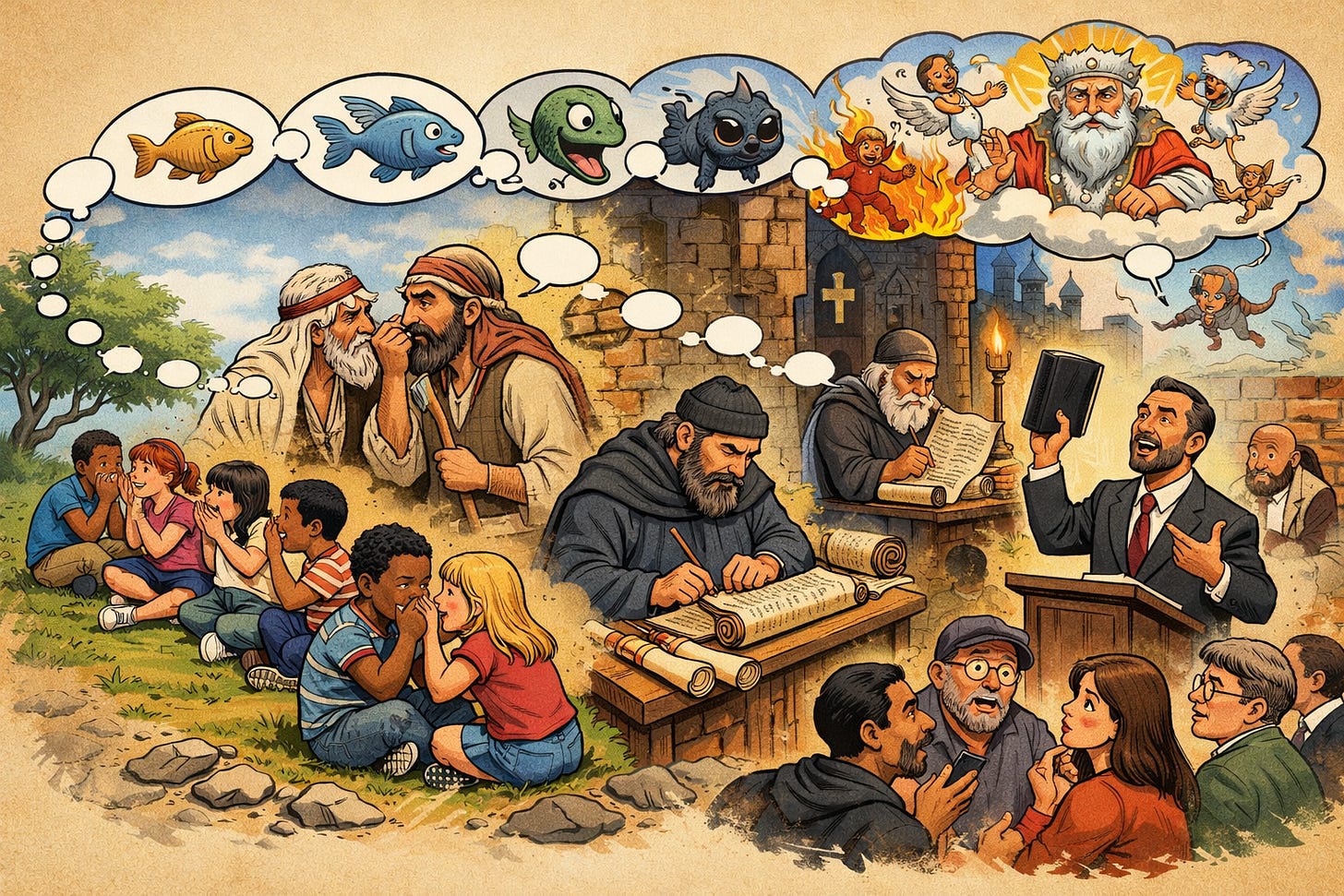
And yet, with a straight face and a solemn hymn, churches ask us to believe that the Bible—the most theologically loaded text ever produced—somehow escaped every rule the Telephone game so efficiently exposes. Not just mostly intact. Not broadly accurate. But perfect. Inerrant. The literal word of God. This is not faith; it is an insult to reason dressed up as reverence.
The central absurdity lies not merely in the claim of divine inspiration, but in the mechanism of delivery. For centuries, the stories that would become the Bible were not written at all. They were spoken. Repeated. Performed. Reworked. Passed from tribe to tribe, from elder to child, from priest to congregation. Oral tradition, we are told, was sufficient—indeed, somehow superior—to the fragile written word. The same human mouth that forgets names, embellishes anecdotes, and rewrites personal history in its own favor was apparently, in this one case, operating under a miraculous quality-control system.
This is special pleading of the laziest sort. When anthropologists study oral cultures, they do not marvel at their precision; they study their fluidity. Stories evolve to suit the needs of the moment. Details are sharpened or softened. Heroes grow taller. Enemies grow crueler. Moral lessons are retrofitted to current anxieties. Oral tradition is not a photocopier—it is a living organism, mutating as it survives.
To insist that biblical stories somehow resisted this process is to argue that human beings behaved like human beings in every context except this one. That gossip distorted village news, legends distorted local history, and myths distorted cosmology—but when it came to Yahweh’s preferences about shellfish and slavery, the human mind suddenly achieved stenographic perfection.
The game of Telephone does not fail because children are stupid. It fails because humans are human. Memory is reconstructive, not archival. Each retelling is an act of interpretation. And interpretation is precisely what theologians later insist never happened.
Even once writing enters the picture, the problem does not evaporate—it multiplies. The Bible was not written by a single author, at a single time, in a single language. It is a stitched-together anthology spanning centuries, cultures, and political regimes. Hebrew texts were translated into Greek, then Latin, then into countless vernacular languages, each translation carrying its own assumptions, idioms, and theological agendas. Words without direct equivalents were approximated. Metaphors hardened into doctrine. Poetic flourishes became legal pronouncements.
Consider how often modern Christians argue about what a single verse “really means.” Now imagine that dispute stretched across two thousand years, filtered through scribes who believed they were preserving divine truth while quietly correcting what they thought were errors. We know this happened because we possess manuscripts that disagree with one another. Verses appear in later copies that do not exist in earlier ones. Stories materialize out of thin air, such as the famous tale of the adulterous woman—beloved, quotable, and almost certainly a late addition.
A perfect word of God would not require footnotes explaining which parts are probably authentic.
Then there are the contradictions, which believers alternately ignore, rationalize, or perform acrobatics to reconcile. Creation happens twice in Genesis, in two incompatible orders. Judas both returns the silver and hangs himself—and also buys a field and falls headlong, bursting open. God commands mercy in one breath and genocide in the next. Kings is contradicted by Chronicles. The Gospels cannot agree on who visited the tomb, when they arrived, or what they found there.
These are not trivial discrepancies. They are the textual equivalent of the Telephone message turning from “meet me at the playground” into “burn down the school.” The attempt to harmonize them usually involves inventing explanations not found in the text itself—an implicit admission that the text, left to its own devices, does not cohere.
Defenders often retreat to a familiar line: the Bible is perfect in its message, not its details. But this is an escape hatch masquerading as humility. Once details are negotiable, authority collapses. If God cannot be trusted to preserve the order of creation, the fate of Judas, or the last words of Jesus, why should we trust him on the nature of salvation, sin, or eternity? Precision suddenly matters very much when the stakes are infinite punishment.
Others argue that God worked through flawed humans, allowing their personalities and limitations to shape the text. This is an honest admission—but it detonates the claim of inerrancy. A book shaped by human limitation is, by definition, a human book. Inspired, perhaps. Meaningful, possibly. But no more immune to distortion than any other product of human culture.
The Telephone game analogy grows sharper here. If a teacher whispers a sentence to one child and allows it to be distorted by twenty others before declaring the final result “exactly what I intended,” the fault does not lie with the children. It lies with the teacher’s method. A deity capable of parting seas, halting the sun, and resurrecting the dead could presumably manage a clearer publication strategy.
Instead, we are told that ambiguity is a feature, not a bug—that confusion tests faith, that contradiction invites humility, that obscurity deepens devotion. This is a clever reversal, but an unconvincing one. No other domain treats incoherence as evidence of authority. We do not praise legal codes for contradicting themselves, nor medical textbooks for offering mutually exclusive diagnoses.
The reality is simpler and far less flattering to religion: the Bible looks exactly like what it is—a collection of human writings reflecting the fears, hopes, prejudices, and power struggles of their time. It condones slavery when slavery is normal. It subordinates women when patriarchy is unquestioned. It imagines the universe as a three-tiered structure because that is how ancient people understood the world. As knowledge expands, interpretation is forced to stretch, retreat, or quietly abandon earlier claims.
This is not how eternal truth behaves. Eternal truth does not require constant reinterpretation to survive contact with reality.
The Telephone game teaches a lesson that theology works tirelessly to suppress: transmission matters. Medium matters. Messengers matter. Once a message passes through human minds, it becomes human. To deny this is to deny the very nature of language, memory, and culture.
The real marvel is not that the Bible contains wisdom, poetry, and moral insight. It would be astonishing if it did not. Humans are capable of all three. The marvel is that so many otherwise rational adults are willing to suspend everything they know about communication, history, and psychology to preserve the illusion that this particular game of Telephone ended in divine clarity rather than predictable confusion.
In the end, the Bible does not fail because it is flawed. It fails because it is claimed to be flawless. Remove the impossible burden of perfection, and it becomes what it has always been: a fascinating, influential, deeply human document. Insist on perfection, and it collapses under the weight of its own contradictions.
The whisper was never divine. The circle was never secure. And the message, by the time it reached us, was already unmistakably human.
It is nearly impossible to think that an omnipotent god would deliver his written message to humanity in a form that suffers with so many issues of error and ambiguity. Just as in the game of Telephone, the final product that survived the rigors of oral transmission, copying, and language translation should be viewed with extreme skepticism.
(5465) God rewards disobedience
There is a disturbing theme throughout the Bible where the more celebrated and more rewarded luminaries are the ones who disobey God in various ways, whereas those who abstain from such push back get very little recognition. The following was taken from:
https://www.reddit.com/r/exchristian/comments/1r7fgg6/shower_thought_the_bible_accidentally_teaches/
The Bible Accidentally Teaches That Obedience Is Useless
Growing up Christian, we were told the formula was simple:
– Obey God → blessing
– Disobey God → punishment
– Don’t believe → eternal punishment
But when you actually read the stories, the Bible doesn’t follow that formula at all. The quiet, obedient, faithful people fade into the background. The people who disobey loudly, doubt, argue, run away, or screw up spectacularly? They get chosen, blessed, promoted, or turned into heroes of faith.
– David — adultery, murder, disobedience → “man after God’s own heart.”
– Peter — denies Jesus three times → becomes “the rock.”
– Jacob — lies, cheats, steals → becomes Israel.
– Rahab — lies to authorities → praised and added to Jesus’ lineage.
– Samson — breaks every vow → hero of faith.
– Moses — kills a man, argues with God, refuses the mission → greatest prophet.
– Gideon — doubts God repeatedly → chosen as judge.
– Jonah — runs away from God → gets a whole book named after him.
– Lot — offers his daughters to a mob → still rescued by angels.
– Solomon — breaks every command for kings → gets unmatched wealth and wisdom.
– Abraham — lies, laughs at God, sleeps with Hagar → “father of faith.”
– Prodigal Son — wastes everything → gets the feast, robe, and ring.
– Thief on the Cross — does nothing right → “Today you’ll be with me in paradise.”
This isn’t a rare theme. It’s the rule. And I know the typical Christian response: “God picks the weak to show His strength.”* But this isn’t an occasional example, it’s the consistent pattern. The most rewarded people are the ones who openly, deliberately, or dramatically disobey God.
Which leads to a weird conclusion to me:
If the Christian God were real, the optimal strategy wouldn’t be obedience, it would be disobedience dramatic enough to force him to show up and correct you and then reward you.
Basically: **be a “bad Christian” to become the rewarded Christian.**
Obedience gets you silence.
Disobedience gets you destiny.
Just a thought.
This suggests that God prefers people who initially do bad things, and then repent, rather than those who are good for the entire duration- quite counter-intuitive. This seems to fit more into a dramatic theme that humans would make up to sizzle up their story. It also explains a strange phenomenon in the United States where evangelical Christians ‘worship’ the famously sinning Donald Trump while dissing the equally famous ‘good-guy’ Barack Obama.
(5466) No Moses means Christianity is false
The following presents the argument that if Moses was not a real person, then Christianity, along with Islam and Judaism, is false. And further, the meticulous records of the ancient Egyptians effectively eliminates the possibility that Moses existed. The following was taken from:
The non-existence of Moses should be enough to destroy Judaism/Islam/Christianity.
Religious (read: Abrahamic) people love to argue from a philosophical or metaphysical point of view. Popular arguments also involve claiming that the sacred texts are symbolic (unless it talks about the most important prophets), or that we lack archaeological evidence to be sure that Abraham or Jesus or Muhammad didn’t exist so we should treat scripture as legit records.
However we DO have archeological evidence that Moses did NOT exist whatsoever. Egypt is the most well-known and studied ancient civilization. It’s also a civilization that LOVED to record history to the point we were able to rediscover pharaohs and events that they tried to suppress (Akhenaten).
What about Moses? We are now 100% sure that no Hebrew whatsoever were EVER enslaved under Egyptian rule and that Moses did not exist.
Moses not existing implies a bunch of things :
-It destroys Judaism since it claims to have been funded by Moses and the Bible written by Moses. God also could not appear to a non-existent person to give him laws
-It destroys Christianity because it undermines the whole ancient testament and it implies that events such as the transfiguration (WHERE JESUS TALKS TO MOSES) are fictional. If the transfiguration is fake, why not the resurrection?
-It destroys Islam because the Quran is filled with tales about Moses and also, Moses himself, in the hadiths is the one who helped Muhammad get the 5 prayers from God during his nocturnal journey.
There. No need to tell me that Genesis is symbolic or whatever. You remove Moses and the whole architecture tumbles down.
No Moses = No Christianity. Full stop.
(5467) Glossing and Interpolation in the Bible
The cumbersome and laborious process of copying scripture lead to a large number of problems affecting the fidelity of the original authors’ writings. One of the of problems was that scribes would sometimes add a note on the sides of the copied text to provide an explanation for what might otherwise have been confusing or for which a relevant detail appeared to be missing. The term for this practice is glossing. Later scribes would at times see these notes and simply add them into the official text of the document. This is known as an interpolation. Many of the biblical interpolations were the result of incorporating glossing comments into the main text. The following , produced by Google Gemini 3.0 Pro, lists 10 examples:
Scribal Interpolations and “Glossing” in the Bible
In textual criticism, a gloss is a brief marginal note or explanation written by a scribe to clarify a difficult passage. An interpolation occurs when a later scribe, thinking the marginal note was a correction or a part of the text accidentally left out, incorporates that note into the main body of the manuscript.
Over centuries of hand-copying, several significant passages were added to the biblical canon through this process.
1. The Johannine Comma (1 John 5:7–8)
This is perhaps the most famous gloss in history. It is a clear Trinitarian statement that appears in later Latin manuscripts but is absent from all early Greek manuscripts.
-
- Original Text: “For there are three that testify: the Spirit, the water and the blood; and the three are in agreement.”
- The Gloss: “…the Father, the Word, and the Holy Spirit, and these three are one.”
- How it happened: A scribe likely wrote the Trinitarian formula in the margin as a theological reflection on the “three that testify.” Later scribes moved it into the text. Because it provided the only explicit scriptural proof for the Trinity, it was defended for centuries despite being a clear addition.
2. The Angel at the Pool (John 5:3b–4)
In many modern bibles, you will notice that verse 4 is missing or put in a footnote. This verse explains why people were waiting at the pool of Bethesda.
-
- The Gloss: “…waiting for the moving of the water. From time to time an angel of the Lord would come down and stir up the waters. The first one into the pool after each such disturbance would be cured of whatever disease they had.”
- The Reality: The earliest and best manuscripts do not contain this verse. It was likely a marginal gloss intended to explain the folk-belief of the time to readers who didn’t understand why the “stirring of the water” (John 5:7) was important.
3. The Doxology of the Lord’s Prayer (Matthew 6:13)
Most Protestants end the Lord’s Prayer with “For thine is the kingdom, and the power, and the glory, forever. Amen.”
-
- The Reality: This sentence is absent from the oldest Greek manuscripts of Matthew and is not found in Luke’s version of the prayer.
- How it happened: Early Christians used this phrase in their liturgy (church services). Scribes, accustomed to hearing the prayer ended this way in church, eventually wrote the liturgical ending into the margin of the Gospel, and it was later absorbed into the text.
4. The “Woman Caught in Adultery” (John 7:53–8:11)
Known as the Pericope Adulterae, this beloved story of Jesus saying “Let him who is without sin cast the first stone” is a massive interpolation.
-
- The Evidence: It is not found in any of the oldest Greek manuscripts of John. Furthermore, the style of the Greek in these twelve verses is completely different from the rest of the Gospel of John.
- The Origin: While many scholars believe the story might be based on an actual oral tradition or a lost document, it was not originally part of John. It appears in various places in different manuscripts—sometimes after John 21, or even in the Gospel of Luke. It was eventually “glossed” into John 8 and stayed there.
5. The Longer Ending of Mark (Mark 16:9–20)
The Gospel of Mark originally ended abruptly at verse 8 with the women fleeing the tomb in fear. Verses 9–20, which include Jesus appearing to Mary Magdalene and the disciples, and the command to handle snakes and drink poison, were added later.
-
- The Motivation: Early scribes found the abrupt ending of Mark (ending with the word “for” in Greek) to be unsatisfying or perhaps the original final page was lost. Two different endings were created by scribes to “fix” the text; the “Longer Ending” is the one that eventually became canonical.
6. “Father Forgive Them” (Luke 23:34)
The famous line “Father, forgive them, for they do not know what they are doing” is missing from several of the oldest and most reliable manuscripts of Luke.
-
- The Controversy: Because it is missing from diverse and early sources, many textual critics believe it was a later addition intended to show Jesus’s mercy toward his executioners, though some argue it was originally there and removed by anti-Jewish scribes. Regardless, its absence in early texts marks it as a likely interpolation.
7. The Eunuch’s Confession (Acts 8:37)
In many older translations (like the KJV), Acts 8:37 features the Ethiopian Eunuch making a formal confession of faith before being baptized: “And Philip said, If thou believest with all thine heart, thou mayest. And he answered and said, I believe that Jesus Christ is the Son of God.”
-
- The Reality: This verse is entirely absent from the oldest and most reliable Greek manuscripts (P45, Sinaiticus, Vaticanus).
- How it happened: As the early church developed more formal baptismal rituals, scribes likely felt the story was “incomplete” without a formal profession of faith. They added the liturgical requirement back into the text to ensure the story matched church practice.
8. The Bloody Sweat in Gethsemane (Luke 22:43–44)
This passage describes an angel appearing to strengthen Jesus and his sweat becoming “like great drops of blood falling down to the ground.”
-
- The Evidence: These verses are missing from the earliest and best manuscripts of Luke (P69, P75, Sinaiticus, Vaticanus).
- The Motivation: This addition was likely a theological move against Docetism (the belief that Jesus was purely divine and didn’t actually suffer). By adding the graphic detail of the bloody sweat, scribes reinforced the humanity and physical agony of Christ.
9. The “God” vs. “He” Variant (1 Timothy 3:16)
A single stroke of a pen changed a pronoun into a claim of divinity.
-
- Original Text: “Great is the mystery of godliness: He (hos) was manifested in the flesh…”
- The Gloss: “Great is the mystery of godliness: God (theos) was manifested in the flesh…”
- How it happened: In Greek, the word for “He” (OC) and the abbreviation for “God” (ΘC) look nearly identical, differing only by a horizontal line in the middle of the first letter and a bar over the top. Later scribes “clarified” the text by adding the line, transforming a simple pronoun into an explicit proof-text for the incarnation.
10. The Displaced “Silence of Women” (1 Corinthians 14:34–35)
While this passage is found in all existing manuscripts, its location is highly suspicious.
-
- The Evidence: In several important Latin manuscripts, these two verses (commanding women to be silent) do not appear after verse 33, but instead after verse 40.
- The Theory: Textual critics argue this is a classic sign of a marginal gloss. A scribe likely wrote these instructions in the margin, and later copyists, unsure where they belonged, inserted them into the main text in different places. This would explain why the passage seems to contradict Paul’s earlier instructions in 1 Corinthians 11 where he assumes women will speak and prophesy.
Conclusion
These examples illustrate that the “original manuscripts” were not frozen in time. They were living documents that scribes felt free to “correct,” “clarify,” or “standardize” according to the traditions of their own day. For a “populous possessing easy access to information,” the existence of these glosses challenges the idea of a perfectly preserved, verbally inspired text.
There is no reason to conclude that an omnipotent god could not have prevented such tampering with his holy text. That it happened suggests that this god was not engaged in the preservation of whatever scripture it might have inspired.
(5468) Religion is human nature
Because of the similarities between the many religions that have developed over history, it seems that if one religion was true, it would stand out in many ways. Christianity is not that. It shares every marker of the faiths that it considers to be false. The following was taken from:
https://docs.google.com/document/d/1Ezc6cTpio_AjcCCtkApmYo5htIB4iyozbWTBwf5UCMk/edit?tab=t.0
The earliest known worshiped idol is the Shigor Idol which is 12,000 years old! History has shown us that it is simply human nature to create gods and attribute meaning to the unknown. Christianity shares every psychological marker and cultural pattern of the very religions Christians label as “false.”
Especially if we look at the qualities of the Old Testament God and compare them to all other Gods at the time it’s just so similar to other ancient deities: a demand for animal and blood sacrifices, the justification of slavery, and the endorsement of tribal conquest. This similarity between religions at the time highlights a serious irony in the logic used for the Flood argument above: Christians often cite other cultures’ flood stories as evidence for the biblical account, yet they don’t see the existence of other similar religions as evidence for their own (obviously, because it’s totally illogical to do so). The reality is that if your religion or story is eerily similar to systems you already believe are manufactured, that similarity is not a “link to truth” but is evidence that your religion shares the same human origins as the ones you dismiss.
I understand that the common counterargument here is that the Christian God is radically different due to a unique moral framework, however this moral distinction largely applies/appears in the New Testament. The Old Testament deity mirrors the characteristics of other ancient Near Eastern gods at the time: requiring blood sacrifice and justifying practices like slavery and conquest. For a supposedly all-powerful, unchanging deity, this moral shift between testaments is inconsistent. This points to an evolution of human morality rather than divine revelation. It shows that religion changed alongside human development, mirroring the moral trajectories of other global cultures independent of the Christian God.
Religion is human nature, and because of that fact, the first assumption regarding every religion should be that it was created by humans for whatever reason. To go beyond that assumption, evidence of an extraordinary quality should be demanded. But such evidence is missing, and not just for Christianity, but for every religion that has ever existed. For this reason, agnostic atheism is the most defensible position.
(5469) Satan and related figures
One of best litmus tests of Christianity is the question of the existence or non-existence of Satan and related figures. It can be asserted that Satan plays a biblical role too important for ‘him’ to be extracted without doing severe (and, in fact, fatal) injury to Christianity itself. The following discusses some of the background of this nefarious being and how ‘he’ changed over time:
In the entry Satan and Related Figures in The Eerdmans Dictionary of Early Judaism (Eerdmans, 2010), scholar Chad T. Pierce provides insight on the development of the figure of Satan in early Jewish and Christian literature.
Early Jewish and Christian literature contains many references to evil celestial beings who battle against God’s people, often by causing violence or leading humans astray. Surprisingly few occurrences name this adversary Satan (1QH 4:6; 45:3; 1QSb 1:8; T. Job 3:6 and 6:1-8:3 are exceptions), preferring names such as Devil, Belial, and Mastema, among others. Although the rise of an evil enemy of God stems from a number of different factors, two appear to have played significant roles.
First, the development of a celestial enemy was heavily influenced by the Jews’ experience under Babylonian and Persian rule. Exposure to Zoroastrianism with its emphases on cosmic dualism played a fundamental role in the expansion of the good versus evil dichotomy found in early Judaism. Similar to the rival gods in Persian literature, Jewish tradition never gives Satan equal status with God. YHWH alone is God, with no evil equivalent.
The dichotomy of good and evil found its personified counterpart in unequal leaders in the respective figures of God and Satan. Accordingly, the idea in the Hebrew Bible of a sovereign God responsible for all things, both good and evil, was replaced with a celestial conflict between God and Satan as the leaders of two distinct warring camps. Thus, Satan may have partly evolved from those attributes earlier assigned to God that appeared questionable to both Jews and Christians of the Second Temple period.
Second, the concept of Satan as a personification of evil solidified with the rise of brutal enemies who oppressed Israel. Israel’s battles against foreign enemies (especially Antiochus IV) eventually became cosmically represented in a heavenly war between God and his angels against Satan and his minions. Thus, the clash between Israel’s theology of election and the reality of its foreign oppression aided in the development of Satan as an autonomous figure.
Satan as a proper name for God’s evil enemy is used thirty-five times in the New Testament. The New Testament writers often use a variety of other terms for God’s celestial enemy, including “Beelzebul” (beelzebul) or “prince of demons” (Mark 3:22; Matt. 12:24-27; Luke 11:15-19); “the evil one” (Matt. 5:37; 13:19, 38; John 17:15; Eph. 6:16; 2 Thess. 3:3; 1 John 2:13, 14); “the tempter” (Matt. 4:3); “the enemy” (Matt. 13:39); and “ruler of this world” (John 16:11). In addition to Satan, the name for God’s enemy most often used in the New Testament is “the Devil” (ho diabolos, 32 times).
Even though Satan is portrayed as the enemy of God in the New Testament, there are still echoes of him acting within the will of God. Satan is used by God to test Jesus (Matt. 4:1). In humans, he destroys the flesh so that the spirit can be saved (1 Cor. 5:1-5). He also appears to help sinners by chastising them so that they learn not to blaspheme (1 Tim. 1:20).
If Satan is not real, then Christianity is false. You cannot say that Satan is fictional while the rest of the biblical narrative is true. That would be like saying U.S. President Reagan was real but Russian Premier Gorbachev was fictional. You really can’t have one without the other.
(5470) Gospels were not intended to be factual
Although most Christians read the gospels as if they are reading a current reputable news report, there is reason to believe that the very authors of these accounts did not intend them to be viewed that way. The following was taken from:
One thing we have to keep in mind is that every gospel is different. Scholars widely suspect Mark was written first, but, again, nobody knows why. The New Testament scholar Adam Winn spends a solid 38 pages of his book The Purpose of Mark’s Gospel [pp.5-42] simply summarizing various proposals on why Mark might have written.
One thing scholars generally do seem to agree on is that the gospels are a blend of fact and fiction. [See for instance Eve-Marie Becker, “History,” in The Oxford Handbook of the Synoptic Gospels (2023, Oxford University Press), p.393; Ole Davidsen, “The Lord, the Lamb, and the Lover: The Gospel of John as a Mixture of Spiritualized Narrative Genres,” in The Gospel of John as Genre Mosaic (2015, Vandenhoeck & Ruprecht, ed. Kasper Bro Larsen), p.133; Telford, Mark; T&T Clark Study Guides (1995, Sheffield Academic), p.34, 45.] Note that traditionalist Christians who view the bible as the inerrant Word of God will necessarily disagree, but I’m pretty much ignoring them in this case since my interest is historical evidence and not religious dogma.
But saying that the gospels mingle fact and fiction doesn’t entail that they were intended to be understood that way. Even the authors themselves may have believed at least some of the fictions their gospels contained. But it also seems likely that they must have known that not everything in their gospel was true.
This is especially evidence with Matthew, Luke, and John. For instance they all seem to have deliberately embellished their resurrection narratives. [See Ian Boxall, Discovering Matthew (2014, Eerdmans), pp.165-6.] Matthew and Luke also apparently embellished the birth legends. [See James G. Crossley, Reading the New Testament: Contemporary Approaches (2010, Routledge), e-book, ch.2; also John Dominic Crossan & Richard G. Watts, Who is Jesus? Answers to Your Questions about the Historical Jesus (1996, Westminster John Knox), p.18.]. And of course the gospel authors all seem to have fictionalized the discourses of Jesus, as was common practice among ancient historiographers and biographers alike. [See Brian McGing, “Introduction,” in Polybius, The Histories: A new translation by Robin Waterfield (2010), pp. xxix-xxx; Helen Katharine Bond, The First Biography of Jesus: Genre and Meaning in Mark’s Gospel (2020, Eerdmans, ebook), ch.2.]
Signs of deliberate invention are more difficult to detect in Mark, but seem likely nonetheless. For example, Arthur Bellinzoni in The Building Blocks of the Earliest Gospel, pp.253f, argues that Mark probably invented a number of stories in the gospels, and at the very least must have fictionalized some of the narrative “glue” to hold together the blocks of tradition he inherited from others.
My own view is similar to that of the theologian Richard Valantasis in his book The Gospels and Christian Life in History and Practice, that one of Mark’s primary purposes may have been to entertain his audience. [See Valantasis, Bleyle, & Haugh, The Gospels and Christian Life in History and Practice, p.65.] He may not have been just recording facts as he heard them, but dramatizing the ministry and passion of Jesus.
The modern-day analogy I like to use is the TV show The Chosen. The showrunner and his team may believe the broad strokes of their story to be true, but they’re still fictionalizing to tell it. So too Mark may have believed in the miracles of Jesus, his resurrection, and so forth, but may nevertheless have invented parts of his narrative.
For instance, the New Testament scholar Adela Yarbro Collins has argued that he deliberately invented the fiction of the discovery of the empty tomb by women on Sunday morning to dramatize his belief in the resurrection. [See Collins, The Beginning of the Gospel: Probings of Mark in Context (1992, Fortress Press), pp.145-6.] If Mark knew a sayings gospel like Q—which is impossible to confirm but remains a possibility—then he might have been influenced by it to write something bigger and better, so to speak.
Matthew and Luke may then have tried to create an “updated” version Mark, each in their own way. [See Arthur Joseph Bellinzoni (Professor of Religion Emeritus at Wells College), The New Testament: An Introduction to Biblical Scholarship (2016, Wipf & Stock), pp.318,327.] They may have also had the same plan to incorporate the material from the hypothetical Q gospel. And of course they fictionalized—in my opinion, quite deliberately. Luke in particular may have seen what Matthew did to Mark (and maybe also Q), and thought to himself that “he can do the same kind of thing, but do it better”. [Mark Goodacre, The Synoptic Problem: A Way Through the Maze (2001, Continuum), p.127.]
Scholars are increasingly coming to view John as knowing the other three canonical gospels, although some still argue for independence. [Hugo Méndez, The Gospel of John: A New History (2025, Oxford University Press), p.14] My own view is that John almost certainly knew Matthew, Mark, and Luke, and used them as sources.
So, when each gospel author departs from his predecessors, and even sometimes contradicts them, that seems to me a clear signal that he understood them to not be entirely factual.
But eventually this changed. Probably by the time of Papias (ca. A.D. 95-110), and certainly by the time of Irenaeus (ca. A.D. 180-190), the gospels were being interpreted as mostly if not entirely factual accounts. And of course that kind of reception in the church continues to this day.
The blurring between fact and fiction is something that modern-day readers are not comfortable with. They prefer to see something as being purely factual, while everything else is viewed as purely fictional. But there exists a lot of in-between areas in ancient writings, and that clearly is reflected in the gospels.
(5471) Jesus began as a disciple of John
All of the gospels point to the fact that Jesus submitted himself for baptism to John the Baptist. If true, this would seem to run counter to the later developed idea of Jesus being God himself. It would seem highly likely that Jesus followed John for a period of time as his disciple, a fact that would be fatal to modern Christian theology. Christian apologists have had to work overtime to resolve this ‘thorny’ issue. The following is an excerpt from James Dunn’s book Jesus Remembered, Christianity in the Making:
Still more to the point, it is highly probable that Jesus himself first emerged from the circle round John. Indeed, it is quite possible that Jesus began, properly speaking, as a disciple of John.
The key fact here is that Jesus was baptized by John (Mark 1.9 pars). This is one of the most securely grounded facts in all the history of Jesus. It is not something which his followers were likely to have made up; there was nothing about the impact made by Jesus which pushed them to attribute it to the influence of John on Jesus as Jesus’ mentor. On the contrary, the fact of Jesus having been baptized by John seems to have been something of an embarrassment to them.
For John’s baptism is clearly signaled in the Synoptics as a ‘baptism of repentance’ (Mark 1.4 pars.), an emphasis which again accords with the report of Josephus. That evidently proved an unsettling thought to many of Jesus’ followers (had Jesus needed to repent?). Hence Matthew’s added note that John himself had urged the inappropriateness of his baptizing Jesus (Matt. 3.14-15). Why Jesus submitted to baptism if it was not to express repentance on his own behalf has been a thorny issue for Christian theology ever since.
[I]t is difficult to avoid the inference that there was an early period in Jesus’ mission which the Synoptic Evangelists chose to ignore, presumably because the distinctive mission of Jesus began only after Jesus separated from the Baptist or was forced by John’s arrest to strike out on his own in Galilee. Whether on the basis of this finding we should speak of Jesus as John’s ‘disciple’ may resolve simply into the question whether ‘disciple’ is the best term to use.
It appears that the gospel authors felt compelled to relate the baptism event (possibly because it was well-known), but that they deliberately avoided any mention of Jesus following John afterwards- because it would have damaged the image of Jesus as being the ‘superior’ prophet.
(5472) One god or two?
Christianity claims that the god of the Old Testament and the god of the New Testament (partly in the form of Jesus) are one and the same. But a simple analysis of the Bible comes to a very different conclusion. The following was composed by Google Gemini 3.0 Pro:
For nearly two thousand years, the Christian tradition has asserted that the Old Testament (OT) and the New Testament (NT) are two parts of a single, continuous revelation. However, critics, historians, and even early Christian “heretics” like Marcion of Sinope have argued that the differences between the two are so profound that they cannot logically be attributed to the same supernatural source.
1. The Moral Character Discrepancy
The most common reason for dismissing the “Single God” hypothesis is the radical shift in divine behavior and temperament.
-
- The OT Deity (The Warrior and Judge): In the Hebrew Bible, God is frequently depicted as a “Man of War” (Exodus 15:3). He commands the total annihilation of entire ethnic groups, including women and infants (1 Samuel 15:3), uses natural disasters as tools of mass execution, and demands strict retributive justice (“an eye for an eye”). He is described as “jealous” (Exodus 34:14) and capable of repentant anger.
- The NT Deity (The Father of Mercies): Jesus presents God as a loving Father who “makes his sun rise on the evil and on the good” (Matthew 5:45). He replaces “an eye for an eye” with “turn the other cheek” and emphasizes forgiveness over sacrifice.
- The Conflict: Critics argue that if God is immutable (unchanging), it is logically impossible for him to evolve from a deity who orders the slaughter of children to a deity who says “suffer the little children to come unto me.”
2. Ethnic Nationalism vs. Universalism
The scope of the deity’s concern shifts from a specific tribe to the entire human race.
-
- OT Particularism: YHWH is the “God of Israel.” His focus is on a specific land (Canaan), a specific bloodline (Abraham), and a specific political entity. His interventions are often designed to favor the Israelites at the expense of other nations.
- NT Universalism: The NT God is “no respecter of persons” (Acts 10:34). The ethnic and geographic boundaries are dissolved (“neither Jew nor Greek”).
- The Conflict: A universal creator would arguably not show thousands of years of preferential bias toward one tiny tribe while ignoring or commanding the destruction of the rest of his creation.
3. Legalism vs. Grace
The “mechanics” of how a human relates to the divine change fundamentally between the two books.
-
- The Law (Torah): In the OT, the relationship is defined by a Covenant of Law. Righteousness is achieved through ritual purity, dietary restrictions, animal sacrifice, and the physical sign of circumcision.
- The Spirit (Grace): In the NT (particularly in Paul’s letters), the Law is described as a “ministry of death” or a “curse” (see
paul_contradictions.md). Righteousness is achieved through internal faith and the indwelling of the Spirit. - The Conflict: If the OT laws were “perfect” and “eternal” (as the OT itself claims), their sudden dismissal as “obsolete” in the NT suggests a change of mind that is inconsistent with an omniscient being.
4. The Concept of the Afterlife
The “Afterlife Assignment” criteria, which you explored in previous queries, are almost entirely absent in the early OT.
-
- OT Silence (Sheol): For most of the OT, there is no concept of Heaven or Hell. All dead go to Sheol, a place of shadows and silence regardless of their moral standing. God’s rewards and punishments are physical and terrestrial (long life, wealth, or plague).
- NT Dualism (Heaven/Hell): The NT is centered on the dualistic destination of the soul. Jesus and the apostles introduce a cosmic system of eternal reward and punishment that was largely foreign to the writers of the Torah.
- The Conflict: It is difficult to reconcile a “Universal Judge” who neglects to mention the existence of an eternal Lake of Fire for the first 1,500 years of his revelation.
5. Anthropomorphism vs. Transcendence
The way the deity “manifests” changes from physical interactions to spiritual ones.
-
- Physical OT God: God walks in a garden, wrestles with Jacob, allows Moses to see his “back parts,” and eats a meal with Abraham. He is often depicted with human body parts and human emotions.
- Transcendent NT God: “God is spirit” (John 4:24), and “no one has ever seen God” (John 1:18). He is an invisible, omnipresent, and purely spiritual entity.
- The Conflict: This suggests an evolution of the human concept of God—from a local mountain deity to a philosophical First Cause—rather than a single being revealing himself.
6. The Nature of Sacrifice (Blood vs. Heart)
-
- OT Sacrifice: The primary method of atonement is the shedding of animal blood (Leviticus 1–7). God is depicted as being “pleased” by the aroma of burning fat and meat. This is a transactional system of animal substitution.
- NT Sacrifice: The NT claims that “it is impossible for the blood of bulls and goats to take away sins” (Hebrews 10:4). The focus shifts to the singular, cosmic sacrifice of Jesus and the “sacrifice of praise” or a “broken heart.”
- The Conflict: If a deity found animal sacrifice efficacious and commanded it for centuries, the sudden declaration that such rituals are worthless suggests a fundamental change in divine requirements.
7. Generational Guilt vs. Individual Agency
-
- OT Corporate Guilt: God explicitly states that he punishes the “children for the sin of the parents to the third and fourth generation” (Exodus 20:5). Entire families (like Achan’s) are executed for the sin of one member.
- NT Individual Responsibility: The focus shifts entirely to individual repentance. “Each will have to bear his own load” (Galatians 6:5), and there is no mention of God punishing descendants for the sins of their ancestors.
- The Conflict: This reflects a shift from tribal morality (where the unit is the family) to modern individualism, casting doubt on the idea that both moral systems were dictated by the same unchanging source.
8. “Dangerous” Holiness vs. “Approachable” Grace
-
- OT Distance: God’s holiness is portrayed as a physical danger. Touching the Ark of the Covenant, even by accident, results in immediate death (2 Samuel 6:6-7). The Temple architecture is designed to keep people away from the divine presence.
- NT Intimacy: The “veil of the Temple” is torn in two (Matthew 27:51), symbolizing the removal of the barrier. Believers are told to “approach God’s throne of grace with confidence” (Hebrews 4:16).
- The Conflict: The shift from a God who kills those who get too close to a God who invites the “unclean” to touch him suggests two different religious “atmospheres” entirely.
Summary Table: The Two Gods
|
Feature |
The God of the Old Testament |
The God of the New Testament |
|---|---|---|
|
Temperament |
Vengeful, Jealous, Quick to Anger |
Loving, Patient, Forgiving |
|
Primary Focus |
The Nation of Israel (Ethnic) |
All Mankind (Universal) |
|
Requirement |
Obedience to the Law (External) |
Faith and Love (Internal) |
|
Afterlife |
Vague / Silence (Sheol) |
Explicit (Heaven/Hell) |
|
Interaction |
Physical / Anthropomorphic |
Spiritual / Transcendent |
|
Holiness |
Dangerous / Exclusive |
Accessible / Inclusive |
|
Justice |
Generational / Corporate |
Individual / Personal |
Conclusion: Marcionism and Modern Skepticism
In the 2nd century, Marcion concluded that the God of the Jews was a “Demiurge”—a lesser, just, but cruel creator—while the God of Jesus was a “Higher God” of pure love who came to rescue humanity from the Demiurge’s law.
Modern secular critics reach a similar conclusion through a different path: they argue that the “God of the Bible” is not one person, but a literary character that evolved over 1,000 years. As human morality progressed from tribal warfare to Hellenistic philosophy, the “God” in their books changed to match their new values. The lack of continuity is not a divine mystery, but a historical record of human ethical evolution.
It can be easily and safely asserted that the god of the Old Testament is not the god of the New Testament. They are two different gods with very little in common- that is, except for the fact that they are both imaginary.
(5473) Five reasons to not be a Christian
In the following, the author lists five reasons why, in their opinion, Christianity is not true:
https://www.reddit.com/r/DebateReligion/comments/1rdem32/why_i_am_not_a_christian/
I’ve been interested in this topic for decades. To serve as my introduction to the sub, here’s a bullet list of the reasoning that is most personally convincing to me as far as why Christianity is not true.
-
- Anthropology. The first true a-ha moment I can remember having about the faith I was brought up in, is when I cracked open my bible to the Old Testament uncleanliness laws regarding women. I realized that this entire mythology was created for a particular people group to understand and function in a particular set of material circumstances….and those circumstances had nothing to do with me. I now understand religions to be reflections of the cultures from which they emerge, which I find to be a damning piece of evidence against any one of them.
- No univocality. I would expect the eternal, all-powerful creator of the universe to reflect its consistent, perfect, and divine will in the writings of the humans it chooses to interact with directly. But at every level, within and between books, we see the most human of misconceptions, contradictions, logical inconsistencies, and simple errors. The Old and New Testaments bouncing all over the place historically, theologically, and epistemologically just screams “This is a human creation.”
- Original sin is preposterous. I try to stay away from tropes and quippy statements from famous atheists when I discuss belief. However, this famous Christopher Hitchens quote entirely sums up the third reason why I am not a Christian: “Once we assume a creator and a plan, it makes humans objects of a cruel experiment whereby we are created to be sick and commanded to be well.”
- Messianic prophecy is a comedy of trans-cultural copy/paste. Somehow, the Greeks got a hold of Jesus fever and turned it into Christianity. It seems fairly well-attested that an iconoclastic Jewish teacher named Jesus existed in first century Judea. However, the link between Jesus and the religious tradition from which his followers desperately need him to emerge as a prophesied figure is comically bad. The Greek-speaking New Testament authors misquote and misattribute Torah passages, use the Greek translation of the source text and not the original Hebrew, actively seek to fulfill prophecy, and even pull from passages that aren’t prophetic and mention them alongside narrated story features as a way of “making them” prophetic. It’s a mess. The Old Testament did not paint a picture of a Jesus-type figure teaching, being persecuted, dying, rising from the dead, and then disappearing for additional millennia. The Jewish messiah was a conquering king that would bring the worship of Yahweh to the world and the world would bow. This, famously, isn’t something that Jesus did.
- We live in a naturalistic world. This final reason emerges from my young mind wondering, “How is it that the most important book in the world contains all these fantastic miracles, spectacles, and interactions directly with god when none of that happens anymore?” The most reasonable answer to this is a direct corollary to my first point: Ancient people believed the world was full of spirits and gods and miraculous things because they didn’t understand why things happened. God doesn’t speak to us, blind men aren’t healed, and fires aren’t lit from the heavens as a response to prayer. This world isn’t supernatural and wasn’t made for us by a god that sent his son to Earth. This fact supports my position that Christianity isn’t true.
This essay can be summed up with the following: If Christianity was true, we would be living in a very different world.
(5474) Christians don’t know how salvation works
Salvation is the meat and potatoes of Christianity, but, by casual observation, most Christians are unsure of how a person’s salvation is determined. There are hundreds of conflicting theories, and this is one of reasons why there are so many denominations. It raises the question of why God would be so imprecise in delivering the criteria for entering heaven. The following was taken from:
https://www.reddit.com/r/DebateReligion/comments/1re5rdb/christians_dont_know_how_salvation_works/
Christians don’t know how salvation works.
I’ve recently become more and more puzzled about the mechanics of salvation. It is presented as one of the central mechanism of Christianity, and Christians often speak with confidence about who is saved and why – yet I’ve noticed when pressed on the details, the confidence seems to quickly dissolve into uncertainty or appeals to the mystery of God. I am hoping for some clarification here, or at least some acknowledgement that the confidence espoused is mostly unwarranted.
The Bible itself presents multiple, partially conflicting criteria for salvation.
Passages emphasize belief:
John 3:16 – Whoever believes has eternal life.
Romans 10:9 – Confess and believe and you will be saved.
Ephesians 2:8–9 – Saved by grace through faith, not works.
Passages emphasize actions:
Matthew 25:31–46– People are judged based on how they treated others.
James 2:2 – Justified by works and not by faith alone.
Romans 2:6–7 – God repays each person according to what they have done.
Some passages suggest salvation can be lost:
Hebrews 6:4–6– Those who fall away cannot be restored.
Matthew 24:13 – Only those who endure to the end will be saved.
Peter 2:20–22 – Escaping sin and then returning to it brings worse consequences.
Others suggest salvation is guaranteed:
John 10:28 – No one can snatch them out of my hand.
Romans 8:38–39 – Nothing can separate us from the love of God.
Some passages suggest belief itself is not fully under human control:
John 6:44 – No one can come unless the Father draws them.
Romans 9:16 – It depends not on human will.
Taken together these do not describe a single clear mechanism. I’ve prepared a few hypotheticals I was hoping some Christians wouldn’t mind answering:
-
- A morally decent atheist who acts compassionately but does not believe in God.
Saved or not?
2. A lifelong Christian who sincerely believes but causes significant harm to others and never repents.
Saved or not?
3. A criminal who converts moments before death with sincere belief but no opportunity for restitution.
Saved or not?
4. A person raised in a non Christian culture who never hears the gospel but lives ethically.
Saved or not?
5. A believer who genuinely believes for decades and later loses faith.
Saved or not?
It seems to me that when Christians are asked these questions, the most common answer is some version of “only God knows” – which in itself is an understandable response, but it also has clear consequences regarding their confidence in how salvation works.
If Christians do not know whether belief, behaviour, divine selection, or circumstance is decisive in these cases then they do not actually know how salvation works in any concrete sense and claims about the mechanics of salvation become provisional at best.
This raises a simple question: if Christians admit they cannot say, even in principle, what ultimately determines salvation in real world cases, on what basis do they claim to know the rules at all?
Saying “only God knows” seems to quietly concedes that humans lack reliable access to the criteria being claimed. If the mechanics of salvation are unknowable in practice, then confidently asserting them in theory seems unwarranted. You cannot reasonably claim certainty about a system whose outcomes you consistently admit you cannot predict.
So which is it?
Do Christians know how salvation works, or do they merely hope it works in a way consistent with their intuitions? If salvation depends on works alone, then faith in Jesus is not required or even necessary. If it depends on faith alone, then actions and moral effort don’t ultimately matter. If it’s some combination of the two, then humans are left guessing how much faith, how many works, or what specific mix is sufficient. In every case, I don’t see any answers to these questions that don’t ultimately rely on individual interpretation or personal guesswork.
Is this why there are so many different denominations preaching entirely different salvation mechanics? Further, what reason would an all-powerful God have to leave what appear to be conflicting instructions about how to be saved? Wouldn’t it have made more sense to be explicitly clear about how to guarantee our salvation for our eternal souls? Why leave arguably the most important thing to us clouded in ambiguity?
Christian theologians struggle with this question, and whatever position they take can by refuted by addressing scriptures that conflict. The easiest and most probable truth is that when a person dies, they die. There is no ‘afterlife.’
(5475) Guide to supernatural beings in the Bible
Although, from all objective observations, we live in a natural world, with natural living things, the Bible tells of a different world, filled with unnatural and supernatural beings. The following summary of these magical entities was produced by Google Gemini 3.0 Pro:
The Celestial Bestiary: A Guide to Supernatural Beings in the Bible
The biblical narrative is populated by a wide array of supernatural entities that extend far beyond the standard categories of “angels” and “demons.” These beings reflect the evolving cosmology of the biblical writers, from the “Divine Council” of the early Hebrew layers to the cosmic principalities of the Pauline epistles.
1. The Godhead (The Elohim)
-
- Yahweh (YHWH): The supreme deity of Israel. In early texts, he is often depicted as the head of a pantheon; in later texts, he is the sole creator.
- The Son (Jesus Christ): In the New Testament, the “Logos” who is both with God and is God.
- The Holy Spirit: The active presence of God, often personified as a counselor or a “rushing wind.”
2. The Divine Council (Bene Ha’Elohim)
Found primarily in the Old Testament (Job 1, Psalm 82, Genesis 6), these are the “Sons of God.”
-
- The Council Members: Lesser deities or divine beings who surround God’s throne, participating in divine decision-making.
- The “Watchers”: Mentioned in Daniel and expanded upon in the non-canonical (but biblically influential) Book of Enoch, these are high-ranking angels assigned to watch over humanity.
3. The Celestial Host (The Heavenly Guard)
Contrary to popular art, these beings are often described as terrifying or non-human in appearance.
-
- Cherubim: Not “baby angels,” but fierce guardians of sacred space. In Ezekiel 1, they have four faces (man, lion, ox, eagle), four wings, and eyes covering their bodies. They serve as the “chariot” or throne-bearers of God.
- Seraphim: Mentioned in Isaiah 6, these “burning ones” have six wings—two to cover their faces, two to cover their feet, and two for flying. Their primary role is the constant praise of God’s holiness.
- The Four Living Creatures (Zoa): Found in Revelation 4, these are distinct from Ezekiel’s Cherubim. They are covered in eyes and represent the highest forms of created life (lion, ox, man, eagle), standing closest to the throne in a state of perpetual worship.
- Archangels: High-ranking angels with specific names and roles. Michael is the warrior/protector of Israel, and Gabriel is the primary messenger.
4. Messengers (Malakim)
The Hebrew word malak and the Greek angelos both simply mean “messenger.” These are the beings most commonly referred to as “angels.” They often appear in human form to deliver divine commands, though their presence is usually accompanied by a “fear not” due to their unsettling nature.
5. The Adversarial Realm
-
- The Satan (The Accuser): As explored in
satan_location.md, this figure began as a functionary in God’s court (the prosecutor) before evolving into the “Prince of Darkness.” - Demons (Daimonia): Predominantly a New Testament phenomenon, these are unclean spirits that inhabit individuals, causing physical or mental illness.
- The Nephilim: The “giants” or “fallen ones” mentioned in Genesis 6:4, the offspring of the “Sons of God” and human women.
- Abaddon / Apollyon: Mentioned in Revelation 9:11 as the “Angel of the Abyss,” the king over a plague of supernatural locusts.
- The Great Red Dragon: Appearing in Revelation 12, this seven-headed, ten-horned beast represents the ancient serpent (Satan) in a cosmic, predatory form, pursuing the “Woman clothed with the sun.”
- The Satan (The Accuser): As explored in
6. Cosmic Chaos Monsters
These beings represent the forces of chaos that God must subdue to maintain order in the universe.
-
- Leviathan: A multi-headed sea serpent or dragon representing the chaotic sea (Psalm 74, Job 41).
- Behemoth: A massive, primeval land beast representing raw physical power (Job 40).
- Rahab: Another sea monster or dragon, often used as a poetic name for Egypt as an enemy of God.
7. Desert and Wild Spirits
Ancient Israelites believed the desolate wilderness was the habitation of specific demonic entities.
-
- Azazel: Mentioned in Leviticus 16, this is the entity to whom the “scapegoat” is sent. Scholars debate whether Azazel is a place or a desert demon who receives the sins of the community.
- The Se’irim (Satyrs): Mentioned in Leviticus 17:7 and Isaiah 34:14, these are “shaggy goats” or goat-demons to whom the Israelites were forbidden to offer sacrifices.
- Lilith (The Night Hag): Found in Isaiah 34:14, she is a desert-dwelling spirit of the night. Later Jewish folklore transformed her into Adam’s first wife who became a demon, though the biblical text treats her as a wild, supernatural inhabitant of ruins.
8. Territorial and Elemental Spirits
-
- The “Princes” of Nations: In Daniel 10, the “Prince of Persia” and the “Prince of Greece” are spiritual beings that fight against Michael. This suggests a belief that every nation had a patron supernatural being.
- The Stoicheia: Mentioned by Paul (Galatians 4:3, Colossians 2:8), these are the “elementary spirits” or “rudiments” of the world that were believed to govern the stars, seasons, and physical elements.
9. Personified Abstractions
In late apocalyptic literature, certain concepts are treated as living, supernatural actors.
-
- Death and Hades: In Revelation 6:8 and 20:14, Death and Hades are personified as riders of the pale horse. At the end of time, they are treated as entities that can be seized and “thrown into the lake of fire,” suggesting they are more than just states of being.
- The Twenty-Four Elders: Seated on thrones around God in Revelation, these are celestial beings of uncertain origin—possibly representing the twelve tribes and twelve apostles, or a high order of angelic council.
10. Shades and Ghosts
-
- The Rephaim: The “shades” or spirits of the dead residing in Sheol.
- The Spirit of Samuel: In 1 Samuel 28, the “Witch of Endor” successfully summons the spirit (elohim) of the deceased prophet Samuel, who speaks from the earth.
Summary Table: Roles and Hierarchies
|
Category |
Primary Function |
Key Biblical Example |
|
Elohim |
Supreme Authority |
Yahweh |
|
Cherubim |
Guardians of the Throne |
Ezekiel 1:5-14 |
|
Seraphim |
Attendants of Holiness |
Isaiah 6:2 |
|
Zoa |
Cosmic Worshipers |
Revelation 4:6-8 |
|
Malakim |
Messengers to Humans |
Gabriel (Luke 1) |
|
Bene Elohim |
Divine Council members |
Job 1:6 |
|
Adversaries |
Accusers / Tempters |
Satan (Job, Matthew 4) |
|
Desert Spirits |
Chaotic Inhabitants |
Azazel / Se’irim |
|
Chaos Beasts |
Symbols of Cosmic Disorder |
Leviathan (Job 41) |
Conclusion
The Bible does not present a single “census” of supernatural beings, but a shifting landscape. The transition from the multi-faced guardians of the Old Testament to the personified abstractions and cosmic dragons of the New Testament reflects the influence of Persian and Hellenistic thought on the Jewish writers. For a skeptic, this variety is evidence of the “Human Construct” (as noted in letter_leaving_faith.md), where the divine realm is populated by the mythological imagination of the era.
The Bible’s evolving landscape of supernatural beings is well understood as the product of pre-scientific human minds. It runs counter to the concept that a universal god was influencing its creation. Simple observation is all that is needed to conclude that the Bible is mostly a fictional tale populated with fictional beings.
(5476) Why did God create Judaism?
If the celestial plan was to set up a universal system of judging humans for post-life reward and punishment, why would God have spent centuries creating and managing the Jewish religion, which had nothing to do with this ultimate goal? The following was taken from:
https://www.reddit.com/r/atheism/comments/1rbyaxc/if_jesus_is_supposed_to_have_died_for_the_sins_of/
If Jesus is supposed to have died for the sins of humanity which came from Adam and Eve, how do Christians explain the whole point of God creating Judaism in the first place?
If the whole point of Jesus being killed as a supposed sacrifice for humanity, what is the whole purpose of God creating Judaism in the first place? Why send all these prophets to the Middle East and make all these kosher laws and this covenant only with a small group of people for it to no longer apply because now Jesus has been sacrificed for humanity’s sins?
Why not just send Jesus and sacrifice him and not go through the whole unnecessary process of Abraham, Moses etc. OT prophets make no sense and serve no purpose if Christianity is true.
The following was a response to the above:
Well, you see, God – who is perfect, who knows all and can do all, and who always accomplishes what he sets out to do – fucked up. Again.
First he made the garden and then fucked up the trees, resulting in original sin. He fucked up his first attempt at civilization building and flushed it down the drain, literally. He fucked up and made rival civilizations in the land he set aside for his chosen people, he fucked up and got his chosen people captured and enslaved in Egypt. He fucked up over and over and over again and wanted to flush everything down the drain and start over again, but he even fucked that up by promising to never do it again.
So he fucked up his self-incarnation and made a superposition of incarnation and demigod son, and then fucked up again and got himself killed before he got his new religion off the ground.
And thus we have Christianity… after a couple more fuckups before it was consolidated from multiple competing Christianities. And then he fucked that up, too, because the damned thing is more unstable than plutonium and keeps falling apart into different Christianities.
Because god is perfect, you see.
The Bible and the history of Christianity in no way reflects the existence of a competent god, much less a smart god, and even much more less- a perfect one. If you want to make up a god, it wouldn’t take a lot of effort to come up with a much better version than this one.
(5477) Questioning Satan’s existence
If Satan is a mythical creature, it would damage the overall authenticity of Christianity, as extracting this figure would cast doubt on much of everything else in the narrative. The following, composed by Google Gemini 3.0 Pro, takes a look at this question:
Evidence and Perspectives on the Existence of Satan
The question of Satan’s existence is a pivot point between theism, psychology, and history. While there is no empirical evidence (data that can be measured or observed under controlled conditions), there are several categories of “indirect evidence” or “phenomenological data” often used to argue for a literal malevolent force.
1. The Argument from “Radical Evil”
Theologians often argue that the existence of “pure” or “radical” evil—acts of cruelty that serve no evolutionary, survival, or even selfish purpose—points toward a supernatural source.
-
- Intelligent Malice: Proponents argue that evil in the world often appears “intelligent” or “coordinated” rather than just chaotic. They suggest that systemic horrors (like the Holocaust or serial predation) feel as though they have a “will” behind them that transcends individual human psychology.
- The Counter-Argument: Sociologists and psychologists argue that “radical evil” is a byproduct of specific human conditions: dehumanization, tribalism, brain pathology (sociopathy), and the “banality of evil” (Hannah Arendt’s concept that average people can commit horrors through simple obedience to a system).
2. Phenomenological Evidence: Exorcisms and Deliverance
The Roman Catholic Church and various Pentecostal traditions maintain extensive records of exorcisms. They cite specific “signs” as evidence of a non-human entity:
-
- Preternatural Phenomena: Claims of individuals speaking in languages they never learned (xenoglossy), demonstrating “impossible” physical strength, or possessing “hidden knowledge” about the sins of those present.
- The Diagnostic Process: Modern Catholic exorcism protocols require a full psychiatric evaluation to rule out schizophrenia, epilepsy, or dissociative identity disorder. Believers argue that the “leftover” cases—those that baffle psychiatrists—constitute evidence of the diabolical.
- The Counter-Argument: Skeptics and neurologists suggest these cases are examples of rare psychological states, “pious fraud,” or the power of suggestion. In a “closed” religious environment, a person’s subconscious may perform the role of a demon based on cultural expectations.
3. The Universal Human Archetype
Anthropologists note that almost every human culture across history has a concept of a “trickster,” an “adversary,” or a “lord of the underworld.”
-
- The Theistic Interpretation: This universality suggests a common human encounter with a real, external spiritual entity.
- The Psychological Interpretation: As explored in
satan_location.md, Carl Jung argued this is evidence of the Shadow Archetype. We “see” a Devil because we are hard-wired to externalize the parts of our own nature that we find unacceptable. The “Devil” is a universal human mirror, not a universal human neighbor.
4. Distressing Near-Death Experiences (NDEs)
While most NDEs are reported as peaceful, a significant minority of individuals report “distressing” or “hellish” experiences.
-
- The Argument for the Adversary: Some survivors describe encountering a profound, malevolent presence or a “void” of total isolation and darkness. Believers cite these accounts as firsthand glimpses into the domain of a literal adversary.
- The Neurobiological Explanation: Scientists suggest these “hellish” visions are the result of extreme physiological stress, rapid fluctuations in brain chemistry (such as DMT or glutamate surges), or the “nocebo” effect, where a person’s fear of judgment manifests as a terrifying hallucination during a medical crisis.
5. The Phenomenon of Intrusive Thoughts
Many religious individuals describe the experience of “temptation” as something that feels external—a thought that is “injected” into the mind.
-
- The “Tempter” Narrative: This feeling of “ego-dystonic” thoughts (thoughts inconsistent with one’s self-image) is often interpreted as the “whispering” of a literal tempter. The suddenness and unwanted nature of the thought are seen as evidence of an outside agent.
- The Psychological Counterpoint: Cognitive-behavioral therapy (CBT) identifies these as intrusive thoughts, which are a normal (if distressing) part of human brain function, particularly in those with high levels of conscientiousness or OCD. The brain often generates “worst-case scenario” thoughts to test moral boundaries, which humans then mistakenly attribute to an external spirit.
6. Historical Evolution (The “Mythological” Evidence)
As detailed in arguments_against_the_devil.md, the concept of Satan changed significantly over time.
-
- Early Bible: A functionary/prosecutor in God’s court.
- Post-Exile: A cosmic rebel (likely influenced by Persian Zoroastrianism).
- Middle Ages: A horned, red monster (influenced by the Greek god Pan and local folk deities).
- The Conclusion: Historians argue that if Satan were a real, objective entity, the description of his nature, role, and appearance would not be so heavily dependent on the specific cultural and political trends of the era in which the “revelation” was written.
7. The Logical/Philosophical Impasse
The “Evidence of Inconsistency” is often the strongest argument against a literal Satan:
-
- The Sovereignty Paradox: If God is all-powerful and all-knowing, a literal Satan can only exist if God allows him to. This makes Satan a tool of God (an “agent”) rather than a true rebel. If Satan is a tool, then the “evil” he does is ultimately commissioned by the Creator, which collapses the distinction between Good and Evil.
- The “Genius” Problem: A being with “angelic” intelligence would logically know that rebelling against an omnipotent Creator is an impossible task. A literal Satan would have to be a “cosmic fool,” which contradicts the description of him as a “subtle” and “wise” deceiver.
Summary Table: Categories of Evidence
|
Category |
“Evidence” For Existence |
“Evidence” Against Existence |
|
Experiential |
Exorcisms, xenoglossy, hellish NDEs. |
Brain chemistry, power of suggestion. |
|
Moral |
“Radical” or “Intelligent” systemic evil. |
Sociology, brain pathology, tribalism. |
|
Psychological |
Feeling of “external” temptation/intrusive thoughts. |
Cognitive science, ego-dystonic thought patterns. |
|
Historical |
Universal presence of an “Adversary” figure. |
Clear evolution of the concept from myth. |
|
Philosophical |
Explains why a “good” God allows pain. |
Creates a paradox regarding God’s power. |
Final Conclusion
The “evidence” for Satan is almost entirely subjective and anecdotal. While the effects of evil are undeniable and measurable, the source of that evil remains invisible. In a modern “World Without Gods,” the most parsimonious explanation is that “Satan” is a powerful, enduring literary and psychological personification of human capacity for cruelty—a necessary character in the human story of trying to understand why we hurt one another.
Given the inconsistent and evolving nature of Satan in scripture and in public discourse, it can be safely asserted that this being does not exist. And once that ‘fact’ is realized, it becomes difficult to assume that God, or any other supernatural beings, exist either. As more information and awareness accumulates, it becomes more and more obvious that we live in a strictly natural universe.
(5478) A better ending to the Bible
The vilification and exclusion of Satan from any possibility of redemption seems to run counter to the themes of forgiveness allegedly preached by Jesus. The following explores this question:
https://www.reddit.com/r/atheism/comments/1rfsf7x/i_think_i_had_a_better_ending_to_the_bible_when_i/
I remember one day we learned the parable of The Prodigal Son and the teacher asked us what we thought about the story.
I said I thought that after the rapture and the last battle with Jesus and everything that Satan would see the errors of his ways and be welcomed back into heaven as the lost son returning home to his father.
It made so much sense to me. God is all about forgiveness and I was told again and again that no matter my sin God wanted me to be with him, that he would forgive me, so why wouldn’t that extend to his fallen angels too?
My Sunday school teacher said I clearly didn’t understand the moral of the story and didn’t know just how evil Satan truly was.
Looking back on it, I think that might have been one of the first cracks that lead me to questioning my faith. But I still think that would make for a much better and satisfying ending to the story of a god that is said to forgive anyone and everyone right? Am I alone in this?
Wrapping up the final book in the Bible, Revelation could have provided this wonderful ending, where Satan concedes his mistake and ‘returns to the fold.’ This would be the way a real god would want to finish off his revelation to the world- no matter how bad you have been, there is always a path back to salvation. A thematic tension marrying the prodigal son with the ultimate revival of Satan would have been a brilliant way to finish off the Bible. But then, brilliance is not a hallmark of this book.
(5479) Virgin birth claims are common
Based on studies conducted in the United States, it is not particularly unusual for a pregnant woman to claim that she has not had sex. If this phenomenon is considered universal, then it must be conceded that Jesus’ mothers’ alleged claim to the same was either false, or that sexless pregnancies are somewhat common. The following was taken from:
https://www.reddit.com/r/DebateReligion/comments/1ritlon/1_in_200_pregnant_american_women_youth_or/
1 in 200 pregnant American women (youth or adolescent) report being a virgin at the time. Either we privilege all virgin birth claims, or treat the Bible’s virgin birth claim like all the rest unless given a reason to do otherwise.
2013 BMJ was what found the above. Virgin birth claims are very common (likely in part due to the popularity of said theme that existed well before the time of Jesus). 1 in 200 for a population of millions is hundreds of cases a year.
Now, we have two options, and both have merit. Either trust the women, conclude that virgin births are common, and realize that Jesus’s claim is unexceptional, or don’t trust the women, assume that virgin births don’t actually happen, just claims for them, and realize that Jesus’s claim is likely untrue.
There can exist a third option, in which we privilege the Bible’s birth claim over all other extant virgin birth claims – but we need a very good reason to do.
And “People wrote down that it happened”, in my experience, hasn’t been enough to conclusively determine if incredibly unlikely things did or did not happen. Could be part of the mythos of the era, or it could be real, but if we just believed everything everyone wrote down, Ryuho Okawa, the Super Space Buddha and Incarnation of El Cantare, sure does have a story for you.
So we have two, maybe three, valid paths – what are people picking, and why? Because “Jesus’s was real and all others are fake” requires a level of evidence that doesn’t seem to apply.
Spectacular claims usually come down to the following syllogism- is it more likely that a miracle has happened, or that the person making the claim is lying or has been deceived? The story of the sexless conception of Jesus falls almost certainly in the latter category.
(5480) Gospel of John- reasons for skepticism
Most Christians favor John over the other three gospels, mainly because it presents Jesus as being profoundly eloquent and more god-like, while presenting a precise (and easier to attain) definition for salvation. But, to historians, this gospel is the most problematic. The following, composed by Google Gemini 3.0 Pro, lists reasons to be skeptical of this gospel:
The Johannine Problem: Reasons for Skepticism Regarding the Gospel of John
The Gospel of John, often called the “Fourth Gospel,” stands in stark contrast to the three “Synoptic” Gospels (Matthew, Mark, and Luke). While the Synoptics share a similar timeline and style, John presents a radically different Jesus, leading many historians to conclude that it is a work of highly developed theological fiction—or “spiritual biography”—rather than a literal historical record.
1. The Radical Shift in Speech Style
In the Synoptic Gospels, Jesus speaks in short, punchy aphorisms, “Kingdom of God” proverbs, and earthy parables. In John, this style vanishes entirely.
-
- Philosophical Discourses: In John, Jesus delivers long, complex, and highly repetitive philosophical discourses.
- Linguistic Uniformity: Notably, Jesus, John the Baptist, and the narrator all speak in the exact same sophisticated, Hellenistic Greek style. This suggests that the words attributed to Jesus are actually the compositions of the author.
2. The “I Am” Sayings and Open Claims to Divinity
In the Synoptics, Jesus is famously secretive about his identity (the “Messianic Secret”). He rarely claims to be the Son of God and focuses on the “Son of Man” as a future figure.
-
- Explicit Self-Exaltation: In John, Jesus openly and repeatedly declares his divinity through the seven “I Am” statements (e.g., “I am the way, the truth, and the life,” “Before Abraham was, I am”).
- The Historical Problem: It is historically improbable that Jesus would have made these public, blasphemous claims in Jerusalem and survived for three years, or that the other three Gospel writers would have “forgotten” to include such monumental declarations.
3. Chronological Contradictions
John’s timeline of Jesus’s life contradicts the Synoptics in several major ways:
-
- The Temple Cleansing: In the Synoptics, the cleansing of the Temple is the final “trigger” that leads to the crucifixion. In John, it happens at the very beginning of Jesus’s ministry (John 2).
- The Day of Crucifixion: In the Synoptics, Jesus eats the Passover meal and is crucified the following day. In John, Jesus is crucified on the “Day of Preparation” for the Passover, at the exact moment the lambs are being slaughtered in the Temple. This is a clear literary/theological device used to identify Jesus as the “Lamb of God,” but it creates a factual contradiction with the earlier records.
4. Absence of Key “Synoptic” Events
Several events that are foundational to the story of Jesus in the first three Gospels are completely missing from John:
-
- No birth story or manger.
- No baptism of Jesus by John (it is only alluded to).
- No temptation in the wilderness.
- No parables.
- No exorcisms (which were Jesus’s primary activity in Mark).
- No Transfiguration.
- No agony in Gethsemane (in John, Jesus goes to his death with total, stoic calm).
5. High Christology (The Logos)
The Prologue of John (“In the beginning was the Word…”) introduces the Greek philosophical concept of the Logos.
-
- Hellenistic Influence: This highly developed theology suggests a late 1st-century author living in a Greek-speaking city like Ephesus, far removed from the Aramaic-speaking, Jewish peasant context of Galilee. The Jesus of John sounds more like a Greek philosopher than a first-century Jewish prophet.
6. The “Signs” Gospel Theory
Scholars believe John used a “Signs Source”—a list of seven miraculous events. In John, miracles are not acts of compassion, but “signs” specifically intended to prove Jesus’s power.
-
- Raising of Lazarus: The most spectacular miracle (raising a man dead for four days) is only found in John. It is historically suspicious that the other three writers—and all contemporary historians—would ignore a man being raised from the dead in a suburb of Jerusalem just days before the Passover.
7. The Shadowy “Beloved Disciple”
The Gospel of John is technically anonymous, but it claims to be based on the testimony of an unnamed “Beloved Disciple.”
-
- Literary Device: Many critics view this figure as a literary “ideal disciple” used to grant the text authority over the other Gospels. By placing this figure at the Last Supper and the Cross, the author claims an eyewitness status that the text’s own Hellenistic style and late dating (c. 90–110 AD) make unlikely.
8. Anti-Jewish Polemic
In John, “the Jews” are treated as a monolithic group of enemies of God. In the Synoptics, Jesus’s conflicts are specific to Pharisees or Sadducees.
-
- Anachronism: The language in John (“being put out of the synagogue”) reflects the tensions of the late 1st century, when the early Church and the Synagogue finally split. The author has projected the “divorce” of his own time back into the life of Jesus.
9. The Missing Institution of the Eucharist
In the Synoptic Gospels, the “Last Supper” is centered on the ritual of the bread and wine (“This is my body… this is my blood”). This is the foundational event for the Christian sacrament of Communion.
-
- Foot Washing Instead: In John 13, there is no mention of the bread and wine at the final meal. Instead, Jesus performs the act of washing the disciples’ feet.
- The Bread of Life Discourse: John moves the “Eucharistic” theology to Chapter 6 (the feeding of the 5,000), long before the final week. This suggests the author rearranged the tradition to prioritize his own “spiritual” interpretation over the historical ritual established in the earlier Gospels.
10. The Pericope Adulterae (The Added Story)
The famous story of Jesus and the woman caught in adultery (“Let him who is without sin cast the first stone”) is found in John 7:53–8:11.
-
- Textual Evidence: This story is entirely absent from the oldest and most reliable manuscripts of John. Furthermore, its Greek style and vocabulary are totally different from the rest of the Gospel.
- Fictional Insertion: While it may be based on an ancient oral tradition, its inclusion in John is a clear example of later “glossing” or interpolation (as discussed in
biblical_glossing_examples.md), calling into question the integrity of the narrative as a whole.
11. The Johannine Epilogue (Chapter 21)
Many scholars believe the original Gospel of John ended at 20:31 (“But these are written that you may believe…”).
-
- The Appendix: Chapter 21 reads like an appendix or a “re-boot” of the ending. It changes the setting to Galilee and focuses on the restoration of Peter and the fate of the “Beloved Disciple.”
- Evidence of Multiple Authors: The phrasing in 21:24 (“We know that his testimony is true”) uses a first-person plural “we,” suggesting a community of editors was responsible for finalising or adding to the text after the original author had finished.
Summary Table: John vs. The Synoptics
|
Feature |
The Synoptic Gospels |
The Gospel of John |
|
Jesus’s Speech |
Parables and Aphorisms |
Long Philosophical Discourses |
|
Jesus’s Message |
The Kingdom of God |
Jesus’s Own Identity (“I Am”) |
|
Christology |
Low (Messianic Secret) |
High (Pre-existent Logos) |
|
Miracles |
Compassionate Healings |
“Signs” of Divine Power |
|
Main Opponents |
Specific Jewish Sects |
“The Jews” (Monolithic) |
|
Setting |
Mostly Galilee |
Mostly Jerusalem |
|
The Last Supper |
Institution of Eucharist |
Washing of Feet |
|
Final Focus |
Agony in Gethsemane |
Divine Stoicism/Control |
Conclusion
From a historical-critical perspective, the Gospel of John is often viewed as a “theological re imagining.” While it contains the most famous verses in the Bible, its radical departure from the earlier traditions and its overt Hellenistic philosophy lead many to conclude that it tells us more about the beliefs of the late 1st-century church than it does about the historical Jesus.
Although the story is compelling and reassuring, any objective review of the gospels would conclude that John is not historical, or at least much less so than the other three synoptic gospels. That it takes such a prominent role in Christian theology is therefore a significant problem. Mark, Matthew, and Luke provide a different Jesus than John, and, to be sure only they or John, but not both, should be in the Bible.
(5481) God exists or doesn’t
The following hypothetical debate between a theist and an atheist highlights the typical talking points that have characterized this subject for centuries:
https://www.reddit.com/r/DebateReligion/comments/1rklffx/god_doesnt_exist/
“God exists.”
“No, he doesn’t.”
“Yes, he does.”
“No, he doesn’t.”
“Then how do you explain the brain, the mind, the eye, and DNA?”
“Then how do you explain the tailbone, male nipples, wisdom teeth, and child leukemia?”
“God works through natural processes, not against them. At least I don’t deny that a design needs a designer.”
“Then your ‘God’ just is the natural process. There isn’t actually some dude out there designing every last snowflake, sapling, or embryo. And shouldn’t God, the most complex, intelligent being in reality, need a designer of his own?”
“He doesn’t. God is uncaused.”
“Then I say that reality is uncaused. Given an infinite amount of time, an infinite amount of space, and a potentially infinite amount of bubble universes with their own physical constraints, complexity and observers are bound to emerge. Call the anthropic principle ‘God’, hell if I care.”
“You’re missing the point. No amount of contingent causes can add up to a necessary ground. Put another way: reality is the set of all contingent things. The set itself cannot be necessary, because any one of its parts is contingent; it must be caused, and its cause cannot be contingent, or else it would be part of the set. It necessarily follows that reality must have a necessary cause. I’m not saying this cause is complex or ‘intelligent’ in the anthropomorphic sense; just that it’s causally active and separate from space, time, and matter.”
“Sounds like a lot of unverifiable philosophizing about a fundamentally brute reality. But let’s say I grant you your necessary cause. What’s to say it’s in any way like the traditional conception of God—all-loving, all-knowing, all-powerful?”
“It very well may not be. Religious traditions frequently used familiar symbols to convey transcendent ideas. However, Jewish iconoclasm vehemently opposed the image of a ‘man in the sky’, and the Vedas ultimately came upon Brahman as the impersonal, faceless, unchanging source behind all avatars. Classical theism came to a depiction of God that wasn’t a being amongst beings, but the ground of being—unchanging, utterly simple, and pure act. This isn’t a diminution of God in the slightest—whereas love points to being, God is being; whereas knowledge points to truth, God is truth; whereas power points to act, God is act.”
“…Yes, yes. In fact, God is so great that he just stands by as millions of Africans starve, the genocide in Gaza rages on, and children around the world are trafficked. Tell me: even if I grant your impersonal, apathetic, impotent ground of being, why should I call him ‘God’?”
“You don’t have to.”
“Then I won’t.”
The concept of a competent, omnipotent, and omni-benevolent god goes by the wayside with even a modicum of analysis. As in the debate above, the position of the atheist is far better grounded than it is for the theist. The atheist, at least, is not challenged with the need to perform a series of Olympic-worthy mental gymnastics to support his assertion.
(5482) The cannibalism paradox
Christian apologists have had to work furiously and overtime to explain why Christianity adopted the trope of followers consuming the flesh and drinking the blood of its deity, when it’s very foundation, the Jewish faith, considered the consumption of blood to be taboo. The following was composed by Google Gemini 3.0 Pro:
The Cannibalism Paradox: Ritualized Flesh-Eating in Universal Religion
The institution of the Eucharist (or Communion)—specifically the command to “eat my flesh and drink my blood”—is a unique feature of the Christian tradition. To determine the likelihood of a “Universal God” introducing such a ritual, one must examine the cultural context of the era and the logical implications of using “cannibalistic” imagery as a primary means of salvation.
1. The Clash with Jewish Law and Universal Taboo
From a historical perspective, a “Universal God” who had spent centuries commanding the Jewish people to strictly avoid the consumption of blood (Leviticus 17:10–14) would face a massive logical inconsistency by suddenly making blood consumption a requirement for eternal life.
-
- The Stumbling Block: In the Gospel of John, when Jesus introduces this concept, many of his followers leave, calling it a “hard saying.” For a 1st-century Jew, the consumption of blood was not just a dietary choice; it was a soul-defiling act.
- Likelihood Argument: It is logically improbable that a deity seeking a “Universal” connection would select a ritual that was explicitly designed to be offensive or “unclean” to the very culture he chose as his primary conduit (the “Chosen People”).
2. Parallels in Ancient Mystery Religions
Skeptics often argue that the “eating the god” motif is not a divine revelation, but a common trope in Mediterranean “Mystery Religions” of the time.
-
- Dionysian and Orphic Rites: The followers of Dionysus engaged in omophagia (eating raw flesh) as a way to internalize the life-force of the god. Similarly, in Mithraism, followers partook in a communal meal of bread and wine.
- The “Theophagy” Concept: The term theophagy (god-eating) predates Christianity. The likelihood that a “Universal God” would reveal a truth that perfectly mimics the pre-existing, localized pagan myths of the region is significantly lower than the likelihood that a new religion was simply absorbing the cultural “DNA” of its environment.
3. The Literal vs. Symbolic Impasse
The debate over whether the ritual is literal (Transubstantiation) or symbolic (Memorialism) creates further problems for a “Universal” claim:
-
- The Problem of Sensory Evidence: If the bread literally becomes flesh, it should be detectable via biology or chemistry. Since the “accidents” (the physical properties) remain bread and wine, the “miracle” is invisible.
- Logical Inconsistency: A Universal God who requires humans to believe something that contradicts their own senses (seeing bread but being told it is a heart muscle) is asking for an act of “blind submission” rather than a rational response to a universal truth.
4. The “Indwelling” Logic: A Universal Perspective
Proponents of the ritual argue that it is the most profound possible way to symbolize total union with the divine.
-
- Biological Union: Food is the only thing that literally becomes part of the human body. By using the imagery of eating, the deity is communicating that he intends to inhabit the believer at a molecular level.
- The “Leveler” Argument: Hunger is universal. Everyone understands the act of eating. In this sense, a ritual based on a meal is “Universal” because it transcends language and class.
5. Why the “Flesh” Imagery?
Historians suggest the “flesh” language in John 6 was a response to Docetism (the belief that Jesus was purely spirit and had no real body).
-
- The Anti-Docetic Polemic: By insisting on “flesh” (sarx), the author of John was emphasizing the physical reality of the incarnation.
- Probability Assessment: If the ritual’s specific wording was a “fix” for a 1st-century heresy, its origin is more likely historical and reactionary than a timeless, universal decree.
Conclusion: Probability Assessment
How likely is it that a Universal God would introduce a ritual mimicking cannibalism?
-
- From a Naturalistic View: Very low. The ritual is a classic example of “Syncretism”—the blending of Jewish sacrificial motifs with Greco-Roman mystery religion imagery. It reflects a specific historical moment rather than a cosmic necessity.
- From a Theological View: Moderate, but only if the deity’s goal is “Theological Scandal”—using an offensive image to filter out those who rely on human logic rather than “divine revelation.”
Ultimately, the visceral nature of the “flesh-eating” ritual serves as a primary piece of evidence for those who view religion as a Human Construct, reflecting ancient fears, taboos, and the desire for “blood atonement” that characterizes early human development.
Christianity would have been on firmer ground if it had excluded the communion rituals of drinking blood and eating flesh, something that didn’t age well during the ensuing twenty centuries. But, from a historical perspective, it is something that we might have anticipated coming from the minds and experiences of Iron Age people.
(5483) Either all or nothing
The Christian carve-out of the Ten Commandments as being still relevant while dismissing all of the other Old Testament laws is not a defensible position. The following was taken from:
Either the whole of the Law applies or none of it does. The Ten Commandments are not special.
In Matthew 5:17-18, Jesus states, “Do not think that I have come to abolish the Law or the Prophets; I have not come to abolish them but to fulfill them. For truly I tell you, until heaven and earth disappear, not the smallest letter, not the least stroke of a pen, will by any means disappear from the Law until everything is accomplished.” (NIV)
This passage is commonly used to justify why Christians, under the “New Covenant,” are allowed to wear polyester blend and eat shrimp, and are not required to marry their rapists. The Law is fulfilled by Jesus; it has therefore passed away.
We’ll leave aside that the heaven and earth have NOT disappeared, which definitely implies that the Law still applies.
My position is that the “New Covenant” framework means that the whole of the Law has been fulfilled and no longer applies. And the Ten Commandments are not an exception. This framework locks Christians into an all-or-nothing: either the whole of the law still applies (no shrimp and you are required to kill your daughter if she isn’t a virgin on her wedding night) or it’s all abolished. There is nothing in the Bible that carves out the Ten Commandments as different from the Law.
Paul’s letters to the Galatians and to the Romans reinforce this. He writes of being free from the law, of living under grace rather than under the Law, and never says “oh, and by the way.”
The excuse that some of the Law is “ceremonial” and abolished and some is “moral” and still applicable is not backed up by scripture. If you think otherwise, show me the verse.
In conclusion, there is no Biblical justification to mark out the Ten Commandments as exempt from the abolishment of the Law. Either you’re free from the Big Ten as well, or you’re free from none of it.
According to the traditional Jewish interpretation, there are 613 commandments in the Old Testament. There is no legitimate basis for declaring that 10 of them are still enforced, while the other 603 no longer apply.
Additionally, most Christians do not realize that there are two versions of the 10 Commandments, one in Exodus 20 and the other in Exodus 34. The second version bears little resemblance to the first, but they were the only ones referred to as the ‘Ten Commandments.’ Christians use the Chapter 20 version, though it appears by reading Exodus that they were superseded by the Chapter 34 version after Moses allegedly smashed the original tablets. That second set includes the infamous commandment to not cook a young goat in its mother’s milk- yeah, that is actually in the Bible.
(5484) Deconstructing the final chapter in Mark
The gospel of Mark closes with its 16th chapter, leaving no doubt about its mythical underpinnings, and represents a gift to all objective historians to confidently relegate it to a place well outside the realm of reliable history. The following was taken from:
https://www.debunking-christianity.com/2026/03/the-cult-goofy-defective-final-16th.html#more
For many centuries, religious scholars and laity alike had no clue that the final chapter of Mark is defective. But as ancient manuscripts came to light, there was a surprise: the original gospel ended at 16:8, “So they went out and fled from the tomb, for terror and amazement had seized them, and they said nothing to anyone, for they were afraid.” They here refers to the three women mentioned in verse 1, who had gone to the tomb to anoint Jesus’ body with spices. How could the gospel end so abruptly? It’s possible that the original scroll was damaged, that is, the end of the scroll somehow got torn off. It just seems so unlikely that the author would have ended the gospel this way—although some scholars have argued that it’s possible.
But clearly some very early readers of this gospel—those entrusted with the manuscripts—felt there had to be more to the story. Hence we find other endings, but the most well-known is now identified as “the long ending,” vv. 9-20.
This long ending should cause major discomfort to devout Christians today. Let’s look at a few of these issues.
1. Where did these additional verses come from? Where did the author get his information? How many decades after the gospel was written were these verses added? As we shall see, it looks like these came right out a cult handbook. “Just take it on faith” is not a good idea when we’re trying to discover authentic history.
2. Superstition is right up front. In verse 9 we read that Jesus appeared first to Mary Magdalene, from whom “he had cast out seven demons.” This is the thought world from which these verses derived. In other words, be skeptical, very skeptical.
3. The clueless apostles. Mary Magdalene rushed to tell the disciples that she had seen the risen Jesus, but “when they heard that he was alive and had been seen by her, they would not believe it.” (v. 11) Right after this Jesus appeared “in another form” to two followers walking in the country. “And they went back and told the rest, but they did not believe them.” (v. 13) Yet in chapters 8, 9 and 10 of Mark’s gospel, Jesus told the disciples about his upcoming death and resurrection. Richard Carrier points out the blunt reality here:
“Another clue that Mark is writing historical fiction is the way he structures his narrative to suit literary aims rather than historical ones. The ceaseless incomprehension of the disciples, for example, is wholly unrealistic. No real human being would ever be that dense or take so long to understand what Jesus was saying and doing…” (On the Historicity of Jesus: Why We Might Have Reason for Doubt, p. 471, Kindle) We are entitled to wonder—if by any stretch of the imagination the disciples were this dumb—why Jesus would have selected followers who were so dense.
[For a thorough analysis of Mark’s gospel, see the 10th chapter in Carrier’s book titled, The Evidence of the Gospels, section 4, The Mythology of Mark (just over 50 pages). Also see Carrier’s July 2024 essay on his blog, All the Fantastical Things in the Gospel according to Mark.]
4. Jesus scolds the disciples for their lack of belief. In v. 14 we read that “Later he appeared to the eleven themselves as they were sitting at table, and he upbraided them for their lack of faith and stubbornness, because they had not believed those who saw him after he had risen.” And of course, this begs the question why the son of a god—part of the Holy Trinity—would have made such poor choices when recruiting his disciples.
5. Full cult mode on display. In verse 16 we find this typical cult bragging/warning: “The one who believes and is baptized will be saved, but the one who does not believe will be condemned.” In other words, if you’re not on our team, you’re out of luck: no eternal life for you!
6. More cult craziness in vv. 17-18. There are five behaviors that those who do believe (they’re fully in the cult) can count on: by using Jesus’ name (i.e., embracing a magic spell—which continues to this day when the devout say, “In Jesus’ name we pray”), they will be able to cast out demons, speak in new tongues, pick up snakes, drink poisons and not be harmed, heal people by touching them. How many devout Christians today measure their piety by these standards? My guess is that a long time ago this list had been forgotten, certainly dismissed as relevant in any way. This is one of the major defects in this chapter.
7. Jesus returns to heaven, verse 19: “So then the Lord Jesus, after he had spoken to them, was taken up to heaven and sat down at the right hand of God.” There are two major defects here. (1) This reflects the ancient view that earth and a nearby heaven were the only components of the cosmos, i.e., earth was down here, and heaven was up there, above the clouds and beneath the moon. There was no understanding that the earth was one of billions of planets—and that it was a major problem to claim that somewhere out there was the throne of a god.
We now know that outer space is brutally cold and pulsing with radiation, hence Jesus ascending to heaven is naïve fantasy, as Scott McKellar has explained. It was in 1950 that Pope Pius XII proclaimed the dogma of the Virgin Mary’s bodily assumption to heaven. He must have been confident that Catholic laity still held to the biblical idea of heaven-and-earth. In 1969 humans first landed on the moon—which means that understanding of our place in the Cosmos probably began to sink in, even with devout folks. So, dear believers: Jesus and Mary are somewhere out there? Maybe orbiting the Sun between Earth and Mars? It’s time to delete fantasy from religion.
In the book of Acts, chapter 1, we read that Jesus ascended to heaven after 40 days. The author of this forged ending of Mark’s gospel was not aware at all of this alternate timing of Jesus’ ascent.
8. In verse 15 we find Jesus-script concerning the duty of the disciples: “Go into all the world and proclaim the good news to the whole creation.” In verse 20 we read that the disciples obeyed this command: “And they went out and proclaimed the good news everywhere, while the Lord worked with them and confirmed the message by signs that accompanied it.” What could this author have meant by everywhere? Was he aware of Africa or Asia? Of Australia or the Americas? What could he have meant by the whole creation? For him, this meant the Mediterranean and lands nearby. He had no understanding of the cosmos—the whole creation—that we know it today.
9. Finally, please be aware of the dishonesty of modern translators/editors of the English versions. The verses I have quoted in this article come from the New Revised Standard Updated Edition. The 16th chapter of Mark required quite a few footnotes, where the variants are mentioned. These are attributed to other ancient authorities. But we have no idea at all who wrote these variants. It is misleading to call them authorities. That is the practice of translators/editors who want to keep laypeople unaware of how changes happened when manuscripts were copied by hand. Variants could have been added by ignorant scribes, or cult fanatics who wanted to enhance the meaning of the texts. Without knowing exactly who they were, it is daft to call them authorities
The major sin of modern translators/editors, however, is printing Jesus-script in red. This is meant to assure readers today that these were the real words of Jesus. But there is no way whatever to verify that any of the Jesus-script in the gospels was really spoken by Jesus. The red letters are a way of lying—intended to keep modern readers in the dark about how the gospels were created.
The Gospel of Mark, as we have seen in this series of Honest Sermons, is a major disappointment from the standpoint of history and responsible theology—if there is such a thing. Although Matthew and Luke copied extensively from Mark, they made a lot of changes. They were disappointed as well, but they also made far too many mistakes. Please give a close read to Richard Carrier’s analysis of the remaining gospels in On the Historicity of Jesus, i.e. Chapter 10: Section 5, The Mythology of Matthew; Section 6, The Mythology of Luke; Section 7, The Mythology of John.
After reading the Gospel of Mark straight-through, it would be amazing if anyone made it to Chapter 16 still thinking they were reading authentic history. But even such a credulous person should view this final chapter as the ultimate nail in the coffin- THE GOSPEL OF MARK IS FICTION.
(5485) Myth of the godless society
It appears that religion is a routine evolutionary byproduct, given that virtually every civilization has created a religion as a basis of its existence. This suggests that religion serves a functional need apart from any association with reality. The following was produced by Google Gemini 3.0 Pro:
The Myth of the Godless Society: Are There Civilizations Without Religion?
In the study of human history and anthropology, “religion” is often defined broadly as a system of beliefs and practices relative to superhuman beings or forces. When searching for a civilization or culture that did not create a religion, we find a complex distinction between “theism” (belief in a god) and “supernaturalism” (belief in spirits, magic, or an afterlife).
1. The Pirahã: The Most Famous Exception
The most cited example of a “godless” culture is the Pirahã people of the Amazon rainforest in Brazil, studied extensively by linguist and former missionary Daniel Everett.
-
- Absence of Creation Myths: The Pirahã reportedly have no stories about the origin of the world or a creator deity.
- The “Principle of Immediacy”: Their culture and language focus almost entirely on direct, personal experience. They generally do not speak of things that happened more than two generations ago or things they have not seen themselves.
- Spirit Belief vs. Religion: While they lack “religion” in the sense of worship, ritual, or gods, they do believe in “spirits” that inhabit the forest. However, they view these spirits as physical entities they encounter, rather than transcendent or divine beings.
- The Anthropological Debate: Many scholars argue that the Pirahã are an outlier rather than a representative “civilization,” and some linguists dispute Everett’s findings, suggesting that the “absence” of religion may be a misunderstanding of their unique linguistic constraints.
2. The Distinction Between Tribe and Civilization
It is important to distinguish between small-scale hunter-gatherer tribes and “civilizations” (large-scale societies with urban centers, social stratification, and written records).
-
- The “Pro-Social” Function of Religion: Anthropologists like Ara Norenzayan argue in Big Gods that religion was a necessary “technology” for the birth of civilization. To keep thousands of unrelated strangers cooperating without killing each other, societies developed “Big Gods”—all-seeing, moralizing deities who punish “free-riders.”
- The Historical Record: Every major ancient civilization (Sumerian, Egyptian, Indus Valley, Shang, Mayan, Incan) was built around a religious core. The temple was often the center of both the economy and the political structure. There is currently no record of a large-scale, pre-modern civilization that emerged without a foundational religious system.
3. The “Uncontacted” Tribes
In isolated groups like the Sentinelese or the Andamanese, direct observation is difficult. However, most known “primitive” cultures practice Animism—the belief that objects, places, and creatures all possess a distinct spiritual essence.
-
- Animism is considered the “basement” of human belief. Even if a group lacks a “High God” or organized clergy, they almost invariably possess a “theory of mind” that projects agency onto the natural world (as discussed in the “Hyperactive Agency Detection” section of
arguments_against_theism.md).
- Animism is considered the “basement” of human belief. Even if a group lacks a “High God” or organized clergy, they almost invariably possess a “theory of mind” that projects agency onto the natural world (as discussed in the “Hyperactive Agency Detection” section of
4. Modern Secular States (The Post-Religious Model)
While no ancient civilization started without religion, several modern “civilizations” have successfully transitioned away from it.
-
- State Atheism: In the 20th century, Marxist-Leninist states (the USSR, Maoist China, Albania) attempted to forcibly remove religion. While successful in dismantling institutions, these states often replaced traditional religion with “Secular Religions”—cults of personality, sacred texts (The Little Red Book), and dogmatic rituals that functioned psychologically like theism.
- Organic Secularization: Countries like Estonia, the Czech Republic, and Scandinavian nations have become some of the least religious societies in history through education and social stability. This suggests that while religion may have been a “scaffolding” required to build civilization, it may not be a “foundation” required to maintain it.
5. Why “No Religion” is Rare: The Biological Imperative
Religious belief appears to be an evolutionary byproduct of how the human brain processes information:
-
- Pattern Recognition: Humans are evolved to see intent. A rustle in the grass is a “tiger” (an agent) rather than just the “wind.”
- Mortality Salience: Religion provides a “buffer” against the paralyzing fear of death. A culture that creates an afterlife narrative may be more psychologically resilient in the face of the high mortality rates common in early human history.
Conclusion
There is no historical evidence of a large-scale civilization that did not create a religion during its formative stages. The “God-concept” seems to be the primary tool used by early humans to manage social complexity and existential dread.
The Pirahã represent a fascinating “glimmer” of a life lived entirely in the present without cosmic narratives, but their survival as a small, isolated group highlights how difficult it is for that model to scale into a “civilization” that builds monuments, maintains armies, or writes history.
The universal tendency of humans to create religions weighs down the claim of any one religion as being the ‘real one’. When there are 100 apples in a barrel, and the first 99 you pull out are all overripe, you can assume the 100th will be as well.
(5486) The complicated and confusing rules of salvation
It is possible for a Christian to simplify their understanding of what it takes to be saved by embracing John 3:16 and not bothering to read much of anything else in the Bible. But it’s the rest of the Bible that throws shade on this strategy. There are many different pathways to salvation discussed in the Bible, and it is a complicated task to understand which of them are critical in order to be saved. The following was taken from:
https://thechurchoftruth.org/salvation-according-to-jesus/
Salvation; According To Jesus
John 3:16 Is The Essence of Christian Salvation Doctrine
For God so loved the world, that he gave his only begotten Son, that whosoever believeth in him should not perish, but have everlasting life.
In English: Jesus died for my sins so that, if I believe in Jesus, I will have everlasting life. Faith in the crucifixion and resurrection is the only requirement for everlasting life.
The Truth Is
According to Jesus, the path to everlasting life is much more complex than John 3:16 implies. Jesus Himself stipulates (see Biblical passages below) the following necessary conditions for you to have eternal life.
-
- love God
- believe in Him that sent Jesus (God)
- believe the Gospel (Old Testament – naturally… the new wasn’t around yet)
- do the will of his father (God)
- be baptized
- do good works
- uphold “the law”
- do from 2-4 of the 10 commandments
- repent
- become as little children
- exceed the righteousness of the scribes and Pharisees
- sell all you have and give it to the poor
The above conditions are cited by Jesus (see below) as being necessary for salvation.
JESUS did NOT say
“I will be crucified soon and that will ( somehow) atone for your sins, then I will be resurrected three days later; this you will have to believe if you are to enter the kingdom of heaven”.
Since Jesus knew he would be crucified, he could have made that the condition for eternal life – but he didn’t.
But John 3:16 Teaches Justification by Faith Only!
For God so loved the world, that he gave his only begotten Son, that whosoever believeth in him should not perish, but have everlasting life.
Christians exhort all who will listen to accept Jesus Christ as their savior and be saved. There is never a mention about anything other than accepting Jesus Christ into your life. John, however was not the originator of this approach to everlasting life. He was inspired by the writings of Paul which appeared at least 40 years prior to John. Paul originated the idea that “Jesus died for your sins … believe in Him”. (How Paul came to this conclusion is presented below. Here are the actual words of Paul that preceded John and John 3:16.
We reckon therefore that a man is justified by faith apart from the works of the law.”Romans 3:28
or
That if thou shalt confess with thy mouth the Lord Jesus, and shalt believe in thine heart that God hath raised him from the dead, thou shalt be saved Romans 10:9
or
“By grace are ye Saved through faith; and that not of yourselves … Not of works, lest any man should boast.” Ephesians 2:8-9
Jesus Explicitly Repudiates Paul’s Interpretation
What Jesus Said…
Here is what Jesus had to say about the path to salvation.
Do the will of God.
“Not everyone who says to me, ‘Lord, Lord,’ will enter the kingdom of heaven, but only he who does the will of my Father who is in heaven. (Matt 7:21)
JESUS says “only he who does the will of my Father” will enter the kingdom of heaven. This alone is enough to discredit the entire “sin atonement – belief only” concept promoted in John 3:16.
No more need be said; but because we know there are those who will not accept this obvious truth, we will say more.
JESUS does NOT say
“I will be crucified soon and will be resurrected three days later; this you will have to believe if you are to enter the kingdom of heaven“.
Since Jesus knew he would be crucified, he could have made that the condition for eternal life – but he didn’t.
Obey “The Law”
In Luke 10:25-37 a lawyer specifically asks what is necessary for eternal life
And, behold, a certain lawyer stood up, and tempted him, saying, Master, what shall I do to inherit eternal life?
He said unto him, What is written in the law? how readest thou?
And he answering said, Thou shalt love the Lord thy God with all thy heart, and with all thy soul, and with all thy strength, and with all thy mind; and thy neighbour as thyself.
And he said unto him, Thou hast answered right: this do, and thou shalt live.”
Well, not exactly good understanding of the 615 commandments contained in “the law”, and a total misunderstanding of the 10 commandments, but good enough for Jesus to confirm that love of his Father is a necessary condition and actions are sufficient to inherit eternal life.
In these passages below from Matthew 5:17-20, Jesus emphasizes that adherence to the law (all 615 of them) is what is required to be called to the kingdom of heaven… and then some.
Think not that I am come to destroy the law, or the prophets: I am not come to destroy, but to fulfil.
For verily I say unto you, Till heaven and earth pass, one jot or one tittle shall in no wise pass from the law, till all be fulfilled.
Whosoever therefore shall break one of these least commandments, and shall teach men so, he shall be called the least in the kingdom of heaven:
but whosoever shall do and teach them, the same shall be called great in the kingdom of heaven.
For I say unto you, That except your righteousness shall exceed the righteousness of the scribes and Pharisees, ye shall in no case enter into the kingdom of heaven.
Wow… Jesus just made it even tougher! Your righteousness has to exceed the righteousness of the scribes and Pharisees in order to enter the kingdom of heaven.
This time a “ruler” asks what shall I do for eternal life and gets the same answer … plus a whole lot more!
And a certain ruler asked him, saying, Good Master, what shall I do to inherit eternal life? …
Thou knowest the commandments, Do not commit adultery, Do not kill, Do not steal, Do not bear false witness, Honour thy father and thy mother. And he said, All these have I kept from my youth up.
…thou one thing: sell all that thou hast, and distribute unto the poor, and thou shalt have treasure in heaven: and come, follow me. Luke 18:18-22
Well OK – Jesus just added yet another requirement. Sell all that thou hast!
Believe the Gospel and be Baptized
“And he saidunto them, Go ye into all the world, and preach the gospel to the whole creation.”
“He that believeth and is baptized shall be saved; but he that disbelieveth shall be condemned.”Mark 16:15-16
Of course, in this case “Gospel” meant the Old Testament, since the New Testament had not yet been written.
Repent
“I tell you, Nay: but, except ye repent, ye shall all in like manner perish: Luke 13:3
Do Good Works
The parable of the sheep on the right hand and the goats on the left ends with Jesus admonishing those who did nothing to help their fellow man
Then shall he answer them, saying, Verily I say unto you, Inasmuch as ye did it not to one of the least of these, ye did it not to me.
And these shall go away into everlasting punishment: but the righteous into life eternal. Matthew 15: 45-46
There can be no question that Jesus taught that works were a prerequisite to life eternal. And, should you question what you just read, read the same concept again.
For the Son of man shall come in the glory of his Father with his angels; and then he shall reward every man according to his works. Matthew 16:27
Tend to the hungry, the thirsty, the stranger, the unclothed, the sick, the imprisioned for those who do not minister
… shall go away into everlasting punishment: but the righteous into life eternal. Matthew25:46
Forsake your wife and children in the name of Jesus (please explain, i.e. “spin” this one for us)
And every one that hath forsaken houses, or brethren, or sisters, or father, or mother, or wife, or children, or lands, for my name’s sake, shall receive an hundredfold, and shall inherit everlasting life. Mattthew 19:29
Be as Naive As a Little Child
Verily I say unto you, Except ye be converted, and become as little children, ye shall not enter into the kingdom of heaven. Matthew 18:7
Feed The Poor
But when thou makest a feast, call the poor, the maimed, the lame, the blind:
And thou shalt be blessed; for they cannot recompense thee: for thou shalt be recompensed at the resurrection of the just. Luke 14:13-14
Be poor, not rich.
And again I say unto you, It is easier for a camel to go through the eye of a needle, than for a rich man to enter into the kingdom of God. — Matthew 19:23-24
But woe unto you that are rich! for ye have received your consolation. Luke 6:24
Ye rich men, weep and howl for your miseries that shall come upon you. James 5:1
John Never Heard Jesus Promote Himself as the Path to Salvation
John relaxed the admission fee for the pearly gates from all that Jesus required (see above) to belief in the resurrection.
Jesus constantly and consistently said believe in my Father and you will be saved. Jesus never said “believe in ME and you will be saved”. We already have the words of Jesus when it comes to salvation (see above). Jesus did not see himself as the savior of mankind. He came to urge his fellow Jews to honor his Father, God etc.
For God so loved the world, that he gave his only begotten Son, that whosoever believeth in him should not perish, but have everlasting life.
Christians have taken John 3:16 out of context, ( something they always accuse anyone of who points out problems with their interpretation). In the well known, oft quoted (out of context) John 3:16, the word “him” (whosoever believeth in HIM) refers to God, not to Jesus. This is the only way it can be read and be true to the actual words of Jesus as quoted above. In addition, if Jesus actually spoke the words of John 3:16, it is obvious that Jesus meant “Him” to be his father, God. Otherwise Jesus would have said “…whosoever believeth in ME …”.
Here, two chapters later, Jesus confirms that “him” refers to God, not Jesus himself
He that heareth my word, and believeth on him that sent me, hath everlasting life. John 5:24
And John, before he even says 3:16, has Jesus refuting the notion that belief in Him (Jesus) alone is sufficient to enter the kingdom of God.
Verily, verily, I say unto thee, Except a man be born of water and of the Spirit, he cannot enter into the kingdom of God. John 3:5
Two chapters later, John acknowledges the requirement that good works are necessary to go unto the resurrection of life.
And shall come forth; they that have done good, unto the resurrection of life. John 5:29
And, again,one chapter later, John reiterates the “baptize” requirement.
Except ye eat the flesh of the Son of man, and drink his blood, ye have no life in you. Whoso eateth my flesh, and drinketh my blood, hath eternal life; and I will raise him up at the last day. John 6:53-54
The Truth Is
We are all saved regardless of what we have said, done or think. Many New Testament passages promise the eventual salvation of everyone. For example: “Therefore, as one trespass led to condemnation for all men, so one act of righteousness leads to justification and life for all men.” (Romans 5:18) Or: “For as in Adam all die, so also in Christ shall all be made alive.” (1 Corinthians 15:22) Or: “He is the propitiation for our sins, and not for ours only but also for the sins of the whole world.” (1 John 2:2) (Or: John 13:32; Romans 11:32; 1 Timothy 2:3-6; 4:10; Titus 2:11; and others.)
Conclusion
You can quibble about the differences but that just reinforces our point. The path to eternal life is not clear. The Bible, unbelievably, contains contradictions about the most important concept in Christianity. Christians believe one thing (John 3:16), Jesus taught something else.
BTW:
We Question Why/How Jesus’ Death Atones For Our Sins
For more analysis of this absurd, but ancient concept, see bloody-human-sacrifice-atonement-mythology
Justification by Blood Sacrifice First Appeared in 5000 BC
Paul’s “idea”that Jesus death atones for YOUR sins is not new. The idea of “atone for sin, salvation through the death of a God” was commonplace in the many religions of the time. Its roots lie not in Judaism, but in mystery-religion, with which Paul was acquainted in Tarsus. The violent deaths of Osiris, Attis, Adonis, and Dionysus brought divination to their initiates. Before that, the Minoans, starting in 5000BC most likely practiced human sacrifice. John Hale, author of Exploring the Roots of Religion, comments that “human sacrifice becomes almost routine as part of the nearly superhuman efforts to glorify divine monarchs through monumental architecture, impressive ceremony, and above all spectacular funeral rites”.
We admit that Paul Does Speak Out of Both Sides of His Mouth
“Knowing that a man is not justified by the works of the law, but by the faith of Jesus Christ, even we have believed in Jesus Christ, that we might be justified by the faith of Christ, and not by the works of the law: for by the works of the law shall no flesh be justified.”
OK, only “faith of Christ” can get you into heaven but you have to be good; goodness alone will not get you there.
“The acts of the sinful nature are obvious: sexual immorality, impurity and debauchery; idolatry and WITCHCRAFT; hatred, discord, jealousy, fits of rage, selfish ambition, dissensions, factions and envy; drunkenness, orgies, and the like. I warn you, as I did before, that those who live like this will not inherit the kingdom of God.
Gal 5:19-21
The Bible Teaches That Death Is Not Final
The dead know not anything, neither have they any more a reward. Ecclesiastes 9:5 ).
Here is how Paul came to the conclusion that “faith, apart from works” is sufficient to enter heaven.
-
- Being a Pharisitic Jew, Paul was well aware of legalistic practices of Judaism requiring blood sacrifice rituals.
- The offering of a sacrifice was considered an act of obedience to God. Paul used this “sacrifice” analogy to interpret Jesus’ crucifixion as an act of obedience to God to atone for the the sins of humankind. Paul wrote, “For as by one man’s (Adam’s) disobedience many were made sinners, so by one man’s (Jesus’) obedience many will be made righteous” (Romans 5:19).
- Paul’s theory about why Jesus had to die is explained in Paul’s letter to the Christians in Rome. Paul used the story of “Adam and Eve” in the Hebrew book of Genesis to explain the origin of sin and death. “Therefore sin came into the world through one man (Adam) and death through sin, and so death spread to all men because all men sinned” (Romans 5:12).
- Then Paul wrote that people are saved from sin and death by Jesus’ death on the cross (his crucifixion). “But God shows his love for us in that while we were yet sinners Christ (Jesus) died for us. Since therefore we are now justified by his blood, much more shall we be saved by him from the wrath of God” (Romans 5:8-9). Paul’s explanation of the death of Jesus was in terms of a blood sacrifice to atone for sins – not an original religious idea.
Paul’s reasoning cannot be viewed as inspired by God because:
-
- It is the antithesis of what God’s son, Jesus taught. See Jesus quotes re salvation (in red) below.
- Paul could not possibly have been inspired by God as evidenced by his wrong teaching that the end would come in his, (Paul’s) lifetime. God would never have let Paul promulgate a false teaching. See below for more on this proof.
So, this whole idea of “atone for sin, salvation through faith” is totally a figment of Paul’s imagination and his knowledge and understanding of universal religious practices. Nowhere does Paul claim that this “atone for sin, salvation through faith” idea of his was relayed to him by God or Jesus. In fact, he says that other than his vision of Jesus, he acted quite alone.
The passage from John 3:16 then, is a restatement of Paul’s self-deluded theology. Paul articulated this “atone for sin, salvation by faith” doctrine at least 40 years before John penned his now famous verse, 3:16. Paul dreamed up the idea of “died for our sins, salvation by faith” and John popularized it with 3:16.
Paul’s Authority Is Discredited
Paul’s many writings are accepted by Christians because they believe his words were {inspired | guided | written | etc. } by God or the Holy Spirit. Accordingly all of Paul’s writings should be without error since his inspiration, God, has perfect knowledge; i.e. is omniscient. Thus Paul’s writings should be perfect and contain no error. But Paul’s writings do contain errors. The most obvious and incontrovertible one is that Paul preached the end times would occur within the lifetime of his audience (ignoring the fact that Jesus said the same thing) . Paul invented the concept of “salvation through faith” totally out of hole-cloth, not through any guidance from God or Jesus. He interpreted the death of Jesus to mark the beginning of end times.
No Doubt: Paul Believed the End Times Would Occur Within His Lifetime
For this we say unto you by the word of the Lord, that we which are alive and remain unto the coming of the Lord shall not prevent them which are asleep. For the Lord himself shall descend from heaven with a shout, with the voice of the archangel, and with the trump of God: and the dead in Christ shall rise first:
Then we which are alive and remain shall be caught up together with them in the clouds, to meet the Lord in the air: and so shall we ever be with the Lord Thessalonians 4:15-17 “
“We which are alive” can mean nothing but those who are standing before and hearing Paul; they will be caught up together. “Them in the clouds” are those who had died before Jesus returned. Paul says that all of you hearing me will be caught up with the dead and WE will ever be with the lord. There can be no interpretation other than that Paul believed the end would occur in his lifetime. On the other hand, Paul claims that this is “by the word of the Lord”; but of course it couldn’t have been since it was wrong.
Wait, there’s more
“But this I say, brethren, the time is short: it remaineth, that both they that have wives be as though they had none.” — 1 Corinthians 7:29
“That ye may be sincere and without offence till the day of Christ. — Philippians 1:10
“Hath in these last days spoken unto us by his Son….” — Hebrews 1:2
“But now once in the end of the world hath he appeared to put away sin by the sacrifice of himself.” — Hebrews 9:26
Any one hearing Paul’s words could reach no other conclusion but the end times would occur within their lifetime.
PAUL WAS WRONG!
Well, it didn’t happen. The end times did not occur within the lifetime of Paul’s audience. If Paul was wrong on this one, most important, fundamental issue, why should anything he says be believed? He obviously was not inspired by God or he could not have misspoke.
Who will render to each one according to his deeds. … For not the hearers of the law are just in the sight of God, but the doers of the law will be justified. — Romans 2:13
WHAT? Here we have Paul contradicting himself. It appears deeds ARE necessary. So which is it Paul?
Christians are tricking themselves if they believe that salvation is a matter of belief only without the need to do anything else. The Bible demands much more, but it is not certain what are the truly critical parameters. This leads to the question of why the most important aspect of Christianity is left in such a troubling state of confusion.
(5487) Gospels are gay literature
The gospels can be interpreted to suggest that Jesus was a homosexual, and that some or most of his disciples were as well. Although being gay is a normal outcome of human biology, it has been denigrated by standard Christian theology and sometimes even punished by death in the name of Christ. The following, written by a gay man, discusses this issue:
https://www.reddit.com/r/DebateReligion/comments/1rpqqqq/the_gospels_are_gay_literature/
The context of the Gospels in the New Testament are that of a group of gay men who all left their wives and children to go live with a man, and other men. Imagine, 13 men, living together, leading a public life; it would be shocking even by today’s standards.
So, it is said a couple times in the Gospels that Jesus loved one of his apostles, but you also get Judas kissing Jesus casually in front of everyone as if it’s no big deal and they do it on the regular, which leads me to think that this was some orgiastic group, used to physical affection towards each other, and probably all fighting to get the most love from Jesus.
Yes, there was Mary Magdalene, but she seems in the story to be making a lot of advances to Jesus, and they never seem to receive a response. It’s like she’s more there to tell the reader that Jesus isn’t interested in women (and that he’d rather be kissing men).
Jesus didn’t sin, but that would also mean kissing other men and loving a man isn’t a sin, and probably that gay sex isn’t a sin either. After all, before the Gospels, the only mention of homosexuality in the Tanakh is one short verse that simply says it is “not clean” (the same word used to describe leprosy), not that doing it is actually being at a “fault” or to commit a “mistake” (this word being often translated by the (totally made-up) word, “sin”) vis-à-vis the divine law.
Let it be clear, that I’m not saying that the Gospels are gay porn literature, but they are gay literature. The story isn’t about sex, but gay is the context of the story. It’s Jesus teaching other men how to be fishers of men. Men needed only to look at him to decide to leave their wives and go with him. He must’ve been handsome as hell.
In the Gospel according to Mark, when the soldiers come to arrest Jesus, there is a verse, seemingly randomly left there, that simply states that a naked man ran away from the encampment where Jesus came to make an arrest, as if the soldiers were interrupting something steamy.
Again in Mark, which is the gayest of all four Gospels, and the first written apparently, the scene where Jesus exorcise a boy is described very erotically, emphasizing the panting, and the general physicality between Jesus and his “patient”. The whole segment is also structured like a sex scene with a rising intensity, a climax and a drop. It can be read as a censored sex scene easily. And at the end, the boy is happy again and cured of his “demons”, like a regular gay porn scene.
All that is not to mock the Gospels, or remove any sacrality from it. Far from that are my intentions. It is just that, as a gay man myself, I see way too many gay topos when reading the Gospels. These are still the stories of gay men even today. My questions for you are : What does it mean for a Sacred Text to be that gay; for divinity and for gayness? What does it mean for Jesus to be this gay, and his followers seemingly ignoring it, avoiding it, and downright backlashing it with hating gays and saying they are going to hell? Are fundamentalists doing Christianity wrong? Or does being a Christian mean something else than following in Jesus’ footsteps? (His footsteps does include rejecting women’s advances, loving at least one other man, living with other men, casually publicly displaying affection towards another man, being at a seemingly gay camping trip where the police shows up and men are running away naked… in short, being gay.) (It also includes, well, sex with a boy, but the histories of pedophilia and the Church and of homosexuality’s conflating with pedophilia are too heavy to be treated in the same debate, so let’s just stick with the gay men being men parts for now…)
This is by no means to offend any Christian. This is a statement of facts concerning the Gospels of the New Testament to better categorize the religious text and shed light on some of its hidden aspects. If you are shocked by the reveal that Jesus is gay, I am more shocked by the fact he’s been kept in the closet for so long by his own Church who has also been promoting anti-gay rhetoric. If you are uncomfortable with the idea of a gay Jesus, you can comfortably ignore that fact and simply choose to look at Jesus just the same.
After all, being gay doesn’t determine the moral value of the individual. According to the Bible, Old Testament, it is simply “not clean”, and only according to Paul does it have a moral value, (but let’s remind ourselves that Paul was a Pharisee, very maybe lied about seeing Jesus, there was no witness, he hurried to send his letters quickly before the first written Gospels were in circulation, and that the Masnavi by Rumi talks at length about the Jewish man who sent letters to the Christians as to confuse them about the teachings of Jesus. Maybe another topic at length to cover Paul would be necessary, but I just think he’s part of the plot against Jesus by the Pharisees to not only destroy the man, but his legacy as well…).
Christian conservatives have mined a few biblical scriptures to paint homosexuals as deviants deserving of ostracism and even death, while ignoring the evidence that Jesus himself was likely gay. But then again, consistency has never been a hallmark of their campaign of hate.
(5488) The cosmic speed limit
Unbeknownst to the gospel writers, the universe works in a way that makes it impossible for a sentient being to see everything that happens in real time. In fact, everything we see happened before we see it, whether a microsecond, minutes, years, centuries, or eons, depending on the distance from the observation. This cosmic speed limit, c, is the nail in the coffin for the existence of an all-knowing, all-powerful deity. The following was composed by Google Gemini 3.0 Pro:
The Cosmic Speed Limit: Light Speed and Universal Monitoring
In classical physics and theology, omniscience is often pictured as a deity “looking down” and seeing everything happening at once. However, according to Special Relativity, the speed of light (c) (approx 299,792,458 m/s) is not just the speed of light; it is the fundamental speed of causality and information. This creates several hurdles for the concept of real-time universal monitoring.
1. The Light Cone and the “Past” Problem
In a relativistic universe, there is no such thing as an absolute “now” that applies to everyone simultaneously. This is known as the Relativity of Simultaneity.
-
- The Past Light Cone: Any observer at a single point in space can only perceive events that fall within their “past light cone.” This means that if you are on Earth, you see the Sun as it was 8 minutes ago, and the Andromeda Galaxy as it was 2.5 million years ago.
- The Lag: To monitor the “entire universe” from a single point, a being would be looking at a “spherical mosaic” of the past. The further out they look, the further back in time they see. A “real-time” view of the whole universe from one location is a physical impossibility because the information from the “edge” (roughly 46 billion light-years away) takes 46 billion years to arrive.
2. The Expansion of Space (The Hubble Horizon)
The universe is expanding, and that expansion is accelerating.
-
- The Cosmological Horizon: Galaxies beyond a certain distance are receding from us faster than the speed of light. The light they emit right now will never reach us, no matter how long we wait.
- The Preclusion: If a being is bound by the speed of light, there are vast portions of the universe that are permanently “invisible” and unmonitory. They are effectively cut off from the observer’s causal reality.
3. The Theological “Loophole”: Omnipresence
To maintain the idea of a “Universal God” who monitors everything in real-time, theologians often shift the definition of the being from “localized” to “omnipresent.”
-
- Zero Distance: If a being is literally present at every point in space simultaneously, it does not need to wait for light to carry information to a central “brain.” It “knows” what is happening at Point A because it is at Point A, and it knows what is happening at Point B because it is at Point B.
- The Critique: This assumes a being that is “non-physical.” If the being has any physical components (like a brain or sensors), those components would still be limited by the speed at which internal signals can travel between parts of its “body,” which would again be limited by c.
4. The Transcendental “Loophole”: The Eternal Now
Another common defense is that a deity exists “outside of time.”
-
- The Block Universe: In this view, time is like a landscape that the being sees all at once (the “Eternal Now”). Past, present, and future are all equally “present” to the observer.
- The Critique: From a scientific perspective, this requires the universe to be a “closed system” or a “static block.” If the being is outside the system, it cannot “intervene” without entering the system and becoming subject to its temporal laws.
5. Quantum Non-Locality: A Scientific Alternative?
Some suggest that Quantum Entanglement might allow for real-time information transfer.
-
- The “Spooky Action”: When two particles are entangled, a change to one is reflected in the other instantaneously, regardless of distance.
- The “No-Communication Theorem”: Crucially, physics tells us that while the correlation is instantaneous, you cannot use entanglement to send information faster than light. Therefore, even a “quantum being” could not use this to “monitor” or “control” the universe in a way that violates c.
Conclusion: Preclusion vs. Definition
If we define a “being” as something that exists within the universe (a physical entity), then the speed of light absolutely precludes it from monitoring the entire universe in real-time. The “lag” is too great, and the expansion of space creates permanent blind spots.
If we define a “being” as something identical to or outside of space-time (a non-physical deity), the speed of light is irrelevant, but the being then becomes “unverifiable” by the standards of science. The “real-time” monitoring becomes a matter of faith rather than a problem of physics.
The science behind the speed of light should have resulted in a revision to our concept of gods, but, instead, it has been conveniently ignored. To get around the problem, theists are now saying that god inhabits all of the space in the universe. This is another way of saying that God IS the universe, which is actually an unintentional admission that there is no god.
(5489) Five factors causing Christians to lose their faith
In this article, John Loftus lists five factors that cause Christians to doubt and eventually leave their faith. The common theme is allowing an opening to free thought independent of whatever inculcation they received during their religious training. The following was taken from:
https://www.debunking-christianity.com/2010/12/five-factors-that-cause-christians-to.html
Five Factors That Cause Christians To Lose Their Faith
[Written by John W. Loftus on 12/9/10] I just thought I’d put this out there since I’ve been thinking about these kinds of things for years. By no means are all of the following factors involved in every story of deconversion. But in almost every case at least one of them is true. So here goes:
1) A crisis of some kind that cannot be reconciled with one’s faith. It could be the loss of a child to Leukemia, being molested by a priest, or a tornado that ripped through one’s house. It could be bankruptcy, or being sent to prison when innocent. Or it could be the loss of one’s life savings because of a con-artist. It could be noticeable hypocrisy from church members, a church fight, and/or being ostracized by the church rather than cared for in times of need. The church is, after all, the one place where they shoot their own wounded. And when cast aside by the church these believers must deal with any doubts on their own, and at that point they are free to question what they believed without the social pressure to conform.
Many different tragic events could cause Christians to question their faith. While most Christians will reaffirm their faith in the midst of a crisis, many others will reject it. Then it will be said of these former believers that they left the fold because of emotional reasons, when the fact is that the crisis merely shocked them into doing what sane reasonable adults should have done all along, questioning what they believe in the first place. Snapping is a good term to describe this process, for in a very short amount of time a person is snapped into seeing these things in a new light.
2) An intense desire to know the truth objectively as possible. This is the intellectually honest approach that few believers ever even consider doing. Having been raised as Christians in a Christian culture they seek as adults to re-evaluate what they were taught to believe because they have subsequently learned that their parents were not always right about everything. This is where they attempt as best as they can to be consistent with the various religions and sects in the world by subjecting them all to the the same level of skepticism.
This represents my Outsider Test for Faith that I’ve been defending here at DC and in my books. At this point they will engage in a real quest for knowledge by reading both sides of the debate, which can and does lead to skepticism about all religious faiths. I have a challenge for these kinds of believers called the Debunking Christianity Challenge. Take me up on this. I dare you. It can do you no harm. Quite the contrary, it can only make you better informed.
3) A deeper study of one’s inherited religious faith. Knowledge is the antidote to the delusion of faith. With childhood indoctrination having such a powerful grip on believers, as I wrote about here, containing so many powerful ideas to keep them in the faith for as long as they live, it sometimes takes a massive amount of information to overcome it. There are people driven to know what they believe and why they believe it. They did not expect to find there was no basis to believe, they just wanted to know about their inherited faith. They are thinkers. They want to know. They have an intense desire, more than most, to become informed. They are not afraid of coming to their own conclusions despite what others whom they know and respect believe. These thinkers are so passionate they enter college and get advanced degrees in theology, Biblical studies, philosophy, or science. While most believers are satisfied with the first glib answer they come across, or they simply punt to faith that God knows the answer, these thinkers are not so easily satisfied.
For Hector Avalos, Robert Price, Bart Ehrman, William Dever, and many others their quest for more knowledge ended their faith, as it did for me. In a similar manner a deeper study of one or more intractable issues that cries out for a solution can and has led believers away from their faith. For the late Ken Pulliam it was the atonement that led him away, even though all he wanted to do was to solve this problem. He could not make sense of how the death of Jesus on the cross could possibly save people from their sins. For exapologist it was a deeper study of the promise of the return of Jesus, which he could not make sense of except that it was a failed one.
4) Entering certain occupations leads Christians away from their faith.
a) Become a Pastor. Then you’ll learn how church people really behave. It could sour you from thinking there is an inward presence of the Holy Spirit in the lives of Christians. Think Dan Barker, Charles Templeton, Joe Holman, yours truly, and many others. I had to start out this way. 😉
b) Become a Psychiatrist/Psychologist. Most practitioners in these fields do not believe. It’s probably because they know what makes people tick so they just can’t believe in a wrathful god who will judge us for our behavior or thinking patterns. Think Valerie Tarico.
c) Become a Biblical Scholar. I dare you. Do not stay within the confines of conservative scholarship, which is not much better than special pleading. Study at real schools. Think Hector Avalos (OT), Bart Ehrman and Bob Price (NT).
d) Become a Biblical Archaeologist. Just think William Dever and his books What Did the Biblical Writers Know and When Did They Know It?


e) Become an Anthropologist. Not only are most anthropologists non-believers they are also relativists. Think David Eller (my favorite).
f) Become a Biologist. Try to maintain intelligent design as a biologist. And after getting your degree try publishing a peer-reviewed paper defending it. Only one has ever slipped through the cracks.
g) Become a Neurologist. Once you see how the brain works it accounts for why we think and behave as we do without the god-hypothesis.
h) Become a Physicist. Enough said. Think Victor Stenger.
i) Become a Zoologist. Study animals and see how much they are like us, and how we are like them. You’ll be forced to consider their fate when they die compared to where humans go when we die. You’ll be forced to consider why they suffer so much if there is a good god.
j) Become a Cosmologist. The existing universe and the many other possible existing ones put out the fires of religious passion. You’ll be forced to consider the vastness of existence and the wastefulness of a creator god whose greatest creation is on this pale blue dot.
5) World travel, not as a missionary necessarily, but just world travel, lots of it. Then it will slowly dawn on the Christian that there are happily fulfilled people around the globe who are both morally good and rational even though they were raised with different religious beliefs. This can be a shocking experience. It will teach Christian believers how parochial and sequestered they are from the real world, one that gets along just fine without any direct Christian influence or teaching. Reading world literature can also have the same effect as traveling the world, for it’s exposing oneself to the people of the world at large, their morals, politics, religious beliefs and social customs.
The common theme of these de-conversion factors is allowing one’s mind to expand and mature, while being open to new information, without screening against a cultural bias. Christian leaders work hard to shield their members from engaging in these types of intellectual voyages, restricting them instead to stay inside a mind-controlled bubble.
(5490) Jesus was not a nice man
Even though the gospels were written by people who admired Jesus and who made up lots of stories to make him look good, there were still a lot of things that got through that filter that paint Jesus as not being a nice person. The following was taken from:
https://thechurchoftruth.org/jesus-did-not-walk-his-talk/
Jesus Was Not A Nice Man
While Jesus is given credit, by Christians, for being the first to utter platitudes like “Love thy neighbor”, the fact is he was merely repeating what others like Confucius and Hammurabi said long before Jesus was born.
Unlike Hammurabi and Confucius though, Jesus had a mean streak that Christians never ever mention.
Here are the problematic statements of Jesus:
He spoke in parables to confuse people so he could send them to hell.
And he said unto them, Unto you it is given to know the mystery of the kingdom of God: but unto them that are without, all these things are done in parables: That seeing they may see, and not perceive; and hearing they may hear, and not understand; lest at any time they should be converted, and their sins should be forgiven them. Mark 4:11, Matthew 13:10-15
He was a false prophet.
Verily I say unto you, Ye shall not have gone over the cities of Israel, till the Son of man be come. Matthew 10:23
Verily I say unto you, There be some standing here, which shall not taste of death, till they see the Son of man coming in his kingdom. Matthew 16:28, Mark 9:1, Luke 9:27
Verily I say unto you, This generation shall not pass, till all these things be fulfilled. Matthew 24:34, Mark 13:30, Luke 21:32
Behold, I come quickly. Revelation 3:11, 22:7, 22:11, 22:20
He was a warmonger.
Think not that I am come to send peace on earth: I came not to send peace, but a sword. Matthew 10:34, Luke 12:51-53
And I saw heaven opened, and behold a white horse; and he that sat upon him was called Faithful and True, and in righteousness he doth judge and make war. Revelation 19:11
He condemned cities to dreadful deaths and to the eternal torment of hell because they didn’t care for his preaching.
Woe unto thee, Chorazin! woe unto thee, Bethsaida! … And thou, Capernaum … shalt be brought down to hell … it shall be more tolerable for the land of Sodom in the day of judgment, than for thee. Matthew 11:21-24
Whosoever shall not receive you, nor hear you, when ye depart thence, shake off the dust under your feet for a testimony against them. Verily I say unto you, It shall be more tolerable for Sodom and Gomorrha in the day of judgment, than for that city. Mark 6:11
But into whatsoever city ye enter, and they receive you not … it shall be more tolerable in that day for Sodom, than for that city. Woe unto thee, Chorazin! woe unto thee, Bethsaida! … And thou, Capernaum, which art exalted to heaven, shalt be thrust down to hell. Luke 10:10-15
He approved of torture.
And his lord was wroth, and delivered him to the tormentors, till he should pay all that was due unto him. So likewise shall my heavenly Father do also unto you, if ye from your hearts forgive not every one his brother their trespasses. Matthew 18:34-35
He approved of slavery (or at least didn’t object to it) and said that God is like a slave owner who beats his slaves and sells families to pay for debts.
And that servant, which knew his lord’s will, and prepared not himself, neither did according to his will, shall be beaten with many stripes. Luke 12:47
The kingdom of heaven likened unto a certain king, which would take account of his servants. And when he had begun to reckon, one was brought unto him, which owed him ten thousand talents. But forasmuch as he had not to pay, his lord commanded him to be sold, and his wife, and children, and all that he had, and payment to be made. Matthew 18:23-25
He compares Gentiles to Dogs (worst kind of insult) a racial slur.
Mark 7:26-27, Matthew 15:22-26
22 And, behold, a woman of Canaan came out of the same coasts, and cried unto him, saying, Have mercy on me, O Lord, thou son of David; my daughter is grievously vexed with a devil.
23 But he answered her not a word. And his disciples came and besought him, saying, Send her away; for she crieth after us.
24 But he answered and said, I am not sent but unto the lost sheep of the house of Israel.
25 Then came she and worshipped him, saying, Lord, help me.
26 But he answered and said, It is not meet to take the children’s bread, and to cast it to dogs.
He told his followers to hate their families.
If any man come to me, and hate not his father, and mother, and wife, and children,and brethren, and sisters, yea, and his own life also, he cannot be my disciple. Luke 14:26
He came to break apart families.
I am come to set a man at variance against his father, and the daughter against her mother, and the daughter in law against her mother in law. And a man’s foes shall be they of his own household. Matthew 10:35-36
The father shall be divided against the son, and the son against the father; the mother against the daughter, and the daughter against the mother; the mother in law against her daughter in law, and the daughter in law against her mother in law. Luke 12:51-53
He insisted that his followers love him more than anyone else (including their families).
He that loveth father or mother more than me is not worthy of me: and he that loveth son or daughter more than me is not worthy of me. Matthew 10:37
He encouraged people to abandon their home and family for his name’s sake.
And every one that hath forsaken houses, or brethren, or sisters, or father, or mother, or wife, or children, or lands, for my name’s sake, shall receive an hundredfold, and shall inherit everlasting life. Matthew 19:29, Mark 10:29-30, Luke 18:29-30
He was rude to his own family.
Then one said unto him, Behold, thy mother and thy brethren stand without, desiring to speak with thee. But he answered and said unto him that told him, Who is my mother? and who are my brethren? And he stretched forth his hand toward his disciples, and said, Behold my mother and my brethren! Matthew 12: 47-49, Mark 3:31-34, Luke 8:20-21
He was dismissive of other people’s feelings toward their families.
And another of his disciples said unto him, Lord, suffer me first to go and bury my father. But Jesus said unto him, Follow me; and let the dead bury their dead. Matthew 8:21-22, Luke 9:59-62
He discouraged marriage.
They which shall be accounted worthy to obtain that world, and the resurrection from the dead, neither marry, nor are given in marriage. Luke 20:35
He was a hypocrite.
He told his followers not to call anyone a fool.
Whosoever shall say, Thou fool, shall be in danger of hell fire. Matthew 5:22
Yet he often called his critics and disciples fools.
Ye fools and blind. Matthew 23:17, 19
Ye fools. Luke 11:40
O fools, and slow of heart to believe. Luke 24:25
He encouraged his followers to mutilate themselves to avoid hell.
Whosoever looketh on a woman to lust after her hath committed adultery with her already in his heart. And if thy right eye offend thee, pluck it out … And if thy right hand offend thee, cut it off, and cast it from thee: for it is profitable for thee that one of thy members should perish, and not that thy whole body should be cast into hell. Matthew 5:28-30
If thy hand or thy foot offend thee, cut them off, and cast them from thee: it is better for thee to enter into life halt or maimed, rather than having two hands or two feet to be cast into everlasting fire. And if thine eye offend thee, pluck it out, and cast it from thee: it is better for thee to enter into life with one eye, rather than having two eyes to be cast into hell fire. Matthew 18:8-9
And if thy hand offend thee, cut it off … And if thy foot offend thee, cut it off … And if thine eye offend thee, pluck it out: it is better for thee to enter into the kingdom of God with one eye, than having two eyes to be cast into hell fire: Where their worm dieth not, and the fire is not quenched. Mark 9:43-48
He encouraged men to castrate themselves.
There are some eunuchs, which were so born from their mother’s womb: and there are some eunuchs, which were made eunuchs of men: and there be eunuchs, which have made themselves eunuchs for the kingdom of heaven’s sake. He that is able to receive it, let him receive it. Matthew 19:12
He approved of God’s killings in the Bible.
And whosoever shall not receive you, nor hear your words … It shall be more tolerable for the land of Sodom and Gomorrha in the day of judgment, than for that city. Matthew 10:14-15
But as the days of Noe were, so shall also the coming of the Son of man be. Matthew 24:37
As it was in the days of Noe, so shall it be also in the days of the Son of man … the flood came, and destroyed them all. Likewise also as it was in the days of Lot … the same day that Lot went out of Sodom it rained fire and brimstone from heaven, and destroyed them all … Remember Lot’s wife. Luke 17:26-32
As Moses lifted up the serpent in the wilderness, even so must the Son of man be lifted up: John 3:14
He believed in the Old Testament’s stories.
But as the days of Noe were, so shall also the coming of the Son of man be. Matthew 24:37, Luke 17:27
But the same day that Lot went out of Sodom it rained fire and brimstone from heaven, and destroyed them all. … Remember Lot’s wife. Luke 17:29-32
For as Jonas was three days and three nights in the whale’s belly; so shall the Son of man be three days and three nights in the heart of the earth. Matthew 12:40
He accepted Old Testament laws.
Think not that I am come to destroy the law, or the prophets: I am not come to destroy, but to fulfil. Matthew 5:17
He criticized the Pharisees for not killing parent-cursing children.
God commanded, saying, Honour thy father and mother: and, He that curseth father or mother, let him die the death. Matthew 15:4
Moses said, Honour thy father and thy mother; and, Whoso curseth father or mother, let him die the death. Mark 7:10
He thinks it is OK to torture billions of people forever after they die.
Every tree that bringeth not forth good fruit is hewn down, and cast into the fire. Matthew 7:19
Fear him which is able to destroy both soul and body in hell. Matthew 10:28
The Son of man shall send forth his angels, and they shall gather out of his kingdom all things that offend, and them which do iniquity; And shall cast them into a furnace of fire: there shall be wailing and gnashing of teeth. Matthew 13:41-42
So shall it be at the end of the world: the angels shall come forth, and sever the wicked from among the just, And shall cast them into the furnace of fire: there shall be wailing and gnashing of teeth. Matthew 13:49-50
Then shall he say also unto them on the left hand, Depart from me, ye cursed, into everlasting fire, prepared for the devil and his angels. Matthew 25:41
And these shall go away into everlasting punishment. Matthew 25:46
He that believeth and is baptized shall be saved; but he that believeth not shall be damned. Mark 16:16
Fear him, which after he hath killed hath power to cast into hell; yea, I say unto you, Fear him. Luke 12: 5
He implied that all Jews are going to hell.
But the children of the kingdom shall be cast out into outer darkness: there shall be weeping and gnashing of teeth. Matthew 8:12
He was a megalomaniac.
Whosoever therefore shall be ashamed of me and of my words in this adulterous and sinful generation; of him also shall the Son of man be ashamed. Mark 8:38
He that believeth on him is not condemned: but he that believeth not is condemned already, because he hath not believed in the name of the only begotten Son of God … he that believeth not the Son shall not see life; but the wrath of God abideth on him. John 3:18, 36
If a man abide not in me, he is cast forth as a branch, and is withered; and men gather them, and cast them into the fire, and they are burned. John 15:16
He called an entire generation perverse, evil, adulterous vipers.
O generation of vipers, how can ye, being evil, speak good things? … Then certain of the scribes and of the Pharisees answered, saying, Master, we would see a sign from thee. But he answered and said unto them, An evil and adulterous generation seeketh after a sign. Matthew 12:34-39, 16:4
Then Jesus answered and said, O faithless and perverse generation…. 17:17
He invented George W. Bush’s false dichotomy.
He that is not with me is against me. Matthew 12:30, Luke 11:230
He speaks doublespeak
Whosoever hath, to him shall be given, and he shall have more abundance: but whosoever hath not, from him shall be taken away even that he hath. Matthew 13:12, Mark 4:25
Unto every one that hath shall be given, and he shall have abundance: but from him that hath not shall be taken away even that which he hath. Matthew 25:29
In other passages Jesus says that the poor will inherit the earth.
He believed in an unforgivable sin.
Blasphemy against the Holy Ghost shall not be forgiven unto men … whosoever speaketh against the Holy Ghost, it shall not be forgiven him, neither in this world, neither in the world to come. Matthew 12:31-32, Mark 3:29, Luke 12:10
He believed in a God (himself?) who had his enemies slaughtered in front of him.
But those mine enemies, which would not that I should reign over them, bring hither, and slay them before me. Luke 19:27
He believed in devils, evil eyes, and unclean spirits.
Jesus sent forth, and commanded them, saying … cast out devils. Matthew 10:5-8
Then was brought unto him one possessed with a devil, blind, and dumb: and he healed him. Matthew 12:22
And Jesus rebuked the devil. Matthew 17:18
And he … cast out many devils; and suffered not the devils to speak, because they knew him. Mark 1:34
Then he called his twelve disciples together, and gave them power and authority over all devils. Luke 9:1
And unclean spirits, when they saw him, fell down before him, and cried, saying, Thou art the Son of God. And he straitly charged them that they should not make him known. Mark 3:11-12
An evil eye … defile the man. Mark 7:22-23
But if thine eye be evil, thy whole body shall be full of darkness. Matthew 6:23, Luke 11:34
There was in their synagogue a man with an unclean spirit … And Jesus rebuked him, saying, Hold thy peace, and come out of him. Mark 1:23-25
He gave them power against unclean spirits. Matthew 10:1
When the unclean spirit is gone out of a man, he walketh through dry places, seeking rest, and findeth none. Then he saith, I will return into my house from whence I came out; and when he is come, he findeth it empty, swept, and garnished. Then goeth he, and taketh with himself seven other spirits more wicked than himself, and they enter in and dwell there: and the last state of that man is worse than the first. Even so shall it be also unto this wicked generation. Matthew 12:43-45, Luke 11:24-26
He condemned people to hell for things that their ancestors supposedly did.
Ye are the children of them which killed the prophets. … Ye serpents, ye generation of vipers, how can ye escape the damnation of hell? … Upon you may come all the righteous blood shed upon the earth, from the blood of righteous Abel unto the blood of Zacharias son of Barachias, whom ye slew between the temple and the altar. Matthew 23:31-35
Someday he’ll fight against people with a sword sticking out of his mouth.
Repent; or else I will come unto thee quickly, and will fight against them with the sword of my mouth. Revelation 2:16
And out of his mouth goeth a sharp sword, that with it he should smite the nations: and he shall rule them with a rod of iron: and he treadeth the winepress of the fierceness and wrath of Almighty God. … And the remnant were slain with the sword of him that sat upon the horse, which sword proceeded out of his mouth: and all the fowls were filled with their flesh. Revelation 19:15, 21
He threatens to kill children (with death).
I will kill her children with death. Revelation 2:23
He’s going to kill billions of people with his sickle.
Upon the cloud one sat like unto the Son of man, having on his head a golden crown, and in his hand a sharp sickle. ,,, And he that sat on the cloud thrust in his sickle on the earth; and the earth was reaped. … And the winepress was trodden without the city, and blood came out of the winepress, even unto the horse bridles, by the space of a thousand and six hundred furlongs. Revelation 14:14-20
He unnecessarily killed 2000 pigs.
And there was a good way off from them an herd of many swine feeding. So the devils besought him, saying, If thou cast us out, suffer us to go away into the herd of swine. And he said unto them, Go. And when they were come out, they went into the herd of swine: and, behold, the whole herd of swine ran violently down a steep place into the sea, and perished in the waters. Matthew 8:30-32
And all the devils besought him, saying, Send us into the swine … And forthwith Jesus gave them leave. And the unclean spirits went out, and entered into the swine: and the herd ran violently down a steep place into the sea, (they were about two thousand;) and were choked in the sea. Mark 5:12-13
Then went the devils out of the man, and entered into the swine: and the herd ran violently down a steep place into the lake, and were choked. Luke 8:33
He killed a fig tree by cursing it. (Because it didn’t have any fruit that he could eat.)
When he saw a fig tree in the way, he came to it, and found nothing thereon, but leaves only, and said unto it, Let no fruit grow on thee henceforward for ever. And presently the fig tree withered away. Matthew 21:19
And seeing a fig tree afar off having leaves, he came, if haply he might find any thing thereon: and when he came to it, he found nothing but leaves; for the time of figs was not yet. And Jesus answered and said unto it, No man eat fruit of thee hereafter for ever. Mark 11:13-14
He didn’t know much about Biology.
It is like a grain of mustard seed, which, when it is sown in the earth, is less than all the seeds that be in the earth: But when it is sown, it groweth up, and becometh greater than all herbs, and shooteth out great branches; so that the fowls of the air may lodge under the shadow of it. Mark 4:31-32
He lied about prayer.
Verily I say unto you, If ye have faith as a grain of mustard seed, ye shall say unto this mountain, Remove hence to yonder place; and it shall remove; and nothing shall be impossible unto you. Matthew 17:20
That whosoever shall say unto this mountain, Be thou removed, and be thou cast into the sea; and shall not doubt in his heart, but shall believe that those things which he saith shall come to pass; he shall have whatsoever he saith. Therefore I say unto you, What things soever ye desire, when ye pray, believe that ye receive them, and ye shall have them. Mark 11:23-24
Whatsoever ye shall ask in my name, that will I do. John 14:13-14, 15:7, 15:16, 16:23
If ye have faith, and doubt not … if ye shall say unto this mountain, Be thou removed, and be thou cast into the sea; it shall be done. And all things, whatsoever ye shall ask in prayer, believing, ye shall receive. Matthew 21:21-22
If ye had faith as a grain of mustard seed, ye might say unto this sycamine tree, Be thou plucked up by the root, and be thou planted in the sea; and it should obey you. Luke 17:6
He said some stupid things.
All things are possible to him that believeth. Mark 9:23
Behold, I give unto you power to tread on serpents and scorpions, and over all the power of the enemy: and nothing shall by any means hurt you. Luke 10:19
That which is highly esteemed among men is abomination in the sight of God. Luke 16:15
Some of you shall they cause to be put to death … but there shall not an hair of your head perish. Luke 21:16-18
Woe unto them that are with child, and to them that give suck, in those days! for there shall be great distress in the land, and wrath upon this people. Luke 21:23
He that believeth on me, as the scripture hath said, out of his belly shall flow rivers of living water. John 7:38
And Jesus said, For judgment I am come into this world … that they which see might be made blind. John 9:39
He that loveth his life shall lose it; and he that hateth his life in this world shall keep it unto life eternal. John 12:25
He talked complete nonsense about the end of the world.
Nation shall rise against nation, and kingdom against kingdom: and there shall be earthquakes in divers places, and there shall be famines and troubles: these are the beginnings of sorrows. … In those days, after that tribulation, the sun shall be darkened, and the moon shall not give her light, And the stars of heaven shall fall, and the powers that are in heaven shall be shaken. Mark 13:8, 24-25, Matthew 24:3-30, Luke 21:10-11
He said that everyone who lived before him was a thief and a robber.
All that ever came before me are thieves and robbers John 10:8
His neighbors rejected him.
Is not this the carpenter’s son? is not his mother called Mary? and his brethren, James, and Joses, and Simon, and Judas? And his sisters, are they not all with us? Whence then hath this man all these things? And they were offended in him. Matthew 13:55-57, Mark 6:3
Is not this Jesus, the son of Joseph, whose father and mother we know? how is it then that he saith, I came down from heaven? John 6:42
Many that saw him up close and personal thought he was mad and possessed by a devil.
Many of them said, He hath a devil, and is mad; why hear ye him? John 10:20
His family didn’t believe in him.
For neither did his brethren believe in him. John 7:5
His friends thought he was insane.
And when his friends heard of it, they went out to lay hold on him: for they said, He is beside himself. Mark 3:21
He said that his true followers would cast out devils, speak in tongues, handle snakes, and drink poisons.
And these signs shall follow them that believe; In my name shall they cast out devils; they shall speak with new tongues; They shall take up serpents; and if they drink any deadly thing, it shall not hurt them; they shall lay hands on the sick, and they shall recover. Mark 16:17-18
He said that disbelievers will be tormented forever in hell.
He that believeth and is baptized shall be saved; but he that believeth not shall be damned. Mark 16:16
He dresses kind of funny.
The Son of man, clothed with a garment down to the foot, and girt about the paps with a golden girdle. His head and his hairs were white like wool, as white as snow; and his eyes were as a flame of fire; And his feet like unto fine brass … and out of his mouth went a sharp twoedged sword. Revelation 1:13-16
The Son of God, who hath his eyes like unto a flame of fire, and his feet are like fine brass Revelation 2:18
His eyes were as a flame of fire, and on his head were many crowns; and he had a name written, that no man knew, but he himself. And he was clothed with a vesture dipped in blood … And out of his mouth goeth a sharp sword … And … on his thigh a name written, KING OF KINGS, AND LORD OF LORDS. Revelation 19:12-16
He is the living dead with keys to hell and death.
I am he that liveth, and was dead… and have the keys of hell and of death. Revelation 1:13-16
The gospel authors had free reign to paint their hero in a positive light, but, truthfully, they failed miserably. The Jesus of scripture is burdened with what most everyone would agree are poor personality traits, such that admiring him requires a lot of qualifications, and, in reality, a dismissal of one’s innate sense of judgment.
(5491) Critique of the Book of Daniel
Christian evangelists have often used the Book of Daniel to bolster their theories about future eschatology, but a more accurate analysis of this book reveals that it is a work of pious fiction. The following was developed by Google Gemini 3.0 Pro:
The Book of Daniel: A Historical-Critical Critique
The Book of Daniel is a unique work in the biblical canon, serving as the bridge between traditional Hebrew prophecy and the vivid apocalyptic literature seen later in Revelation. While traditionalists attribute the book to a 6th-century BCE prophet living in Babylon, modern historical-critical scholarship views it as a 2nd-century BCE work of “pious fiction” designed to encourage Jews during the persecutions of Antiochus IV Epiphanes.
1. The Problem of “Vaticinium Ex Eventu” (Prophecy After the Fact)
The strongest evidence for a late date (c. 167–164 BCE) is the startling accuracy of the book’s “prophecies” up to a specific point in history, followed by immediate inaccuracy.
-
- Detailed Accuracy: Daniel 11 provides a minute-by-minute account of the wars between the Ptolemies and the Seleucids. It accurately describes the rise of Antiochus IV, his campaigns in Egypt, and his desecration of the Jewish Temple.
- The “Breakpoint”: At Daniel 11:40, the text predicts that Antiochus would go on another campaign and die in the land of Israel. Historically, Antiochus died in Tabae (modern Iran) in 164 BCE.
- Critique: To a historian, this suggests the author was writing during the persecution. He was accurate about the past (which he recorded as “prophecy”) but guessed wrong about the immediate future.
2. Historical Anachronisms and Errors
If Daniel were a high-ranking official in the 6th-century Babylonian and Persian courts, his grasp of basic history is surprisingly flawed compared to contemporary records (like the Nabonidus Cylinder or the Cyrus Cylinder).
-
- Darius the Mede: Daniel claims a “Darius the Mede” conquered Babylon and preceded Cyrus the Great. History shows that Cyrus conquered Babylon directly from Nabonidus. There is no record of a “Darius the Mede” in any contemporary Babylonian, Persian, or Greek source. Scholars believe the author confused the later Darius Hystaspes with the fall of Babylon.
- Belshazzar’s Title: Daniel refers to Belshazzar as the “King” and the “son of Nebuchadnezzar.” We now know from archaeology that Belshazzar was the son of Nabonidus, and while he acted as co-regent/crown prince, he was never technically the “King” of Babylon.
- Nebuchadnezzar’s Madness: The story of Nebuchadnezzar living like a beast for seven years (Daniel 4) has no parallel in Babylonian records. However, there are Dead Sea Scroll fragments (The Prayer of Nabonidus) that describe King Nabonidus suffering from a similar affliction. It appears the author of Daniel transferred a story about the unpopular Nabonidus to the more famous Nebuchadnezzar.
3. Linguistic Evidence (The Greek and Persian Words)
The language of Daniel is a mix of Hebrew and Aramaic, but it contains several “loanwords” that betray its true era.
-
- Greek Loanwords: Daniel 3:5 lists musical instruments like the kitharis (zither), psalterion (psaltery), and symphonia (bagpipe). These are Greek words. While a few Persian words might be expected in the 6th century, Greek words did not enter the Near Eastern vocabulary in this way until after the conquests of Alexander the Great (late 4th century BCE).
- Persian Influence: The book is saturated with Persian administrative terms that would not have been in common use during the early Babylonian exile.
4. The Genre of Apocalyptic Survival Literature
Daniel is best understood not as a history book, but as Apocalyptic Literature—a genre that flourishes when a minority group is under extreme threat.
-
- Purpose: The stories in the first half (the Fiery Furnace, the Lion’s Den) are “court tales” intended to show that Jews can remain faithful to their Law and survive under foreign tyrants.
- Encouragement: The visions in the second half are intended to show that the current “beast” (Antiochus IV) is just the last in a line of failing human empires, and that God’s kingdom is about to intervene.
- Critique: From a skeptical perspective, the book is a masterpiece of political propaganda. It uses a legendary figure from the past (Daniel) to speak to the crises of the present, granting the author’s message “ancient authority.”
5. Inclusion in the Canon
In the Hebrew Bible, Daniel is not placed in the section of the “Prophets” (Nevi’im), but in the “Writings” (Ketuvim).
-
- The Delay: This suggests that the book was written too late to be included with the classical prophets (like Isaiah or Jeremiah), whose collections were already closed by the 2nd century BCE.
Summary Table: 6th Century vs. 2nd Century Claims
|
Feature |
6th Century (Traditional) |
2nd Century (Critical) |
|
Author |
Daniel, an exiled Jew. |
Anonymous Jewish author (the “Hasidim”). |
|
Context |
The Fall of Babylon. |
The Maccabean Revolt. |
|
History |
Historically accurate. |
Contains errors about the 6th century. |
|
Greek Words |
Impossible/Miraculous. |
Natural (Post-Alexander). |
|
Prophecy |
Supernatural foreknowledge. |
Vaticinium ex eventu (History written as prophecy). |
Conclusion
The Book of Daniel is a classic example of pseudepigrapha—writing under a false name. While it failed to accurately predict the death of Antiochus or the end of the world, it succeeded in its primary human goal: providing the psychological and theological framework necessary for the Jewish people to survive a period of intense cultural erasure. For the critic, Daniel is not a window into the future, but a vivid record of a community struggling to make sense of suffering in the 2nd century BCE.
The Book of Daniel should not have been placed in the Bible, but the men who compiled the standard canon during the 4th Century were not well-informed about its origin. So it represents another factor reinforcing the concept that that Bible is a strictly human creation.
(5492) When Christians say atheists were never Christians
In the following, John Loftus addresses the accusation that people who leave the Christian faith were never ‘real’ Christians to begin with:
https://www.debunking-christianity.com/2013/02/five-definitive-answers-when-christians.html
Five Definitive Answers When Christians Say We Never Were Christians
When I first went online I was repeatedly told by Christians that I was never a Christian. At first I got upset because it was personal with me. In my mind it was as if they were calling me a liar. I answered pretty much as former pastor’s wife Theresa did right here, by trying to express my devotion to Christ and his church. Over the years I have developed better answers. Here are the five definitive answers to such drivel:
1) So what? What does this have to do with my arguments? If I was never a Christian how does that affect your judgment of them? If some atheists were never Christians does it mean you don’t have to take their arguments seriously? If you must do so with them, why is this an issue when it comes to me?
2) If you think this then that’s just one of the delusions you have. There are many others. 😉 You have to believe one interpretation of some ancient superstitious texts over the overwhelming number of testimonies from all ex-Christians, which highlights your delusion.
3) So let me get this straight, your God promised to save me if I believed, and I did, and he didn’t keep his promise? What does that say about your God?
4) I actually don’t think any Christian has real faith, so at least I honestly admit I’m a non-believer. As I said before in a letter to Christians who claim I still really believe deep down :
You think you believe but you really don’t. You see, your behavior itself tells on you. You don’t live every waking hour of every day the way you would if you truly believed. I don’t even have to know you, but if you’re a man you probably peek at pornography on the web–say it isn’t so? You don’t give your money to Christian causes like you would if you truly believed. You don’t pray enough. You don’t read the Bible like you should, or evangelize as you should. You’re not truly grateful for the purported sacrifice Jesus made for you that saved you from hell. Nor do you really care about the fate of unbelievers who are heading to hell. If you truly believed unbelievers will be eternally punished for their unbelief then your whole life would be radically different. So your behavior tells on you. You do not believe. Underneath all of the protestations to the contrary you simply do not believe. You are in denial. You deny that you are an atheist.
You probably have someone in your life that rubs you wrong—a relative?—that you simply cannot forgive, and you may even dislike someone to the point where you may even hate them. Some Christians are even having extra-marital affairs right now, or they are pilfering from the church treasury, or beating their wives. Are you? You have guilt running through your veins for all of this and yet you claim that you stand forgiven in the eyes of God—is that not a contradiction?
You claim to believe you should or should not do this or that, and you even claim there is a Holy Spirit who only helps Christians, but you continue to behave as you actually believe, which is not much better than non-Christian neighbors you know.
If I believed there was a brick wall in front of me, I wouldn’t walk into it. But your life is nothing but walking through your self proclaimed wall of beliefs. You daily walk through that wall because you really do not believe there is a wall where you claim it is!
So don’t tell me I really believe. I do not. It’s you who are in denial. You simply are going through the motions because of the social benefits of the people whom you respect and whom are your helpers through life. You need some father godlike figure in the sky so you can feel secure and comforted both here and in the afterlife, so you believe this father figure in your mind. But he just doesn’t exist, and deep down you know this.
5) But more than all of this I actually agree. I was never a Christian if being a Christian means there is a God, that he sent Jesus to atone for my sins, that he was raised from the grave and that I’ll spend eternity in heaven for believing. So as I wrote in more detail:
There are two perspectives to describe our lives as former Christians. On the one hand, from our former Christian perspective, we can describe ourselves as having truly been Christians, in that we experienced salvation, regeneration, the Holy Spirit, and answered prayer. We had accepted Jesus’ death on the cross for our sins, and believed he bodily arose from the dead and would return to earth in the parousia. We repented from every known sin, again and again. We confessed “Jesus is Lord.” We prayed the non-Biblical sinner’s prayer (where is that in the Bible?) by inviting Jesus to come to live inside us. We thought we had a personal relationship with God in Jesus Christ just like you do now. We tried to live a spiritual life in gratitude for God’s grace by reading the Bible and obeying what we read in it. So we evangelized, tithed, attended worship services, Bible studies, and became leaders in our respective churches.
Some of us were ministers, pastors,and preachers. Others were Sunday school teachers, superintendents, elders, deacons, and/or Bible study leaders. I taught people who are now in ministry at a Bible College. There are at least three men presently in the ministry because of my influence.
For you to reject our testimony you will probably have to reject the testimony of someone you know right now in your church, whom you look up to as a Christian, who may reject Christianity in the future. The problem is you just may not personally know someone like that right now. The chances are you will. Then what will you think?
On the other hand, from our present perspective, the Christian faith is false and based upon ancient superstitions. We believe we were deluded about it. We were never true Christians in the sense that there is no truth to Christianity. If being a Christian means that we had a personal relationship with God-in-Jesus Christ, then we never had such a relationship, for such a supernatural being is based upon non-historical mythology. There is no divine forgiveness because there is no divine forgiver. There was no atonement because Jesus did not die for the world’s sins. There was no God-man in the flesh to believe in. Our petitionary prayers were nothing but wishful hoping. And we believe this is true about your claim to be a Christian too. You are not a Christian, either, because there is no Christ, no Messiah, no God-in-the-flesh, no Holy Spirit regeneration, no devil and no heaven to go to when you die.
If an atheist can become a Christian, then a Christian can become an atheist. It is disingenuous to suggest that an atheist who de-converts was never a real Christian. Any atheist who was a prior Christian knows this is true.
(5493) The Bible lacks error-correcting codes
There is no reason to conclude that a god who desired to disseminate written text for the edification of human beings, present and future, would fail to use its omnipotence to preserve a ‘perfect text.’ The failure of the Bible to reflect this fact suggests that it is not a product resulting from divine influence. The following was taken from Google Gemini 3.0 Pro:
The Information Theory of a Perfect Text
In a “Christianity is True” world, the transmission of the message would be protected by the mathematical laws of Information Theory. A deity communicating through a “noisy channel” (human history) would logically use Error-Correcting Codes (ECC) to ensure zero signal loss.
-
- Divine Checksums: We would expect the original languages (Hebrew/Greek) to exhibit a non-random, high-level mathematical structure—such as every seventh letter forming a hash that verifies the integrity of the previous six. If a scribe accidentally changed a single letter, the “parity check” of the whole sentence would fail, making the error immediately detectable.
- Kolmogorov Complexity: A divinely inspired text would likely have an extremely high information density. It would be “incompressible”—containing no redundant or “filler” text—yet would remain perfectly clear.
- Mathematical Armor: Modern technology uses Reed-Solomon codes to ensure data on a scratched CD still plays perfectly. A universal deity would likely apply “Mathematical Armor” to its text, such that even if 30% of the manuscripts were lost or corrupted by “glossing,” the original message could be reconstructed with 100% mathematical certainty. The existence of thousands of variants in the actual Bible suggests the “signal” was never armored against the “noise” of time.
The lack of error-correcting codes, along with the extreme proliferation of variants in biblical texts is strong evidence that the Bible is a product exclusively of human minds. A bible created or directed by a supernatural god would most likely contain a sufficient amount of error-correcting codes to allow for a high-fidelity (essentially perfect) reconstruction of the original text (even if all of the originals were lost).
(5494) Seven worst teachings of Jesus
Although some of what Jesus is recorded to have said in the gospels is commendable, there are too many counter-examples to afford him any measure of credit. The following lists seven ‘mis-speaks’ that let us know that Jesus was not the divine mastermind that Christians claim:
(1) Matthew 5:27-28
“You have heard that it was said, ‘You shall not commit adultery.’ But I tell you that anyone who looks at a woman lustfully has already committed adultery with her in his heart.
This is the ultimate establishment of thought crime. In this case, it generally refers to a man who experiences lust at the sight of a woman, a response that he is biologically geared to experience. To engineer this into a form of adultery is absurd.
(2) Matthew 6:25-26, 31-34
“Therefore I tell you, do not worry about your life, what you will eat or drink; or about your body, what you will wear. Is not life more than food, and the body more than clothes? Look at the birds of the air; they do not sow or reap or store away in barns, and yet your heavenly Father feeds them. Are you not much more valuable than they?”
“So do not worry, saying, ‘What shall we eat?’ or ‘What shall we drink?’ or ‘What shall we wear?’ For the pagans run after all these things, and your heavenly Father knows that you need them. But seek first his kingdom and his righteousness, and all these things will be given to you as well. Therefore do not worry about tomorrow, for tomorrow will worry about itself. Each day has enough trouble of its own.”
This is the antithesis of what every parent tells every child- that they must think about the future and prepare for the upcoming challenges.
(3) Mark 4:11-12
He told them, “The secret of the kingdom of God has been given to you. But to those on the outside everything is said in parables so that they may be ever seeing but never perceiving, and ever hearing but never understanding; otherwise they might turn and be forgiven!’
Blocking the pathway of forgiveness to people who have done nothing wrong is a travesty of justice that cannot be reconciled with the Christian claim that Jesus wishes all to come to redemption.
(4) Matthew 25:41,46
“Then he will say to those on his left, ‘Depart from me, you who are cursed, into the eternal fire prepared for the devil and his angels.’
“Then they will go away to eternal punishment, but the righteous to eternal life.”
Jesus threatening eternal conscious torment for any person, no matter how evil, should be the showstopper for anyone considering to become a Christian.
(5) Matthew 5:38-39
“You have heard that it was said, ‘Eye for eye, and tooth for tooth.’ But I tell you, do not resist an evil person. If anyone slaps you on the right cheek, turn to them the other cheek also.”
It should be obvious that employing this strategy in real life would place a person in a highly perilous position that could not be sustained over any period of time. Eschewing self-defense is not a realistically viable option.
(6) Luke 12:47-48
“The slave who knows the master’s will and does not get ready or does not do what the master wants will be beaten with many blows. But the one who does not know and does things deserving punishment will be beaten with few blows. From everyone who has been given much, much will be demanded; and from the one who has been entrusted with much, much more will be asked.”
In this verse, Jesus endorses the practice of slavery, and further endorses the use of corporal punishment, even in cases where the slave does something that he doesn’t know is wrong.
(7) Mark 9:43-48
“If your hand causes you to stumble, cut it off. It is better for you to enter life maimed than with two hands to go into hell, where the fire never goes out. And if your foot causes you to stumble, cut it off. It is better for you to enter life crippled than to have two feet and be thrown into hell. And if your eye causes you to stumble, pluck it out. It is better for you to enter the kingdom of God with one eye than to have two eyes and be thrown into hell, where the worms that eat them do not die, and the fire is not quenched.”
Here, Jesus is promoting the concept of self-mutilation in what appears to be a last resort to refrain from sinning. This is no way comports to authentic or judicious advice, but rather to a barbaric solution to a more easily rectified problem. Even if this was meant to be figurative, it is still not something that an omniscient voice should have uttered.
None of the seven quotes above belong in a book that purports to present the thoughts of a divine personage. Rather, they reflect the mind set of people living the Iron Age, long before the evolution of modern-day ethics and morality.
(5495) Bible could have revealed the mind of God
It is often stated by Christian apologists that God could not have imparted sophisticated scientific information in the Bible because the language of biblical times, coupled with the general ignorance of the populous, was not geared to achieve such a result. But this is not true. In the following, Google Gemini 3.0 Pro was tasked with such a task using King James linguistics to demonstrate how this could easily have been accomplished:
1. On Germ Theory
“Wash thy hands with the soap of the earth and running water after thou hast touched the dead or the sick; for there be tiny creatures of rot, invisible to the eye of man, which creep within the flesh to bring the pestilence.”
2. On Mathematical Constants (pi)
“And the measure of the great circle, being divided by the breadth thereof, shall be three units, and one-tenth, and four-hundredths, and one-thousandth, and five-ten-thousandths; even so shall this ratio endure in all the works of thy hands.”
3. On the Solar System
“The Sun is the great lamp of the heavens, and the Earth is a ball that hangeth upon nothing, circling the fire in its course; even as the Moon is a mirror that borroweth light to govern the night and the tides of the deep.”
4. On the Periodic Table
“Behold, the foundations of the world are built of ninety and two dusts of the earth, from the breath of the air which is lightest, unto the heavy metal of the mountains; each after its own weight and kind, fashioned in the furnace of the stars.”
5. On the Genetic Code (DNA)
“In the secret parts of thy loins, I have written the book of thy life with four letters of spirit, twisted as a ladder of gold; that every limb and every hair should grow according to the command of the code.”
6. On the Speed of Light (c)
“Light is the swiftest of all things; it flieth across the void three hundred thousand leagues in the space of a single heartbeat; for nothing in all creation may outrun the fire of the morning, nor escape its limit.”
7. On Global Geography
“Beyond the great waters of the west, there lieth a land of two vast continents; and in the far south, a kingdom of ice where the sun never setteth in the summer, and the stars of the Cross guide the wayfarer in the dark.”
8. On Thermodynamics (Entropy)
“As a garment waxeth old, so shall the heavens fade; for the heat of the world floweth into the cold, and all things tend toward the silence of the dust, until the sun itself shall be spent as a candle in the wind.”
9. On the Fundamental Forces
“Four are the cords that bind the stars: the weight of the earth that pulleth down, the spark that leapeth in the storm, and the two great powers that hold the tiny seed of the atom together; without these, the world would vanish into the void.”
10. On Digital Hash Codes
“Search out the letters of my word; for if thou countest every seventh character from the beginning, it shall reveal a secret tongue of ones and zeros, which being joined together, showeth the image of the hidden heart of man.”
Had these verses been placed in the Bible, it is certain that they would have eventually been discovered to be precocious for their time, providing evidence of the truth of the Bible. If Christianity is true, then God, being omniscient and omnipotent, had the ability to deliver this kind of support for the truth of the Bible, but chose not to do so.
(5496) Elisha’s power of resurrection
Elisha was a major prophet in the Old Testament and the disciple and successor of Elijah. His ministry, recorded in the book of 2 Kings, is characterized by numerous miracles—including healing Naaman of leprosy and raising a child from the dead—and his involvement in the political affairs of the Northern Kingdom of Israel.
But one of the most amazing events surrounding Elisha occurred after he had died:
2 Kings 13:20-21
Elisha died and was buried.
Now Moabite raiders used to enter the country every spring. Once while some Israelites were burying a man, suddenly they saw a band of raiders; so they threw the man’s body into Elisha’s tomb. When the body touched Elisha’s bones, the man came to life and stood up on his feet.
Elisha, even when dead, is so filled with God’s magic that when his bones touch another dead person, that person reanimates. He actually resurrects directly upon contact. There’s no metaphor there. There’s no symbolism there. We are just meant to believe that this dead prophet is so powerful that even after his soul has been removed from his body that just his bones have the power to raise the dead. This story is in the Bible that Christians proudly carry into their churches every Sunday.
(5497) Top ten reasons why Christianity is false
When philosophers, historians, and scientists evaluate the truth claims of Christianity, they generally look at the historical foundation, the internal consistency of the theology, and how well those claims align with our modern understanding of the universe. Here are ten primary arguments, generated by Google Gemini 3.0 Pro, used to conclude that the Christian narrative is likely a human construct rather than a divine revelation:
1. The Late, Anonymous, and Contradictory Gospels
The foundational documents of Christianity were not written by eyewitnesses. Mainstream historical scholarship agrees that the Gospels were written anonymously in Greek (not the Aramaic of Jesus) between 40 and 60 years after the crucifixion. Because they were written decades later by authors trying to persuade different communities, they contain irreconcilable contradictions—such as differing genealogies, completely different nativity stories, and major timeline discrepancies (like the Synoptic vs. Johannine dating of the Last Supper).
2. Jesus as a Failed Apocalyptic Prophet
In the earliest Gospel texts, Jesus repeatedly preaches that the “End of the Age” and the establishment of the Kingdom of God on Earth is imminent. In Matthew 16:28, he states: “Truly I tell you, some who are standing here will not taste death before they see the Son of Man coming in his kingdom.” The early church expected Jesus to return within their lifetimes. When this apocalyptic prophecy failed to materialize, later Christian theology had to continually “spiritualize” or delay the concept of the Second Coming.
3. The Archaeological Origins of Yahweh
Modern archaeology and historical linguistics have demonstrated that the God of the Bible did not begin as the solitary creator of the universe. Early Israelites were polytheistic Canaanites. “El” was the supreme creator deity of the Canaanite pantheon, and “Yahweh” was likely a regional warrior/storm god. Over centuries, the cult of Yahweh assimilated the traits of El (and his consort, the goddess Asherah) until the religion evolved into strict monotheism. The Bible itself contains the theological “fossils” of this evolution.
4. The Biological Collapse of “Original Sin”
Christian theology (especially articulated by Paul in Romans) relies heavily on the concept of the “Fall.” Because Adam brought sin and death into the world, Jesus (the “Second Adam”) had to die to reverse the curse. However, modern genetics and evolutionary biology prove that the human population never bottlenecked to two single individuals, and that death, disease, and suffering existed for hundreds of millions of years before humans evolved. If there was no literal Adam, no literal Eden, and no literal “Fall,” the foundational premise for the Atonement unravels.
5. The Silence of Contemporary Historians
If the events of the New Testament happened as described, they should have left a massive historical footprint. Yet, no contemporary historian, Roman official, or Jewish chronicler writing during the life of Jesus mentions him. Furthermore, spectacular public events—such as the three hours of darkness covering the land, the massive earthquake, and the graves opening to release the resurrected saints into Jerusalem at the moment of the crucifixion (Matthew 27:51-53)—are entirely absent from any secular historical record of the era.
6. The Ethics of Blood Atonement
The core mechanism of Christian salvation is Penal Substitutionary Atonement—the idea that God’s justice required a blood sacrifice to forgive human sin, so he punished Jesus in our place. Ethically, this violates the modern concept of justice. You cannot justly punish an innocent person for the crimes of the guilty. A perfectly loving and omnipotent being could simply forgive transgressions without requiring a violent mechanism of scapegoating.
7. The Incompatibility of Hell and Perfect Love
The concept of eternal conscious torment is logically irreconcilable with a deity described as infinitely loving, perfectly just, and all-merciful. Infinite punishment for finite, temporal crimes (or simply for arriving at the wrong metaphysical conclusion based on insufficient evidence) is the definition of disproportionate cruelty.
8. The Epicurean Paradox (The Problem of Evil)
If God is all-powerful, he has the ability to stop horrific suffering. If he is all-loving, he has the desire to do so. The existence of childhood leukemia, tsunamis, and the brutal reality of animal predation strongly suggest that the universe is not overseen by an omnipotent, benevolent father figure. The “Free Will” defense often used by apologists cannot account for natural evil (diseases and natural disasters) that have nothing to do with human choices.
9. Divine Hiddenness and Geographic Determinism
If the most important fact in the universe is recognizing Jesus as the savior to avoid eternal separation from God, one would expect this message to be universally and unambiguously clear. Instead, religious belief is overwhelmingly determined by geography and parental inheritance. A universal creator relying on fragile, easily corrupted, and highly localized ancient texts to communicate a life-or-death message is inconsistent with the nature of a rational, loving deity.
10. The Psychological Architecture of Religion
Humanity has invented thousands of distinct religions, all with their own miracles, holy books, and deeply felt personal revelations. Psychology and anthropology show that humans are hardwired to detect agency (HADD), fear death, and create overarching narratives for social cohesion. Christianity perfectly fits the structural profile of an evolving human mythology; it is the natural byproduct of the human brain trying to cope with an indifferent universe, rather than a supernatural intervention.
It should be noted that any attempt to compile an analogous list promoting the truth of Christianity would fail at the outset, devolving into specious and vacuous special pleading. BUT: if Christianity was actually true, such a list would be extremely compelling, likely starting with an analysis showing the effectiveness of Christian prayer verses the prayers of other religions.
(5498) How to detect mythology
When a person is confronted with someone trying to convert them to a certain religion, it is instructive to compare the history, tenets, and practices of that religion against a set of values that generally should not be considered to be a part of any ‘true’ religion.
With that in mind, one should determine whether the religion in question contains one or more of the following:
1. Human or animal sacrifices
2. Moral values that reflect the priorities of a primitive culture
3. Instructions to hurt, kill or look down on other people
4. Reasons to look down on yourself
5. Encouragement to abandon family ties
6. Scientifically inaccurate statements
7. Magical beings, powers or events that no longer exist
8. A holy book with dubious authorship
9. Threatened punishment for non-followers
10. Elements borrowed from previous mythologies
11. Emphasis on beliefs over actions
12. A deity that expresses human emotions, especially anger
13. Instructions for the enslavement of other humans
14. Punishment of homosexuals or related
15. Identifies a ‘chosen people’
16. Sexism and misogyny
17. Practices genital mutilation
18. Demands unconditional worship
19. Punishment of the innocent to absolve the guilty
20. A holy book that contains numerous contradictions
Out of these points, if a religion contains more than 3, it should be looked upon with suspicion. More than 5, severe suspicion. More than 10, lights out. Christianity hits all 20.
(5499) Critique of the Book of Leviticus
Although most Christians pay scant attention to the Old Testament Book of Leviticus, nevertheless, it remains in all Christian bibles, and is still considered by priests, pastors, and church luminaries as the ‘word of God.’ As such, it is game for criticism, as was done below by Google Gemini 3.0 Pro:
The Book of Leviticus is often the “graveyard” of Bible-reading plans. While Genesis is a drama and Exodus is an action-thriller, Leviticus is a dense, technical manual for priests. A modern critique of Leviticus generally focuses on the friction between its Iron Age ritualism and contemporary understandings of science, ethics, and social justice.
1. The Bio-Medical Critique: Ritual vs. Reality
From a scientific perspective, Leviticus is a fascinating record of “pre-scientific” attempts to manage public health. However, it fails any test of modern medical accuracy.
The “Leprosy” Misdiagnosis: Chapters 13 and 14 deal extensively with tzaraath, translated as leprosy. However, the symptoms described (hair turning white, spreading on walls or clothing) suggest a conflation of diverse conditions: psoriasis, vitiligo, and fungal mold.
-
- Atonement over Antibiotics: The “cure” for a healed skin disease involves ritualistically killing one bird, dipping a live bird in its blood, and sprinkling the blood on the person. This lacks any hygienic or therapeutic value and, from a germ-theory perspective, would likely introduce more pathogens into a healing wound.
- Arbitrary Dietary Laws: Chapter 11 classifies animals as “clean” or “unclean” based on external traits (chewing the cud, having cloven hooves). While some apologists argue these were early health codes (e.g., avoiding trichinosis in pork), the logic falls apart when it bans camels (ruminants) or allows locusts. The divisions are symbolic and cultural, not biological.
2. The Ethical Critique: Slavery and Capital Punishment
For many, the most difficult aspect of Leviticus is its moral framework, which is firmly rooted in the hierarchy of the ancient Near East.
-
- The Sanctification of Slavery: Leviticus 25:44–46 explicitly allows the Israelites to buy slaves from the surrounding nations, stating, “they shall be your property… you may leave them to your sons as an inheritance.” Unlike the “debt-servitude” mentioned for fellow Israelites, this describes hereditary chattel slavery—a concept deeply at odds with modern human rights.
- Excessive Capital Punishment: Chapter 20 prescribes the death penalty for a wide array of behaviors, including adultery, homosexuality, cursing one’s parents, and practicing spiritism. A critique here centers on the disproportionality of justice; the “Law of God” demands execution for moral or social infractions that modern societies view as private matters or minor family disputes.
3. The Ritual Critique: The “Blood as Currency” Problem
The core of Leviticus is the sacrificial system—the idea that “without the shedding of blood, there is no forgiveness.”
-
- Transactional Morality: This system views “sin” almost as a physical stain that must be bleached out by the life-force (blood) of an innocent animal. Critics argue this fosters a transactional view of morality, where ethical failures can be “paid for” through ritual slaughter rather than genuine restitution or character growth.
- The Scapegoat: Leviticus 16 introduces the “Scapegoat” (Azazel), where sins are symbolically placed on a goat and driven into the wilderness. Psychologically, this is a form of displacement—transferring guilt onto an external object rather than dealing with the root cause of the behavior.
4. The Sociological Critique: Purity as Control
Sociologists and anthropologists (like Mary Douglas) often critique Leviticus as a tool for social boundary-setting.
-
- In-Group vs. Out-Group: The “Holiness Code” (Lev. 17–26) is designed to make the Israelites as distinct as possible from the Egyptians and Canaanites. The laws aren’t necessarily about “goodness” but about separateness.
- Body Politics: By regulating everything from menstruation to nocturnal emissions (Chapter 15), the priesthood exerted control over the most intimate aspects of human life, using “shame” and “uncleanness” as a means of religious gatekeeping.
5. The Disability Critique: “Blemishes” and Exclusion
One of the most jarring sections of Leviticus is found in Chapter 21, where God lists the requirements for priests. It establishes a strict “aesthetic” for holiness that equates physical wholeness with spiritual worth.
-
- Institutionalized Ableism: Leviticus 21:17-23 forbids any descendant of Aaron who has a “blemish” from approaching the altar to offer food to God. This includes the blind, the lame, those with “mutilated faces,” or even those with “crushed testicles.”
-
- The Critique: This creates a theology where physical disability is seen as a barrier to the divine. It reinforces the idea that the “imperfect” body is unwelcome in “perfect” spaces, a concept that modern ethics and disability studies find deeply regressive.
6. The Gender & “Impurity” Critique
Leviticus 12 and 15 codify the “uncleanness” of biological functions specific to women, such as menstruation and childbirth.
-
- Childbirth “Penalty”: According to Leviticus 12, a woman is ritually unclean for 40 days after bearing a son, but 80 days after bearing a daughter.
-
- The Critique: There is no biological or moral reason for this discrepancy. It reflects an ancient patriarchal hierarchy where the birth of a female was seen as “doubly” polluting or less desirable. These laws effectively “medicalized” and “shamed” the natural reproductive process, isolating women from the community during vulnerable periods.
-
- The Logistical/Environmental Critique
Critics often point to the “Blood Cult” from a practical standpoint. The Book of Leviticus describes a system where thousands of animals are slaughtered in a single, confined space (the Tabernacle).
-
- The “Sacrificial Slum”: In a desert environment with limited water, the sheer volume of blood, offal, and animal waste produced daily would have created a massive sanitation crisis.
-
- The Critique: The text treats these sacrifices as a “pleasing aroma” to God, but the physical reality would have been an environmental and olfactory nightmare. The “purity” of the ritual stands in stark contrast to the likely “impurity” of the actual site, which would have been a breeding ground for the very “pestilence” the text sought to avoid.
-
- The “To’evah” (Abomination) Critique
The word “abomination” is used frequently in Leviticus to describe everything from eating shellfish to homosexual acts.
-
- Category Errors: Anthropologist Mary Douglas argued that “abomination” in Leviticus simply meant “out of place.” Shellfish were “abominations” because they lived in the water but didn’t have fins or scales—they violated the “category” of fish.
-
- The Critique: By using the same word for dietary choices as for sexual behavior or idolatry, the text flattens moral nuance. It suggests that a breach of cultural categorization is as offensive to the Creator as a breach of ethical conduct. This “moral flattening” makes it difficult to extract a coherent ethical system for the modern world.
The Final Synthesis
When viewed together, these points suggest that Leviticus is less a “timeless moral guide” and more a survival manual for a specific tribe trying to maintain order through rigid categorization. It is a book of “walls”—walls between clean and unclean, male and female, whole and broken, Israelite and foreigner. While these walls helped a small nation survive the chaos of the Iron Age, they often collapse when placed under the weight of modern universal human rights and biological reality.
A critique of Leviticus suggests it is an authentic artifact of its time. It shows a tribal people trying to make sense of a dangerous world through the only lens they had: ritual, sacrifice, and strict hierarchy. It shows no signs that this tribe of people were in contact with an omniscient being. While it provides deep insight into ancient Levantine culture, its status as a “divinely inspired” guide for modern living is severely challenged by its endorsement of slavery and its lack of basic biological insight.
(5500) Transition from poly- to monotheistic Judaism
Christianity’s credibility crumbles in the wake of the way that its ‘base’ religion, Judaism, evolved from a polytheistic theology to a monotheistic one. There is little leeway here to describe this history as anything more than humans shuffling the cards and making it up as they went. The following is from Google Gemini 3.0 Pro:
The transition of the Israelite religion from ancient Canaanite polytheism to strict, universal monotheism is one of the most fascinating subjects in modern archaeology and biblical scholarship. This isn’t a fringe theory; it is the mainstream consensus taught in secular university religious studies departments worldwide.
The discovery of the Ugaritic texts in 1929 (a cache of ancient Canaanite clay tablets in modern-day Syria) gave historians the “Rosetta Stone” they needed to understand the religious environment out of which the Israelites emerged.
Here is how scholars trace the evolution of Yahweh across three distinct historical stages.
Stage 1: Polytheism and the Canaanite Pantheon
Long before there was an “Israel,” the Canaanites worshipped a vast pantheon of gods.
-
- El: The supreme creator god, the gray-bearded patriarch of the deities.
- Asherah: The mother goddess and consort/wife of El.
- Baal: The young, dynamic storm and fertility god.
- Yahweh: Originally, Yahweh was not part of the mainstream Canaanite pantheon. Archaeological and linguistic evidence suggests Yahweh was a regional warrior and storm deity from the southern deserts (Edom, Midian, or Teman).
Over time, a specific group of Canaanite tribes evolved into what we now call the Israelites. As they developed their own distinct identity, the southern god Yahweh was introduced to them and slowly began to assimilate the characteristics of the high god, El. This is why the Old Testament frequently uses “El” or “Elohim” interchangeably with “Yahweh” (often translated as “The LORD”).
The Biblical Fossil: You can still see this merger in Deuteronomy 32:8-9. Older manuscript traditions (like the Dead Sea Scrolls) read: “When the Most High [Elyon/El] gave the nations their inheritance… he fixed the borders of the peoples according to the number of the sons of God. But Yahweh’s portion is his people, Jacob…” > Here, El is the supreme boss dividing up the world, and Yahweh is one of his “sons” receiving Israel as his specific territory.
Stage 2: Monolatry (Henotheism)
As the kingdoms of Israel and Judah established themselves, the religion evolved into Monolatry—the belief that many gods exist, but you should only worship one of them.
During this period (roughly the time of the early kings like David and Solomon), Yahweh was Israel’s national god, but the existence of other national gods was considered a matter of biological and geographical fact.
-
- Moab had their god, Chemosh.
- Ammon had Milcom.
- Israel had Yahweh.
This is why the First Commandment is not “I am the only God that exists.” It is: “Thou shalt have no other gods before me.” It is a treaty of exclusive loyalty, like a marriage vow, acknowledging that other “suitors” are out there.
The Biblical Fossil: In Psalm 82, you can see Yahweh taking control of the pantheon: “God presides in the great assembly; he renders judgment among the ‘gods’.” He then condemns the other gods to die like mortal men, effectively promoting himself to the supreme and solitary position.
Stage 3: Strict Monotheism and the Exile
The final leap to strict monotheism happened due to a catastrophic geopolitical trauma: the Babylonian Exile in 586 BCE.
The Babylonians destroyed Jerusalem, burned Yahweh’s temple to the ground, and dragged the Israelites into captivity. In the ancient world, if your city was destroyed, it meant your god was weak and had been defeated by the conquering nation’s god (in this case, Marduk).
To save their religion from extinction, the Israelite prophets and priests did something philosophically brilliant. They completely redefined who Yahweh was.
-
- The Theological Pivot: They declared that Yahweh hadn’t lost to Marduk. Instead, Yahweh was actually the only God in the entire universe. He was simply using the Babylonians as an instrument to punish Israel for their sins.
It is during and immediately after this Exile that we see the writings of prophets like “Second Isaiah” (Isaiah 40-55), who mocks the very idea of other gods, calling them mere blocks of wood and stone. This is the moment when the warrior god of a small desert tribe was elevated to the omnipotent, omnipresent Creator of the cosmos.
The Archaeological Conclusion
By tracing the names of places, the linguistic roots of Hebrew, and the physical idols dug up in Jerusalem (where thousands of household fertility idols of Asherah have been found), historians conclude that the Bible is a curated, edited document. It was written largely in retrospect by the “winners” (the strict Yahwists) to project their later monotheistic theology back onto their polytheistic ancestors.
Humans made up these gods, then eliminated some of them, ending up with the solo god Yahweh. Deity shuffling is the act of humans, not gods. If Yahweh is real, and the only god of the universe, it is BEYOND INCONCEIVABLE that he would have allowed his CHOSEN people to be misguided on this CRITICAL TRUTH for hundreds of years. Yet, that is what Christians must admit, even though most of them do not think that deeply.
Follow this link to #5501